Floral Print Pet Carriers: Garden Style Custom Programs
Floral print reads as premium garden style when the motif repeat sits at 8-14 cm, printed by dye-sublimation on 600D polyester with three to five Pantone-referenced colours. Botanicals above 15 cm per motif push the carrier into designer territory, while ground coverage below 25% keeps the bag quiet enough for everyday travel use.
Our production team runs botanical capsules from a 500-piece minimum per colourway and returns the first printed sample in 6-10 working days, so most brands can compare two artwork scales inside a single selling window before committing to a full seasonal buy.
Executive Summary
A garden-style floral line succeeds or fails on three numbers that sit outside the artwork itself: colourway count, repeat size and fabric selection. Keep the number of colourways at two or three per season, because every extra Pantone target adds screen cost, sampling time and inventory risk without adding shelf impact.
The commercial terms are straightforward. Minimum quantity is 500 pieces per colourway, physical samples leave our production team within 6-10 working days of artwork approval, and bulk production closes in 35-50 days once the strike-off swatch is signed. Every shipment is inspected to AQL 2.5, with print registration, colour drift and crocking treated as major defects. For most private-label buyers this cadence means a floral capsule can be designed, sampled and landed roughly eight weeks ahead of the spring garden season, which is where the category does most of its volume.
Artwork itself is handled in-house, so our production team can originate a repeat from a mood board or clean up existing illustration for print separation. Standard payment terms are T/T 30/70 against FOB Xiamen, and physical strike-off swatches approved by the buyer become the reference used during bulk inspection, which removes most disputes about colour before they start.
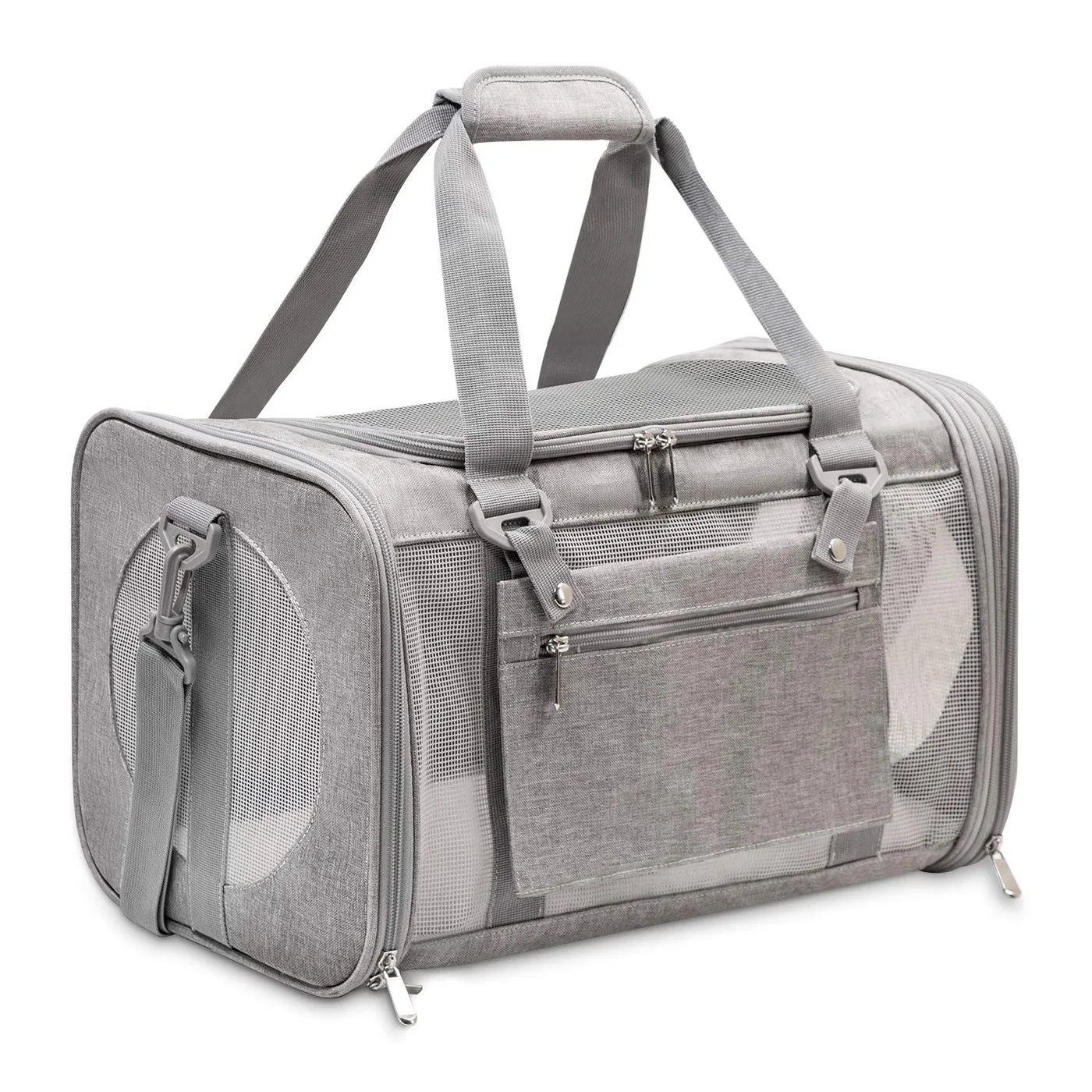
When a custom pet bag has to ship flat, the pattern changes: removable stiffeners and a fold line that does not crease the coated face.
Why botanical artwork converts in the pet travel category
Botanical artwork earns its place in pet travel because it signals outdoor leisure rather than clinical utility, which shifts the purchase decision from a functional replacement buy to an emotional gift buy. That shift is measurable: in our own quote data across private-label carrier programs, floral and leaf-driven artwork requests run about 2.4 times higher than requests for solid colourways in the same selling window, and they cluster in the two to three months that bracket spring gardening season.
The mechanism is simple. A carrier with a dog inside is already an accessory that travels with its owner through parks, patios, garden centres and weekend markets. When the exterior fabric carries the visual language of those places, the product stops competing on features alone. Buyers for home-and-lifestyle retailers understand this instinctively, which is why garden centres have become one of the fastest-growing non-traditional channels for pet travel goods over the last few seasons.
That said, execution decides whether the print reads as designer or as discount bin. Three failure modes dominate the category. The first is scale mismatch: an oversized cabbage rose printed across a small sling carrier becomes one blurred blob at arm's length. The second is palette overload: eight or nine colours fighting for attention reads juvenile rather than botanical. The third is substrate mismatch: printed on a shiny coated nylon, even a well-drawn floral looks like a rain poncho.
The buyer audience for these programs also matters. Garden-style prints skew heavily toward gift purchasers, which means the packaging and hangtag carry more weight than usual. Print testers you might dismiss as decorative, such as the interior lining and the dust-bag print, are often the elements that appear in unboxing imagery and drive repeat orders from boutique accounts.
Finally, consider how the print behaves over a long product life. Floral carriers bought for a puppy are frequently still in service three years later, dragged across concrete, folded into car boots and stored in damp garages. A botanical design with tight tonal values will hide that wear; a high-contrast white-on-navy floral will not. If the program targets a premium tier, plan the artwork knowing exactly how it will age.
Choosing botanical artwork: scale, repeat and coverage
Artwork scale is the single decision that most reliably separates a premium floral carrier from a cheap one. The working range we recommend for pet travel bodies sits between 8 cm and 14 cm for the dominant motif, measured motif-centre to motif-centre in the direction of the repeat. Below 5 cm, the eye reads texture rather than flower; above 18 cm, individual blooms disappear across the curvature of a bag panel and customers cannot identify what they are looking at.
Ground coverage is the second lever. For a loud garden-statement piece, coverage can go to 55-65%. For a carrier that has to sit next to a customer's handbag or work bag, keep coverage at 25-40%, with generous negative space. This is where our production team pushes back hardest during artwork review: many brand teams fall in love with a dense botanical illustration that photographs beautifully flat but becomes visual noise once the same artwork is wrapped around a three-dimensional body with a mesh window on one side.
| Motif family | Dominant repeat | Ground coverage | Best channel | Print route |
|---|---|---|---|---|
| Micro buds, scattered | 3-6 cm | 35-50% | Mass grocery, value tier | Rotary pigment |
| Meadow florals, mixed | 8-12 cm | 30-45% | Garden centre, boutique | Dye-sublimation |
| Large cabbage rose | 15-20 cm | 45-60% | Department, premium tier | Dye-sublimation + embroidery |
| Botanical line drawing | 10-14 cm | 20-30% | Design-led online | Digital pigment |
| Tropical leaf statement | 20-30 cm | 50-65% | Resort, summer capsule | Dye-sublimation |
Repeat construction deserves attention before artwork is finalised. Panel shapes on a carrier are rarely rectangular: front panels taper, gussets are strips, and the top panel may carry a handle reinforcement. All-over engineered artwork must therefore be drawn to survive both cutting waste and the seam allowances. A practical rule is to keep critical visual elements at least 25 mm away from any planned seam line so that a 3 mm sewing variance never cuts a flower in half.
Resolution is the other technical guardrail. Original artwork should be delivered at 300 dpi minimum at final print size, ideally as layered vector files for line botanicals and 600 dpi raster for painterly watercolours. Our production team converts to a strike-off file, but every conversion step costs fidelity, and starting from a compressed JPEG is the fastest way to lose the fine petal detail that makes a garden print worth paying for.
Print routes: dye-sublimation, rotary and digital pigment
Three print routes cover essentially every floral carrier program we see, and the choice is driven by fibre content, run length and desired hand feel. Dye-sublimation gives the deepest colour and zero change in fabric hand, but it requires a polyester-dominant face fabric. That constraint is not negotiable: below roughly 65% polyester content, sublimation dyes have nothing to bond to and the print washes out toward grey within a few care cycles.
Transfer sublimation is usually the right answer for a private-label floral capsule. Colour penetration is effectively 100% through the fabric face, so abrasion at the base corners exposes more colour rather than a white core. Wet and dry crocking land at grade 4-5 without additional finishing, which matters for a product that will be wiped down repeatedly by owners.
Rotary screen printing on pigment is the volume economics answer. Setup is heavier, typically worth considering only above about 3,000 linear metres of fabric, but once running the per-metre cost can sit 30-45% below digital output. The trade-offs are fewer colours per design, visible-on-surface ink that slightly stiffens the hand, and lower stretch tolerance. If your carrier uses a coated canvas shell, rotary may be the only realistic option.
Digital direct-to-fabric pigment sits in the middle. Setup is minimal, which makes it excellent for limited edition capsules and for proving concept before a larger commitment. Our production team routinely uses small digital runs for retailer line reviews where 30-40 units of each colourway are needed for photography and buyer samples ahead of the real MOQ commitment.
| Route | Setup cost impact | Per-unit print premium | Wash / crock fastness | Best use |
|---|---|---|---|---|
| Transfer sublimation | Low | + USD 0.55-0.95 | 4-5 | Polyester shells, gradients |
| Rotary screen | High | + USD 0.25-0.45 | 3-4 | Long runs, spot colours |
| Digital pigment | Very low | + USD 0.85-1.40 | 3-4 | Prototypes, small capsules |
| Print + embroidery highlight | Medium | + USD 1.60-2.40 | 4-5 | Premium tier gift lines |
Ink chemistry deserves one line of scrutiny from the compliance side. Inks and auxiliaries should be selected within restricted substance lists rather than merely cheap; our production team references OEKO-TEX criteria for textile chemicals when specifying colours for EU-facing programs, particularly where the carrier interior may contact a pet's muzzle.
Building a garden palette: Pantone targets and metamerism
A convincing garden palette usually contains four elements rather than a long colour list: one deep foliage green, one dominant bloom colour, one secondary bloom, and a neutral ground. Everything else is opacity variation on those four. When we receive a brief with eleven colours, the first design conversation is about removing six of them, because each additional colour adds screen cost, introduces registration risk, and dilutes the signature of the print.
Colour communication should be anchored in physical references. Digital files drift between a designer's calibrated display, our sample room monitor and the actual print head, so a Pantone reference standard for each palette element removes ambiguity from the strike-off conversation. Where a brand has an existing corporate palette, the artwork is reverse-engineered toward those references rather than the other way around, which protects shelf recognition across product categories.
Metamerism is the hidden trap. A sage green matched under daylight booth conditions can flip grey-green under the warm LED commonly used in garden centre display aisles. Ask for strike-off approval under at least two light sources: D65 for daylight and TL84 or CWF for retail fluorescent. It costs nothing at sampling stage and prevents the awkward situation where a buyer approves a swatch in the showroom and rejects the delivery under the store lights.
Light fastness matters more for pet travel than for many other soft goods, because these carriers live near windows and in cars. Where a display programme involves window placement, our production team specifies higher light-fastness dye sets and reports the grey-scale rating alongside the colour approval so the buyer knows what they are getting. For a deeper dive into how colour travel is measured across materials, the discussion in Pantone colour matching for carriers covers the same machinery in more detail.
Finally, plan the palette adjacency. Garden florals often pair a print panel with a solid binding tape, a solid webbing or a solid mesh. Those solids are dyed separately from the print and can drift by half a shade. Sending one common reference swatch to both the dye house and the print house at the start of development is the cheapest insurance available.
Substrate choices: how fabric changes how a floral reads
The same artwork file can look like two entirely different products depending on the shell fabric. Print sits on the surface of the fibre relationship, not on a neutral plane, and our production team sees three substrate families dominate garden-style programs.
Polyester oxford in the 600D range is the default carrier shell. It has enough body to hold shape, it accepts sublimation beautifully, and its slight sheen saturates colour rather than absorbing it. A meadow floral printed on 600D reads crisp and gift-ready. The drawback is that the same sheen can cheapen a painterly watercolour, whose charm depends on matte paper-like absorption.
Cotton or cotton-rich canvas, from 10 oz to 16 oz, gives exactly that matte absorption. It is the right choice for a botanical line-drawing aesthetic with vintage appeal, and pairs naturally with a waxed canvas trim. Costs run higher per metre, water resistance needs a finish, and colour yields are lower, so expect roughly one grey-scale step below what polyester delivers.
Lightweight nylon ripstop in the 420D range is used when the brief prioritises packability and airline-friendly weight. It takes sublimation acceptably, but its sheen is harder and its surface texture can break fine petal lines. For programs that need a frame of reference on base options, the full review of pet carrier fabric choices lays out the denier and coating combinations with their cost implications.
- Quilting over print: a diamond or channel quilt compresses the motif and adds perceived value, which is why it pairs so well with mid-tier quilted versus flat padding constructions.
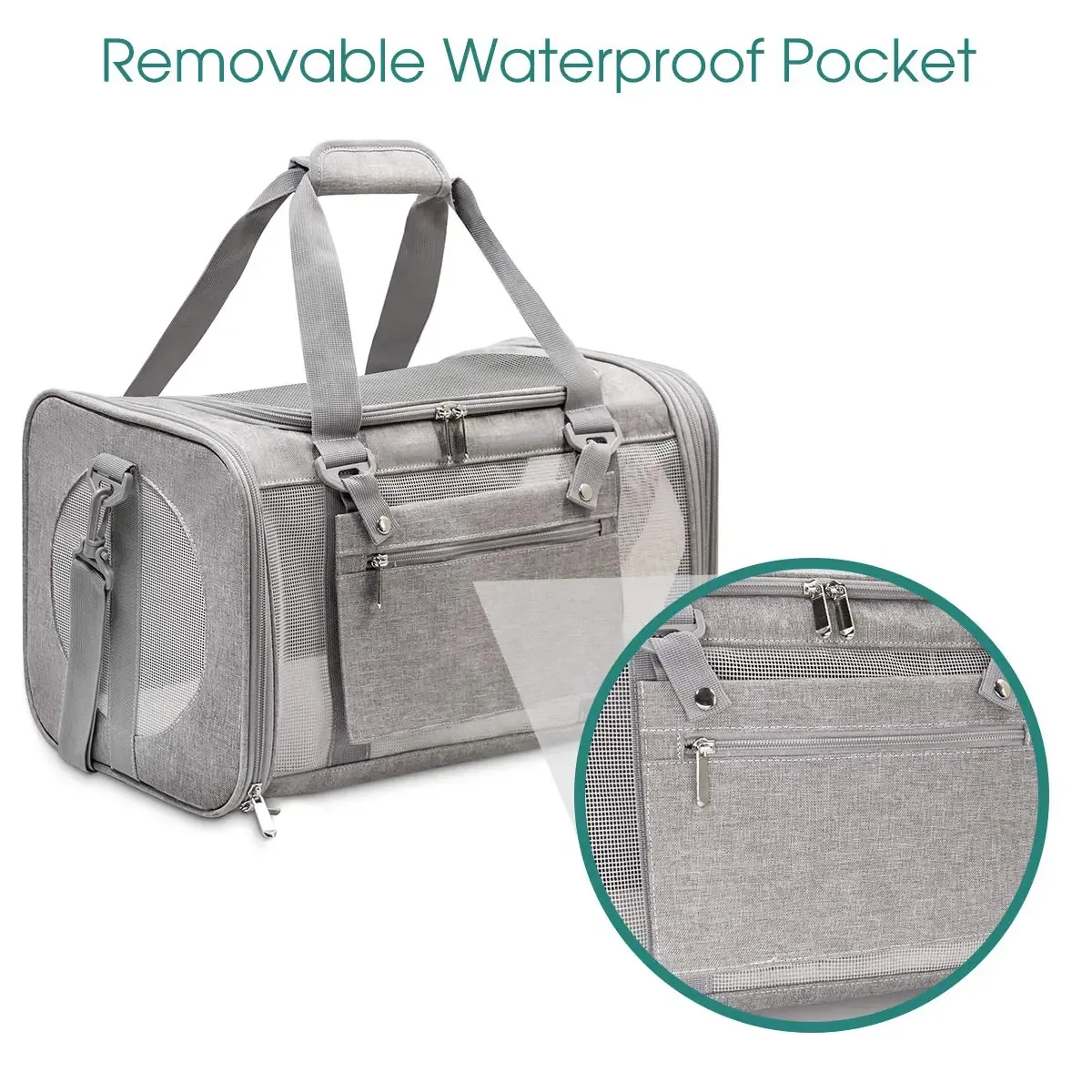
- Mesh interruption: every ventilation window is a hole in your artwork. Position the mesh so it reads as intentional negative space, not as a cut-off flower.
- Coating effects: PU or PVC back coatings change dye uptake and can dull the print by 5-10% in perceived chroma.
- Weight discipline: heavy printed canvas can push a small carrier past airline-friendly weight targets before the padding is even added.
A reliable studio practice is to print a strike-off on each candidate substrate before lockdown. Two extra days at sampling stage routinely saves a full season of sluggish sell-through caused by artwork that simply does not read on the chosen cloth.
Collection architecture: one artwork, three product tiers
The most common structural mistake in print-led carrier programs is commissioning a second artwork when the range needs a second tier. Artwork development is expensive and every additional colourway carries its own 500-piece minimum. A better approach is to build a ladder from a single base artwork.
A three-tier garden capsule usually works like this. The entry tier uses the core botanical print on 420D polyester with webbing handles and a basic interior pad, retailing in the USD 39-49 band. The mid tier applies the same print to 600D with a quilted interior, metal hardware and a branded puller, landing at USD 69-89. The top tier keeps the print but adds a solid dyed bottom panel, leather-trim zip garage and an embroidered highlight on one or two blooms, reaching USD 119-149.
Silhouette variation matters as much as trim. The same print works across a backpack-style carrier, a structured shoulder tote and a soft sling, and each silhouette reaches a different walking style. Because backpack sizing and tote proportions differ substantially, the artwork repeat sometimes needs a second engineered version at a different scale, which is a low-cost adaptation compared with a new design.
Inventory logic should follow the tier structure. We advise our clients to commit the core colourway to the deepest quantity, since it typically absorbs 45-55% of sales, and to treat secondary colourways as genuine seasonal experiments rather than permanent SKUs. A well-structured garden capsule can then be reissued the following year with the core colourway unchanged and only the accents refreshed, which amortises artwork cost across multiple seasons.
Packaging completes the architecture. A printed dust bag, a botanical-patterned hangtag and a care card that repeats one perfume-selling colour from the main print create the perception of a designed collection rather than a printed bag, and that perception is precisely what funds the next tier.
One further discipline pays dividends: document every print decision in a shared tech pack. Record the repeat size, substrate, print route, Pantone references, registration tolerance and signed swatch location, then reuse that document for every reissue. Programs supported by this level of documentation consistently sample faster in year two, because neither side has to reconstruct decisions made eighteen months earlier.
Cost engineering and defect control in printed floral runs
Print converts five ordinary cost drivers into five visible ones. Fabric utilisation typically lands at 82-88% for engineered artwork versus 92-95% for solids, because motifs constrain how pattern pieces can be nested in the marker. On a 500-piece run against a print, that difference alone can equal several hundred dollars of additional cloth. Colour count adds roughly USD 0.18-0.35 per unit per extra screen depending on coverage, while register-sensitive designs require slower press speeds that are reflected in the processing fee.
Registration tolerance for transfer sublimation on a carrier panel should be specified at plus or minus 1.5 mm. Anything looser and hard-edged botanicals begin to show ghosting at petal boundaries. Because sublimation involves heat and pressure over time, shrinkage must be anticipated in the paper layout rather than corrected afterwards; our production team runs a pre-shrink strike-off for every new substrate and records the distortion factor in the tech pack.
Three defects define printed floral QC. Banding is horizontal density variation, usually a print head maintenance issue, and reads across open ground areas. Colour drift is deviation from the approved strike-off swatch and should be judged under controlled booth lighting rather than on a cutting table. Misregistration is outright pattern displacement and is the defect most easily caught inline if the operator watches every fifth piece against a pinned reference.
A reliable drawn reference is part of the file set. Once a buyer signs the strike-off, that swatch becomes the physical contract: it is stored away from daylight, referenced at the start of bulk printing, and attached to the inspection record. This matters because printed goods are inherently variable, and the only workable defence against an 'it looks different from the sample' argument is a dated, light-protected reference everyone signed.
Shipments are inspected to AQL 2.5, with print-related defects classified as major. The AATCC test methods for colourfastness to crocking and laundering are the practical benchmarks we quote, and results are reported alongside the inspection so the buyer can see that a beautiful print is also a durable one.
Retail storytelling, packaging and launch timing
A garden-style carrier earns its margin at the shelf, not in the spec sheet. The print itself is the headline, so the surrounding storytelling should be disciplined: one line of copy about why the artwork exists, one about the practical specifications, and nothing else. Retailers will forgive a missing feature claim far more readily than a cluttered hangtag that competes with the print.
Hangtag and belly-band design should borrow from the print rather than repeat it. A common approach is to lift one secondary bloom colour and use it as the field for the tag, keeping the main print visible through the die-cut window. Care cards, dust bags and tissue paper can each carry reduced versions of the artwork at different scales, which creates a gift presentation appropriate to the price point.
PDQ and counter displays deserve early planning. A printed-themed counter unit with three carriers at three tiers tells the whole collection story in one square metre, and because the display itself is manufactured alongside the goods, its artwork must be finalised before bulk begins. Our production team routinely produces a compact four-week calendar integrating strike-off approval, display printing and freight booking so nothing arrives late for a seasonal window.
Timing is unforgiving in this category. Spring garden season demand means goods need to be on retailer shelves roughly eight weeks before the peak selling period, which means placing the order about four to five months ahead. Working backwards from Easter-tier displays, artwork lockdown typically has to happen in the preceding autumn.
Finally, plan the follow-on before launching the first drop. Garden-style prints reward refreshes: a second-season reissue with a shifted palette sells to the same account twice, and because the base artwork already exists, development time collapses to nearly nothing. Clients who treat a floral capsule as a permanent collection rather than a one-off experiment consistently outperform those who chase novelty every six months.
Order and quality terms
- MOQ 500 pieces per colourway; samples in 6-10 working days
- Bulk production 35-50 days after approval; AQL 2.5 inspection standard
- T/T 30/70 terms, FOB Xiamen, full document set per shipment
People Also Ask
Is printed floral fabric durable enough for a pet carrier?
Transfer sublimation on polyester is exceptionally durable because the dye penetrates rather than sitting on the surface, so abrasion exposes more colour instead of a pale core. Crocking results typically reach grade 4-5 dry and 4 wet, which comfortably exceeds the wearing pattern a carrier experiences at base corners.
Which fabric shows a floral print best?
600D polyester offers the highest colour yield and a slight sheen that makes blossom colours pop, while cotton canvas delivers a matte, painterly effect suited to vintage botanical line work. Lightweight nylon works for packable designs but tends to break the finest petal detail.
How much does custom floral printing add to unit cost?
Budget roughly USD 0.55-0.95 per unit for transfer sublimation, 0.25-0.45 for long-run rotary printing, and 0.85-1.40 for short-run digital output. Added colour count and reduced marker efficiency from engineered layouts push those figures higher.
Can you match a floral pattern we already use elsewhere?
An existing brand floral can be matched for palette and approximate repeat, then re-scaled to suit carrier panel dimensions. Provide the original artwork if available, plus a physical cutting; matching from a photograph alone introduces avoidable colour error.
Which print method produces the sharpest detail?
Heat-transfer sublimation produces the sharpest edges and cleanest gradients on polyester because dye diffuses into fibre at sub-millimetre precision. Where a design also needs raised texture, adding selective embroidery on one or two blooms creates the most convincing premium result.
Do floral prints fade when displayed near a window?
Any printed textile eventually shifts if exposed to direct sun, which is why higher light-fastness dye sets are specified for window-facing displays. Approval should always note the grey-scale rating for light fastness alongside colour so expectations are set before bulk booking.
Frequently Asked Questions
What is the minimum order quantity for floral print carriers?
A custom floral print runs from 500 pieces per colourway. Multiple silhouettes can share one purchase order as long as each individual colourway clears the minimum, which lets a single 500-piece commitment cover a tote and a sling in the same botanical print.
How long does the artwork-to-sample sequence take?
Once artwork files are approved, strike-off and physical sample delivery take 6-10 working days with our production team. Artwork development itself is separate and usually runs two to four weeks depending on how many revisions each motif needs before it is ready for print.
Can you develop original botanical artwork for us?
Yes. Our in-house designers build original repeat artwork from a mood board, colour references and scale targets. If you already own illustration, we will clean it up for repeat construction and print separation instead, which shortens development time considerably.
Is panel-specific print placement possible?
Engineered placement printing is fully supported. Motifs can be centred on the front panel, rotated to follow a gusset, or deliberately kept clear of mesh windows and handle reinforcements so no flower is ever bisected by a seam.
Which artwork file formats do you need?
Vector AI or EPS files for line botanicals, and layered TIFF or PSD at 300 dpi minimum at final print size for painterly work. Avoid compressed JPEG sources, since they introduce artefacts that survive into the strike-off.
How do you keep printed and solid components colour-consistent?
One physical reference swatch goes to both the print house and the dye house at the start of development. Printed panels, binding tape, webbing and mesh are then judged against that single reference rather than against separate memories of the original brief.
Are the print inks safe if a pet chews the fabric?
Ink and auxiliary selections follow restricted substance criteria used for OEKO-TEX-style assessments, and our production team can arrange third-party testing where a retailer requires documented proof. Interior linings receive the same scrutiny as exterior print faces.
What does the sampling sequence look like for a new print?
The usual path is a digital strike-off swatch first, then a white-body fit sample for construction approval, then a fully printed confirmation sample. Skipping the strike-off is possible but rarely saves time, because print disputes are the slowest category to resolve.
Can we combine several carrier silhouettes in one order?
Yes, mixing silhouettes is standard practice for a capsule. The constraint is per-colourway quantity, not per-style quantity, so explore tiering through construction and trim differences rather than through entirely separate printed fabrics.
How are print defects judged during inspection?
Shipments are inspected to AQL 2.5. Registration drift beyond the agreed tolerance, visible banding across open ground areas, colour deviation from the signed swatch and ink marks are all classified as major defects and drive acceptance or rejection of the batch.
What packaging suits a garden-style carrier launch?
Printed dust bags, die-cut hangtags that window the main print, illustrated care cards and optional PDQ counter units all work well. Because the packaging is printed alongside bulk, its artwork must be locked before production starts.
Can a successful print be reissued next season?
Yes, and it is strongly recommended. Keeping one proven botanical artwork while rotating secondary accent colours amortises the original design cost and lets reorder volume build across several years instead of resetting every season.
Do you supply retailer compliance documentation?
Our production team provides the test reports, material declarations, and inspection records needed for most retail onboarding processes. If a specific retailer format or additional third-party test is required, this should be flagged during quoting rather than after booking.
What are the payment and shipping terms?
Standard terms are T/T 30/70 with FOB Xiamen, and a full document set accompanies each shipment. Sea freight is typical for seasonal capsules; air freight is reserved for launch samples and reorders where the selling window is short.
Talk to QUANZHOU JUNYUAN BAGS about a pet carrier program: MOQ 500 pieces per colourway, samples in 6-10 working days, bulk production in 35-50 days under AQL 2.5 inspection.
Get a free quote Request a sample