Custom Poop Bag Holder: Waste Bag Dispenser Design Guide
Custom cat carrier shells come in soft, vacuum-formed and injection-moulded variants, and each one carries its own tooling and MOQ pool.
Why Branded Waste-Bag Holders Belong in an Accessory Capsule
A dispenser is the cheapest way to put a brand mark into a customer hand every single day. It clips to a leash, it sits in a pocket, it hangs by the door, and it travels to the park twice a day. No other item in a walking capsule gets that frequency of contact for such a small unit cost, which is why merchandisers treat it as an entry-price touchpoint rather than a standalone product.
From a design standpoint the capsule logic is simple. A dispenser is the natural companion to a leash and a harness, and it is the item most often bought as an add-on at the shelf. When the pod uses the same shell fabric, the same webbing colour and the same badge language as the lead products, the whole wall reads as one family. That visual coherence is what makes a four-piece capsule look like a brand instead of four unrelated SKUs.
The commercial case is equally clear. Dispensers are light, they pack flat, and they absorb freight badly when oversized, so a compact pod keeps landed cost predictable. Refill rolls are the repeat-purchase engine behind them, and the holder is what locks a customer into your refill size. Getting that interface right at the design stage is a strategic decision, not a detail.
Designers also value the dispenser because it is forgiving to develop. Tooling is minimal, sample cycles are short, and a colourway can be tested in a single 500-piece run without committing to a full seasonal buy. That makes it the ideal first step for a brand extending from carriers into daily walking accessories, and the natural companion piece to a custom waste bag refill program.
The risk to avoid is treating the pod as a commodity. Once the shape, the clip geometry and the badge finish are generic, price becomes the only differentiator and the SKU erodes into a promotional line. A defined silhouette, a consistent colour story and a recognisable mark protect it.
Dispenser Structures: Clip Pods, Sleeve Pouches and Zip Wallets
Three structures cover almost every brief we receive, and each one carries a different cost profile and a different logo opportunity. The clip pod is a moulded or sewn shell with a grommet or slit feed and a swivel hook. The sleeve pouch is a soft fabric tube with an elasticated mouth. The zip wallet is a flat, structured case that opens like a coin purse and holds a roll plus a key or a card.
The pod wins on retail hanging efficiency because it is three-dimensional and photographs well on a header card. The sleeve wins on price and packs into an envelope, which suits subscription boxes and e-commerce inserts. The wallet wins on perceived value and supports a larger print area, but it needs a lining, a zip and a puller, so the trim count climbs quickly.
| Structure | Typical size | Bag capacity | Logo area | Best retail position |
|---|---|---|---|---|
| Clip-on pod | 9 x 6 x 5 cm | 1 roll, 15 bags | 3.5 cm woven label or 4 cm silicone badge | Header card beside leashes |
| Sleeve pouch | 11 x 7 cm flat | 1 roll, 15 bags | 5 cm heat transfer or 6 cm screen print | Subscription box, counter bowl |
| Zip wallet | 12 x 9 x 3 cm | 1 roll plus card slot | 7 cm embroidery or 6 cm rubber patch | Gift table, premium aisle |
| Bone-shaped pod | 10 x 6 x 5 cm | 1 roll, 15 bags | 3 cm silicone badge only | Impulse rail at checkout |
Choice of structure should follow the channel, not the mood board. A pod designed for a hanging card needs a flat back panel so it lies still on the board, while a bowl-dump SKU needs a silhouette that reads from above. These are small geometry decisions with outsized effects on sell-through.
Feed design deserves more attention than it usually gets. A slit cut too narrow shreds the bag on the pull, and a grommet set too loose lets the roll spin and unspool inside a pocket. We prototype the feed with the actual refill gauge the client intends to sell, because a 15-micron bag behaves very differently from a 22-micron one.
The closure is the last structural variable. Hook, carabiner, Velcro strap and elastic loop each add a different trim cost and a different perceived quality level. A metal carabiner reads premium, a webbing loop with a branded snap reads technical, and a simple elastic loop reads disposable. Pick one and carry it across the capsule.
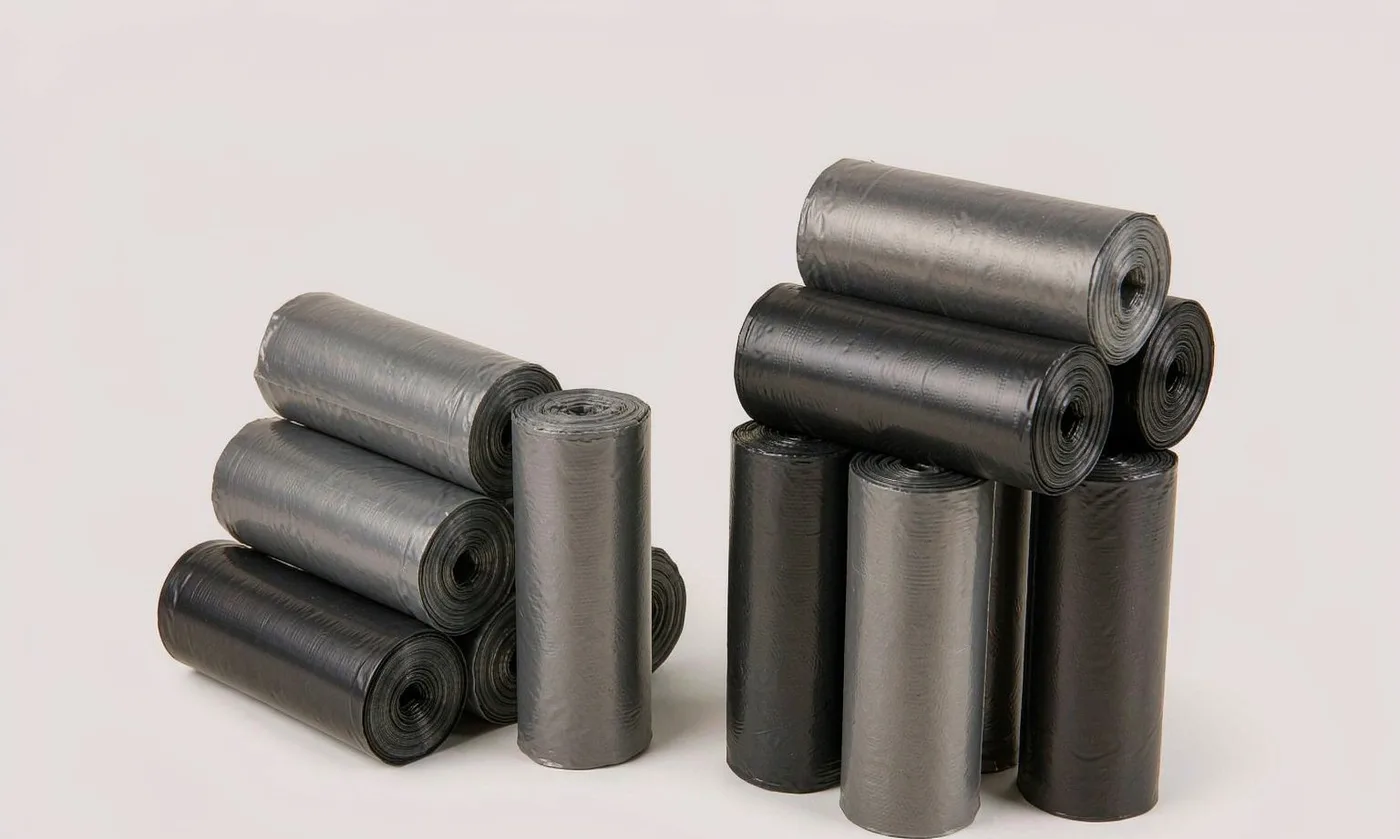
Brand Marks on a 9 cm Surface: Woven Labels, Silicone Badges and Heat Transfer
A dispenser offers roughly 60 cm2 of printable surface in total, so mark selection is a discipline rather than a free choice. The three crafts that survive this scale are the woven label, the silicone or rubber badge, and heat transfer. Embroidery works only on the wallet silhouette, and screen print works only on flat sleeve panels.
A woven label is the most durable and the most legible at small size. Damask weave holds fine lettering down to about 2 mm cap height, and a folded-end label sewn into a side seam reads as a finishing detail rather than an applied sticker. Cost per piece is low, but the loom setup is a fixed charge amortised over the run, which is exactly why the 500-piece colourway minimum exists.
Silicone badges give the tactile, slightly rubbery handfeel that reads as modern outdoor gear. They can be moulded in two colours, they hold a Pantone reference better than any printed mark, and they survive abrasion from a leash hook. The trade-off is a mould charge and a longer lead time on the first order, which needs to be built into the launch calendar.
- Woven label: best for fine type, lowest piece cost after setup, sewn into a seam
- Silicone badge: best colour fidelity, highest perceived value, needs a mould
- Heat transfer: best for multi-colour artwork on sleeves, no setup tooling
- Rubber patch: best for bold single-colour marks on coated shells
- Metal charm on the puller: best as a secondary mark, not the primary one
Heat transfer is the flexible option for artwork with gradients or photographic elements. It sits flat, it adds no thickness, and it allows a different graphic per colourway from the same base shell, which is a genuine advantage when a brand wants four distinct stories on one silhouette. Wash and rub resistance should be verified before approval.
Placement rules matter as much as craft. On a pod, the mark should sit on the face opposite the feed so it stays visible when the pod is clipped to a leash. A mark placed on the same face as the grommet disappears into the wearer hand, which is the single most common layout error we correct at sample stage.
For brands building identity across a wider range, the mark language should be documented once and reused. The same badge geometry that anchors a dispenser can be carried onto a woven label program for collars and harnesses, so the family reads consistently from 3 cm to 12 cm.
Material and Handfeel: Neoprene, Coated Polyester and Recycled Ripstop
Material choice on a dispenser is a handfeel decision disguised as a durability decision. Neoprene gives a soft, slightly springy squeeze and hides scuffs, which makes it the safest choice for a dark everyday colourway. Coated polyester gives a crisp, technical surface that takes print beautifully but shows creases. Recycled ripstop reads as performance gear and supports a sustainability claim on the hang tag.
Shell weight typically sits between 210D and 600D. A 210D liner-weight fabric feels flimsy on a structured pod and will collapse under the weight of a full roll, while a 600D shell on a sleeve pouch feels overbuilt and stiff. Matching fabric weight to structure is the fastest way to make a cheap sample look expensive, and it costs nothing in unit price.
Coatings change both the feel and the print behaviour. A PU coating adds water resistance and a faint sheen, but it can repel the adhesive on a heat transfer unless the surface is pre-treated. A TPU laminate is softer and more flexible but yellows slightly under UV, which matters for a product that lives on a leash in sunlight.
Sustainability claims need to be defensible. Recycled content should be traceable to a certified source, and any fabric that touches the claim should be screened against OEKO-TEX textile criteria. A vague eco badge on a hang tag is a compliance exposure waiting to happen in a market that checks.
Trim materials should be specified in the same pass as the shell. A cheap zinc alloy clip will tarnish against a premium shell within a season, and a mismatched zip tape colour will break the capsule at the shelf. Specifying trim finish codes alongside Pantone references in one tech pack avoids the mismatch entirely.
Finally, consider the acoustic and tactile signature. A pod that clicks shut, a zip that pulls smoothly and a badge that feels slightly soft to the thumb are the three details customers describe in reviews. They cost very little to specify and they are the details that get a private label dispenser reordered.
Colour Systems and Trim Coordination for Repeatable Drops
A dispenser capsule lives or dies on colour repeatability. Four colourways launched in spring and reordered in autumn must match closely enough to sit on the same shelf without visible drift, and that only happens when colour is specified numerically rather than by eye. Every shell, webbing, zip tape and badge needs its own Pantone reference recorded in the tech pack.
Dyed fabric and moulded silicone rarely match perfectly from the same reference because the pigments and the substrate differ. The practical method is to approve a physical standard card per colourway at sample stage, then hold that card as the reference for every reorder. A standard card costs almost nothing and removes an entire category of dispute.
| Element | Specification method | Tolerance | Reorder risk |
|---|---|---|---|
| Shell fabric | Pantone TCX reference plus lab dip | Delta E under 1.5 | Lot-to-lot dye variation |
| Webbing and loop | Pantone reference plus physical swatch | Delta E under 2.0 | Supplier change mid-season |
| Silicone badge | Pantone reference plus moulded chip | Delta E under 1.5 | Pigment batch drift |
| Zip tape and puller | Supplier colour code cross-referenced | Visual match to card | Anodising shade shift |
Seasonal drops should reuse the core neutrals and rotate only the accent. A capsule with two permanent neutrals and two rotating accents keeps the reorder base stable while still giving the range a sense of newness each season. This is how accessory brands keep small items profitable over several years.
Trim coordination is where most capsules break. A shell matched to Pantone and a webbing matched to a supplier code will sit one shade apart under retail lighting, and the difference is obvious on a small object viewed at arm length. Approving trims together on one card is the fix.
Lighting conditions deserve a mention. Retail LED, daylight and phone camera flash each shift a colour differently, and a dispenser photographed for e-commerce should be shot under the same lighting standard used for approval. Otherwise the online image and the shelf product tell two different colour stories.
Documented colour systems also shorten future sampling. Once a brand has an approved card library, the next silhouette can be sampled against existing references in a single pass rather than reopening the whole colour conversation.
Packaging, Header Cards and Counter Display That Earn Shelf Space
Dispensers sell on impulse, and impulse is a packaging outcome. A header card turns a soft object into a hangable SKU, defines the brand block at eye level, and gives the retailer a reason to place the item beside leashes rather than in a clearance bowl. The card should carry the mark, the colourway name and one line of functional copy, nothing more.
Three formats cover most programmes. A hanging header card suits peg walls and is the most common choice in pet specialty. A printed pillow box suits gift positioning and protects a silicone badge in transit. A PDQ tray holding twelve units suits counter placement and lets a retailer merchandise an entire colourway story in one footprint.
Whatever the format, the packaging must make the refill interface obvious. A customer needs to understand in two seconds that the pod takes a standard roll, and that your refill is the one designed for it. A small diagram on the back of the card does more for refill attach rate than any amount of copy.
- Header card: lowest cost, best peg-wall density, needs a flat back panel
- Pillow box: highest perceived value, protects badges, higher freight volume
- PDQ tray: best for multi-colourway stories, requires 12-unit pack multiples
- Kraft band: lowest material use, suits sustainable positioning, weak on shelf
Barcode placement, country of origin and any required warnings should be laid out during packaging design, not after. Retrofitting a barcode onto a finished card means reprinting the run, and reprinting a run inside a 35-50 day production window is a schedule risk nobody needs.
E-commerce variants should be designed alongside retail ones rather than derived from them. A mailer-safe pack that survives a parcel network without a rigid box saves weight and reduces damage claims, and it is cheaper to design in than to add later as a protective insert.
Colourway naming belongs to the packaging system as well. A named palette that runs across header cards, hang tags and product pages lets a retailer reorder by name rather than by photograph, and it gives the brand a vocabulary that customers start using in reviews. Four names reused season after season build more recognition than four new names each drop.
Cost Drivers Behind a 500-Piece Colourway
On a part this small, fabric is rarely the main cost. Trims, setup charges and packaging carry the weight, and understanding that split is what allows a designer to cut cost without making the product look cheaper. The table below shows where a typical unit price is distributed for a mid-spec pod.
| Cost element | Share of unit cost | Fixed or variable | Design lever |
|---|---|---|---|
| Shell fabric and lining | 18-24% | Variable | Weight and width yield |
| Trims: clip, zip, grommet | 22-30% | Variable | Trim count and finish grade |
| Brand mark | 8-16% | Setup plus variable | Craft choice and colour count |
| Labour and assembly | 15-20% | Variable | Stitch count and construction |
| Packaging | 8-14% | Setup plus variable | Format and print colours |
| Setup amortised over 500 | 6-12% | Fixed | Run size per colourway |
The single biggest lever is trim count. Moving from a carabiner plus a branded snap to a single webbing loop removes two purchase orders, two inspections and two failure points, and it typically cuts unit cost by more than downgrading the shell would.
Setup amortisation explains the MOQ. Loom setup for a woven label, mould amortisation for a silicone badge and plate charges for packaging are fixed sums, so a 500-piece colourway spreads them across a viable base while a 100-piece run would push the fixed share past 30%.
Assembly complexity is the quiet cost. A pod with an internal divider, a lined interior and a reinforced grommet panel takes meaningfully longer to sew than a two-panel shell, and labour time compounds at 500 pieces. Simplifying construction is often invisible to the customer and visible in the margin.
Freight is the last variable. A pod that packs flat or nests reduces volumetric weight, and on a low-unit-price item freight can quietly exceed the packaging cost. Designing for flat pack at the start protects landed cost across every reorder.
The most useful way to read this cost model is as a set of decisions that compound. Trim count, mark craft and packaging format are chosen once and then repeated on every reorder, so a choice that saves three percent at launch returns that same three percent for as long as the SKU exists. That is why we spend disproportionate time on the first tech pack rather than negotiating harder on the first invoice.
Sampling Calendar, Quality Gates and Launch Rhythm
A dispenser programme runs on a predictable clock. Samples take 6-10 working days from an approved tech pack, bulk production takes 35-50 days after sample approval, and inspection runs to AQL 2.5 before shipment on FOB Xiamen terms under T/T 30/70. Working backwards from a shelf date is the only reliable way to plan a seasonal launch.
The sample stage should be treated as two rounds rather than one. The first round confirms silhouette, feed function and handfeel. The second confirms colour against the standard card, badge placement tolerance and packaging fit. Compressing both into a single round is the most common cause of a delayed launch on small accessories.
Functional testing should be specified before tooling, not after. Clip pull strength, zip cycle count, colour fastness to rubbing and badge adhesion are all cheap to test at sample stage and expensive to discover failing at final inspection. Where a client wants documented methods, we align with ASTM test standards and verify results through SGS third-party testing.
Quality gates should sit at three points: incoming trim and fabric check, in-line construction check at 20% completion, and final AQL 2.5 inspection before packing. On a small sewn part, most defects originate in trim, so incoming inspection is where the leverage actually is.
Launch rhythm for an accessory capsule usually follows the wider range. A dispenser should land two to four weeks after the hero leash and harness so the add-on has an installed base to attach to, and it should be reordered on the same calendar as the core neutrals so shelf presence never lapses.
Limited colourways work well on this item because the risk is contained. A 500-piece accent run can test a trend without committing to a full season, and the learning transfers directly to the next capsule. Over a year, four small drops build more brand recognition than one large one on a product this size.
Production capability
- SGS-verified production space of 4,950 m², 149 machines, 7 assembly lines
- Pet carrier and pet bag output since 2014 from a 137-person team
- 200,000 units shipped monthly under BSCI and ISO 9001 systems
People Also Ask
What is the MOQ for a custom poop bag holder?
The standard minimum is 500 pieces per colourway. That level lets loom setup for woven labels, mould amortisation for silicone badges and packaging plate charges spread across a viable base, keeping the fixed share of unit cost under roughly 12%.
How long does a custom dispenser sample take?
Samples take 6-10 working days once the tech pack, colour references and artwork are approved. We recommend two rounds: one for silhouette and feed function, one for colour, badge placement and packaging fit.
Which logo method works best on a small dispenser?
Woven labels give the finest detail and lowest piece cost, silicone badges give the best colour fidelity and a tactile finish, and heat transfer handles multi-colour artwork on flat sleeve panels without tooling.
Can a dispenser be matched to an existing leash colour?
Yes. Submit the Pantone reference or a physical swatch and we will lab dip the shell and match webbing, zip tape and badge pigment against one approved standard card for the whole capsule.
Do dispensers come with refill rolls included?
They can. Many brands ship the pod empty with a header card pointing to their own refill, which drives repeat purchase. Including one starter roll is also common and adds a small packing step.
What inspection standard applies to bulk orders?
Bulk orders are inspected to AQL 2.5 before shipment, with incoming trim checks and an in-line construction check at 20% completion as earlier gates. Shipments move FOB Xiamen under T/T 30/70 terms.
Frequently Asked Questions
What sizes does a custom poop bag holder come in?
Most pods sit around 9 x 6 x 5 cm, sleeves around 11 x 7 cm flat, and zip wallets around 12 x 9 x 3 cm. Any of these can be resized, but keeping the internal roll diameter standard protects refill compatibility.
Can I order four colourways in one production run?
Yes, as long as each colourway reaches 500 pieces. Mixed-colourway runs are common and share the same tooling and packaging plates, which lowers the per-colourway setup burden.
How is the bag feed opening designed?
The feed is prototyped against the actual refill gauge you intend to sell. A slit or grommet sized for a 22-micron bag will shred a thinner one, so we test with the real roll before tooling is released.
Is a silicone badge worth the mould charge?
It depends on positioning. For a premium capsule the badge carries the perceived value and holds colour better than print. For a promotional tier, a woven label or heat transfer reaches the same brand effect at lower cost.
What fabric weight should I specify?
Structured pods usually take 420D to 600D, soft sleeves take 210D to 300D, and recycled ripstop sits around 70D to 210D depending on coating. Weight should follow structure rather than price alone.
Can packaging be printed in full colour?
Yes. Header cards, pillow boxes and PDQ trays all support full-colour print, though each additional spot colour adds plate cost. We lay out barcode and origin marks in the same pass to avoid reprints.
Do you provide a physical colour standard card?
We approve a physical standard card per colourway at sample stage and hold it as the reference for every reorder. This removes the drift that happens when fabric and silicone are matched from the same numeric reference.
What is included in the tech pack?
The tech pack carries dimensions, material specs, Pantone references, stitch density, trim finish codes, badge placement tolerances and the packaging format. One document keeps launch and reorder visually identical.
How do you handle trim quality on small parts?
Trim is inspected on arrival because most defects on a sewn dispenser originate there. Clip pull strength, zip cycling and badge adhesion are verified before assembly begins rather than at final inspection.
Can the dispenser match a wider walking capsule?
Yes. Sharing shell fabric, webbing colour and badge language with a leash and harness is what makes a small capsule read as one brand on the shelf rather than a set of unrelated items.
What happens if a colourway needs reprinting?
Reprinting inside a 35-50 day production window is a schedule risk, which is why barcode, origin and warning layouts are finalised during packaging design. Approved artwork is held on file for reorders.
Are recycled materials available for the shell?
Recycled ripstop and recycled polyester are both available and can support a documented sustainability claim. Any claim should be traceable to a certified source and screened against textile safety criteria.
How should I time a launch against a hero product?
Land the dispenser two to four weeks after the hero leash or harness so the add-on attaches to an installed base. Reorder on the same calendar as the core neutrals so shelf presence never lapses.
Talk to QUANZHOU JUNYUAN BAGS about a pet carrier program: MOQ 500 pieces per colourway, samples in 6-10 working days, bulk production in 35-50 days under AQL 2.5 inspection.
Get a free quote Request a sample