Custom Leash: Matching Set Specification for Brand Ranges
A custom leash matching set costs $2.40-$9.50 per unit at 500-5,000 pieces, and the two specifications that decide quality perception are webbing width and hardware load rating. Match the collar webbing, hardware finish and logo treatment exactly, and the leash stops being an accessory and becomes the reason the set sells. Our production team samples leashes in 6-10 working days and runs bulk in 35-50 days, inspected to AQL 2.5.
This executive summary covers leash development inside a coordinated private label range. MOQ 500 pieces per colourway across the size run is the standard entry point, set by loom or print set-up, hardware procurement and webbing dye minimums. Sampling takes 6-10 working days from approved artwork and includes physical webbing in the intended weave, a fitted hardware sample with the specified clip, and a documented load test result. Bulk production runs 35-50 days after sample sign-off, with custom-dyed webbing, padded handles and bespoke hardware finishes at the longer end. Finished goods are inspected to AQL 2.5 under documented ISO 9001 procedures at our SGS-verified production base, and shipments move FOB Xiamen on T/T 30/70 terms. Decide the clip type and the load rating before artwork is finalised, because both determine the webbing width and the minimum stitch specification. Plan collar and leash as one purchase wherever possible: buying webbing and hardware for both items in a single lot is the largest cost saving available in a coordinated programme, and it is also what guarantees the two items arrive as a genuine colour match.
Customised pet carrier work differs from stock buying in one respect: the pattern is graded to your size ladder and held on file for reorders.
The Leash's Role in a Matching Set
The leash is the item in a pet range that customers hold. The carrier is carried, the collar is worn, but the leash is gripped for thirty minutes a day, every day, in every weather. That makes it the most tactile product in the range and the one that most directly shapes how a customer describes the brand to a friend.
In commercial terms the leash is the natural completion of a set. A customer who has bought a collar will buy the matching leash at a very high rate, because a mismatched leash is visually obvious to everyone at the park. Set completion is therefore strongest on the collar-to-leash pair, and brands that launch both together consistently outperform brands that stagger them.
There is a hierarchy argument too. Because the leash uses the same webbing, hardware and logo treatment as the collar, it costs very little incremental design effort and shares all of the set-up investment. The marginal development cost of adding a leash to a collar programme is small, and the marginal revenue is significant. That asymmetry is why the leash is usually the third product a brand develops, right after the carrier and the collar.
The leash also carries the widest price spread in an accessory range. A simple flat webbing lead sits at the entry; a padded, double-handled, reflective, hardware-heavy training lead sits at the top. That spread lets a brand use the leash to create a visible tier structure inside one product category, which is useful when a retailer wants a good-better-best story on a single fixture.
Finally, the leash is the most photographed item in use. Every walk produces images of the leash in hand, and a leash with a distinctive weave, a recognisable wordmark and hardware that catches light becomes free marketing. Design it to be recognisable at social media scale, not only at product-shot scale, and see how the same logic applies to custom collar coordinated sets, which share the specification almost entirely.
Length, Width and Construction Architecture
Leash geometry is a small set of decisions with large consequences for usability, cost and perception. The three core variables are length, width and construction.
Length is the first decision. A 120 cm lead is the everyday standard, long enough for a relaxed walk and short enough for control. A 180 cm lead suits training and recall work, and a 300 cm long line suits field training. A short 60-90 cm traffic lead suits city walking and vet visits. Most ranges need two lengths - a standard and a traffic or training length - rather than one compromise.
Width follows load. A 15 mm width suits cats and toy breeds, 20 mm suits small dogs, 25 mm suits medium dogs and 25-32 mm suits large and powerful breeds. Width is also a perception signal: a narrow lead on a large dog looks under-specified even when the material is strong enough, and customers read that as a safety problem.
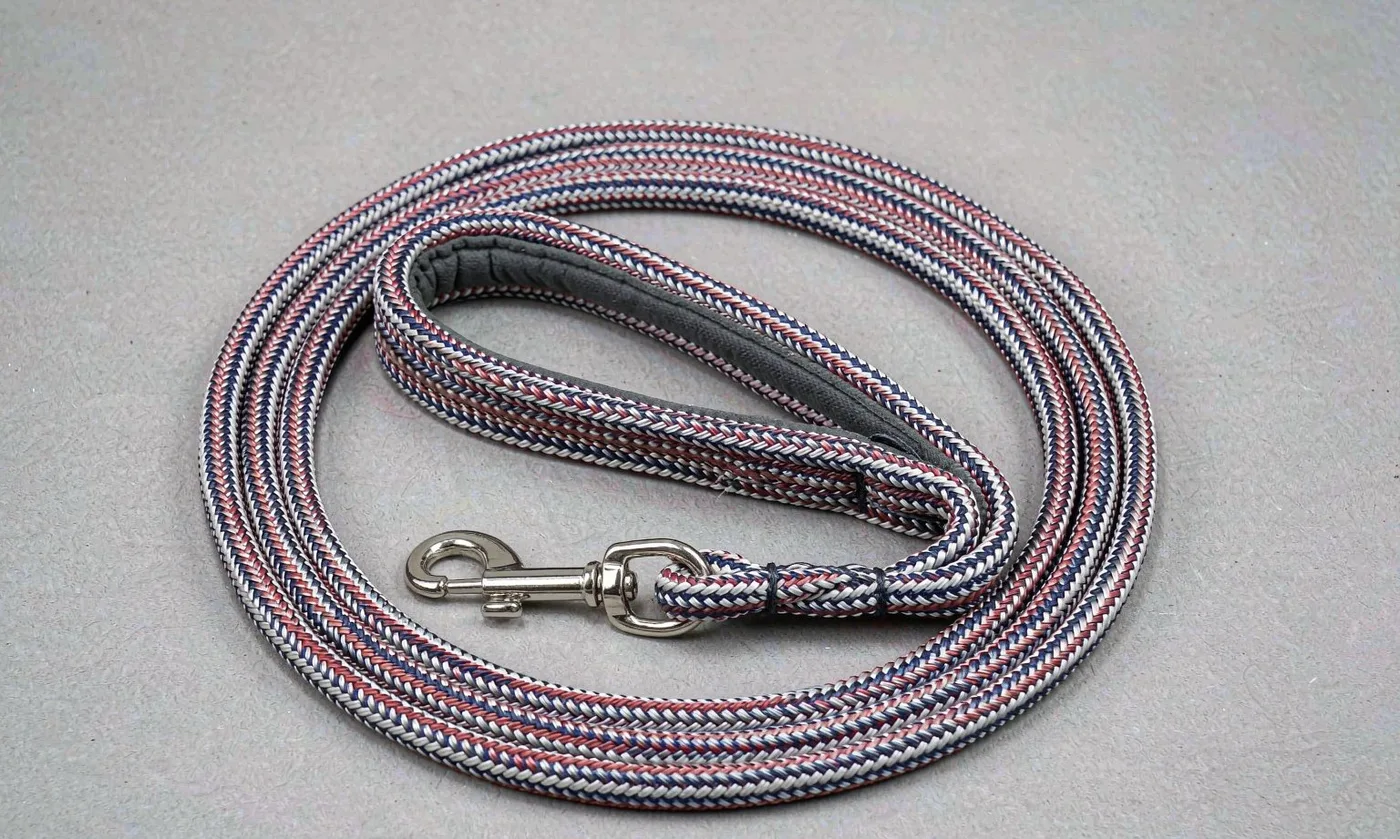
Construction describes how the webbing is assembled. A flat single-ply lead is the simplest and cheapest. A folded and stitched construction doubles the webbing at the handle and at the clip, improving comfort and strength at the two stress points. A tubular or rope construction gives a soft, premium handfeel and works well with climbing-rope aesthetics. A bungee or elastic section absorbs sudden load, which is genuinely useful for dogs that lunge, though it requires a clear usage statement in the copy.
| SKU tier | Length | Width | Construction | Working load rating | Typical use |
|---|---|---|---|---|---|
| Traffic lead | 60-90 cm | 15-20 mm | Flat, single ply | 80 kg | City walks, vet visits |
| Everyday lead | 120-150 cm | 20-25 mm | Folded and stitched | 150 kg | Daily walking |
| Training lead | 180 cm | 20-25 mm | Folded, padded handle | 200 kg | Recall and obedience work |
| Large breed lead | 120-150 cm | 25-32 mm | Double ply, box stitch | 300 kg | Powerful dogs |
| Long line | 300 cm | 20-25 mm | Flat, no handle loop | 150 kg | Field and recall training |
Stitch specification is the hidden quality variable. A box stitch with a bar-tack at the clip end and at the handle is the professional standard, and it should be specified explicitly with thread type, stitch count and pattern. Most leash failures occur at a stitch, not at the webbing or the hardware, and the fix costs almost nothing at specification stage.
Finally, decide the end treatment. A clean folded loop, a D-ring sewing, or a metal end cap each give a different finish. A matching end cap in the hardware finish of the rest of the set is a small cost with a visibly premium result.
Hardware: Clips, Snaps and Swivel Specification
Hardware on a leash carries real load, and it is the component most likely to be under-specified by a brand team working from photographs rather than from engineering.
The clip family matters first. A bolt snap is the classic: a spring-loaded gate with a thumb slide, familiar, reliable and available in a wide range of sizes. A trigger snap is lighter and slimmer, suited to small breeds. A carabiner-style clip with a screw gate is the strongest and most technical, and it reads as serious equipment. A swivel bolt snap adds rotation, which prevents the lead from twisting during a walk - a small feature that customers appreciate immediately and remember.
Material is the second decision. Zinc alloy is the standard, offering good strength at reasonable cost and accepting every plating finish. Solid brass is heavier, stronger in corrosion terms and develops a patina that heritage brands like. Stainless steel is the strongest and most corrosion-resistant, with a technical, medical look that suits performance lines. Aluminium keeps weight down but has a lower working load, so it suits small breeds only.
Load rating must be specified as a number, not as a size. A clip should carry a documented working load with a comfortable margin over any realistic pull from the largest dog the SKU is intended for, and that number should appear on the tech pack along with the test report. Our production team records a pull test result for every hardware specification and reruns it whenever a supplier or finish changes.
Finish should match the set, as always, and plating thickness should be specified rather than assumed. A clip rubs against a collar D-ring on every walk, so contact-point wear is a certainty, not a risk. Antique and matte finishes disguise that wear; mirror finishes advertise it.
One often-missed detail: gate action. A gate that is too stiff frustrates a customer with cold or wet hands; a gate that is too light may open unintentionally. Specify the spring tension target and test it on physical samples rather than leaving it to chance.
Handle Design: Padding, Traffic Loop and Ergonomics
The handle is the part of the leash the customer actually feels, and it is where comfort complaints originate. Three elements deserve specification: padding, the traffic loop and the loop geometry.
Padding material determines comfort under load. Neoprene is the most common: soft, slightly springy, cheap and available in many colours, though it holds water and can feel warm in summer. Closed-cell foam is lighter and dries faster but compresses over time. Fleece or faux-shearling lining is the softest option and reads as premium, at the cost of washing performance. A padded handle should extend over 150-250 mm of the loop and be tapered at both ends so it does not create a hard edge.
A second traffic handle - a short loop 30-50 cm from the clip - is the feature that most reliably upgrades a leash from everyday to considered. It gives instant control in traffic, at a doorway or near another dog, and it is a tangible reason to choose a higher tier. The traffic loop should be built from the same webbing and stitched with the same pattern as the main handle, so it reads as designed rather than added.
Loop geometry is the ergonomic half. A loop that is too small cramps the hand; too large and the lead slides during a sudden pull. An internal width of 110-140 mm suits most adult hands, and the loop should be shaped so it does not collapse flat when set down. A small internal grip strip, or a subtle texture on the underside of the padding, prevents slip in wet conditions.
Extras should be chosen carefully. A small D-ring on the handle for a waste-bag dispenser or a poop-bag holder is genuinely useful and is one of the most appreciated features in the category. A carabiner loop for keys is less useful than it sounds and adds bulk.
Coiled presentation is worth a decision as well. A leash displayed coiled and banded on a hook shows the weave and the hardware but hides the length; one displayed hanging full-length shows scale but takes far more fixture space. Most retailers prefer a compact coiled presentation with a clear length callout on the packaging, which means the packaging copy has to communicate length in both metric and imperial. Getting that callout right reduces the most common e-commerce return reason in the category, which is a customer surprised by how long or short the lead actually is.
Finally, check the handle against gloves. A winter customer wearing gloves needs a materially larger internal loop than a summer customer, and brands selling into cold climates should size the loop accordingly.
Reflective, Contrast and Visibility Details
Visibility features are the clearest example of a small specification that delivers functional value, marketing value and price justification simultaneously.
Three reflective technologies are in common use. A reflective thread stitched into the webbing edge gives a subtle, integrated effect that survives washing and abrasion extremely well. A reflective tape or piping applied along the length gives a much stronger return and is visible from a long distance, though it can stiffen the webbing slightly and may crack after many wash cycles if a cheap grade is used. A reflective printed transfer offers full design freedom - a logo can be made reflective - but it is the least durable of the three.
Placement matters more than quantity. A reflective line along both edges of the webbing reads clearly from either side and from the front or rear of a moving dog. A single central line is cheaper and less effective. On dark colourways, reflectivity is not optional: a black leash with no reflective element is genuinely hard to see at dusk, and customers notice that the brand thought about it.
Contrast detailing is the daytime equivalent. A contrasting stitch colour, a contrasting edge binding or a two-tone weave makes a leash readable in daylight photography and on a shelf. It also gives the designer a legitimate way to introduce a second colour into a colourway without changing the dye lot.
Compliance is a light consideration here but a real one. Reflective materials should carry their own declarations, and performance claims in copy should be conservative and accurate rather than absolute. A claim that the leash is visible at a stated distance should be supported by the material specification rather than invented for marketing.
There is a design opportunity in visibility work that most brands miss. Because reflective elements read as safety equipment, they can be used to justify a higher price on a colourway that costs only marginally more to produce. The honest way to use that is to state clearly what the reflective element is and where it sits, rather than implying performance the product does not have. Customers reward specificity, and a precise claim about a reflective edge is more persuasive than a vague claim about safety.
Finally, plan visibility features into the colourway system. A core colourway with reflective thread, a seasonal colourway with reflective piping, and a premium colourway with a reflective logo transfer gives three tiers of the same idea at three price points.
Logo Placement and Colour Matching on a Long Surface
A leash offers the largest logo canvas of any accessory in the range, and the most freedom about where the mark goes. That freedom is often wasted by repeating the collar treatment without thinking about the difference in scale.
Jacquard weaving works beautifully on a leash because the surface is long enough for a repeated wordmark, which is the classic premium look in this category. Sublimation printing allows a full-colour pattern running the whole length, gradient effects and even photographic imagery, at no set-up cost and on light polyester only. A silicone badge sewn near the handle gives a tactile, technical mark and works on any ground colour. A woven label at the handle is the cheapest option and reads well in product photography.
Placement strategy should follow use. The handle end is where the hand covers the mark, so artwork there is partially wasted. The middle of the length is visible in photographs and in motion. The area just above the clip is visible when the lead is coiled on a hook in store. A repeated jacquard wordmark solves the problem elegantly, because the mark appears everywhere regardless of how the lead happens to hang.
Colour matching follows the same three-step method used across the set: a master target in a recognised reference library maintained by Pantone, a physical standard approved in each material, and recorded references evaluated under two light sources. Because leash and collar are dyed and woven together, the same dye lot should be used for both, and the lot number recorded on both tech packs.
Hardware colour is the last piece. An anodised aluminium clip in a custom colour can match the webbing exactly, which produces the most coordinated-looking set available in the category and is a genuine differentiator on shelf.
Load Testing, Standards and Documentation
A leash is load-bearing equipment, and a brand that cannot produce a test result for its hardware and stitching is carrying an avoidable risk. Testing is inexpensive and it changes how seriously a retailer takes the range.
The two tests that matter are a static pull test on the assembled leash and a repeated-load or cycle test on the clip gate. A static pull test establishes the force at which the assembly fails, and the specification should require a working load comfortably below that figure. A cycle test opens and closes the gate several thousand times to verify that the spring and the gate geometry survive use.
Test methods are published by standards bodies, and referencing a recognised method rather than an invented one is what makes a result credible. ASTM International maintains a large catalogue of mechanical and material test methods, and aligning internal testing with an established method gives the brand a defensible number. Independent verification is available through organisations such as SGS, and a third-party report carries more weight with a retail buyer than an internal document.
Chemical documentation runs alongside. Dyed webbing, coatings, inks and metal hardware each need declarations appropriate to the market, and specifying already-certified inputs is far cheaper than testing finished goods. Heavy metals testing applies to hardware for the US market; REACH obligations apply in the EU.
Documentation discipline is what makes reorders safe. Each leash SKU should carry a tech pack recording webbing specification and dye lot, hardware specification and load rating, stitch pattern, colour references, visibility features and approved sample photographs. When a reorder lands a year later, that file is the difference between a repeat production run and a new development project.
Finally, write honest copy. State the intended size range, the working load and the intended use, and avoid implying that a leash is suitable for a purpose it was not tested for.
Cost Tiers, Set Bundling and Launch Cadence
Leash economics reward consolidation. Because the leash shares webbing, hardware and artwork with the collar, consolidating the set onto one specification produces a larger saving than optimising any individual item.
At 500 pieces the fixed costs - loom or print set-up, hardware procurement, dye minimum - dominate. At 1,500 pieces the same costs spread three ways and unit price typically improves by 25-40 percent. Beyond roughly 5,000 pieces the curve flattens and material dominates. Practical advice: buy webbing and hardware for collar and leash in one lot, in one purchase order, and the saving appears without any negotiation at all.
Bundling is where the pair earns its margin. A collar and leash sold as a set is the strongest accessory bundle in the category, because the two are visibly interdependent. A three-piece set with a harness, or a four-piece set with a bandana, increases basket value further and gives the customer an obvious gift. On shelf, hanging the set together on one fixture consistently outsells the same items merchandised apart.
Timing follows the standard pattern: sampling in 6-10 working days, bulk in 35-50 days after approval, with padded handles and custom hardware at the longer end. Start the leash at the same time as the collar, roughly 110 days before launch, and lock hardware first because it has the longest procurement tail.
Cadence should mirror the range. Keep core colourways permanently available to capture replacement purchases - leashes are lost, chewed and worn out - and add one seasonal colourway per quarter at 500-1,000 pieces. Because the leash inherits the collar specification, a seasonal colourway can cascade across collar, leash, harness and keychain from a single design decision, which is the structural reason coordinated sets are more profitable than assortments of separate products.
Production capability
- SGS-verified production space of 4,950 m², 149 machines, 7 assembly lines
- Pet carrier and pet bag output since 2014 from a 137-person team
- 200,000 units shipped monthly under BSCI and ISO 9001 systems
People Also Ask
How much does a custom leash cost?
Between $2.40 and $9.50 per unit depending on webbing, hardware, padding and length, with the sharpest improvement between 500 and 1,500 pieces.
Why sell the leash as a set with the collar?
The collar-to-leash pair has the strongest set-completion rate in the category, because a mismatched lead is obvious to everyone and customers buy the pair together.
What causes leash failures?
Most failures happen at the stitch, not the webbing or the hardware. Specifying a box stitch with bar-tack at the clip and handle prevents nearly all of them.
Should we offer different leash lengths?
Yes. Two lengths cover most needs better than one compromise: an everyday 120-150 cm lead plus either a short traffic lead or a longer training lead.
How do we test leash strength?
Run a static pull test on the assembled leash and a cycle test on the clip gate, aligned with a recognised standards method and verified by an independent laboratory where possible.
Do reflective features matter on a leash?
Yes. Dark colourways without reflectivity are hard to see at dusk, and a reflective edge is one of the cheapest ways to add functional and marketing value.
Frequently Asked Questions
What is the minimum order for a custom leash set?
MOQ 500 pieces per colourway across the size run, which covers loom or print set-up, hardware procurement and webbing dye minimums.
How long does leash sampling take?
Sampling takes 6-10 working days from approved artwork and includes physical webbing, a fitted hardware sample with the specified clip, and a documented load test result.
What is the bulk production lead time?
Bulk runs 35-50 days after sample sign-off, with custom-dyed webbing, padded handles and bespoke hardware finishes at the longer end.
What leash length should a range include?
Most ranges need two lengths: a 120-150 cm everyday lead and a 60-90 cm traffic lead or a 180 cm training lead, rather than one compromise length.
How wide should a leash be?
15 mm suits cats and toy breeds, 20 mm small dogs, 25 mm medium dogs and 25-32 mm large or powerful breeds. Width is also a perception signal for customers.
Which clip type is best?
A swivel bolt snap is the most versatile because it prevents twisting. A screw-gate carabiner is strongest and most technical, and aluminium keeps weight down for small breeds only.
What load rating should we specify?
Specify a documented working load with a comfortable margin over the largest dog the SKU is intended for, and require a pull test result on the assembled leash and on the clip gate.
Should a leash handle be padded?
Yes for medium and large breeds. Neoprene is the standard, closed-cell foam dries faster and fleece lining is softest but washes poorly. Extend padding over 150-250 mm and taper the ends.
Is a second traffic handle worth the cost?
Yes. A short loop 30-50 cm from the clip gives instant control in traffic and is one of the most reliable ways to justify a higher price tier.
How do we keep leash and collar colours matching?
Use one dye lot for both items, record the lot number on both tech packs, approve a physical standard per material and evaluate under two standard light sources.
What reflective option is most durable?
Reflective thread stitched into the webbing edge survives washing and abrasion best. Tape or piping gives a stronger return and printed transfers allow reflective logos but wear faster.
What inspection standard applies before shipment?
Finished goods are inspected to AQL 2.5 under documented ISO 9001 procedures at our SGS-verified production base, shipped FOB Xiamen on T/T 30/70 terms.
Talk to QUANZHOU JUNYUAN BAGS about a pet carrier program: MOQ 500 pieces per colourway, samples in 6-10 working days, bulk production in 35-50 days under AQL 2.5 inspection.
Get a free quote Request a sample