Custom Pee Pads: Disposable Pad Program Design
A custom pet bag programme is usually a size ladder rather than a single style, and the ladder is what determines how many colourways you can afford.
Where Disposable Pads Fit in a Brand Portfolio
A disposable pad is one of the few pet products with a genuinely predictable consumption curve. A household with a puppy, a senior dog or a post-surgery recovery case uses pads on a fixed rhythm, and that rhythm makes the category one of the strongest repeat-purchase lines a pet brand can own. It is also the category where private label performs best, because shoppers replenish rather than compare.
Portfolio logic matters more here than in most accessories. A pad sits naturally beside a bed, a blanket and a crate mat, and it gives a brand a legitimate reason to talk about the home environment rather than only about walks. That widens the brand story from outdoor gear into daily living, which is where the larger baskets usually sit.
The design challenge is that pads are a low-involvement purchase with a high-consequence failure mode. Nobody admires a pad, but everybody notices one that leaks through to the floor. That means the design brief should prioritise reliable performance and clear on-pack communication over decorative ambition, and it should treat absorbency figures as marketing assets rather than internal data.
Channels differ sharply. Retail buyers want a tiered good-better-best structure with obvious shelf differentiation. Subscription buyers want a single reliable format shipped on a cadence. Veterinary and grooming channels want a plain, professional pack with a stated performance figure. One product platform can serve all three if the packaging and the size matrix are planned for it from the start.
Finally, pads give a brand an entry into bundles. A starter kit pairing a pad pack with a bed or a travel mat lifts average order value in a way that single accessories rarely do, and the bundle can be assembled from existing SKUs without new tooling. That is an efficient growth path for a young private label.
Brands entering the category should decide early whether they are competing on performance or on price, because the two strategies lead to different specifications, different pack counts and different retail conversations. Attempting both in one launch usually produces a confused range that neither buyer group champions.
There is also a defensive reason to own this category. Pads are bought on habit, and once a household settles on a format it rarely re-evaluates, which means the brand that wins the first purchase tends to hold the replenishment for years. Entering with a clearly specified product and honest on-pack figures is how that first purchase is won.
Pad Construction: Top Sheet, Absorbent Core and Back Sheet
A pad is a laminate, and performance comes from how the layers work together rather than from any single material. The standard build runs five layers: a nonwoven top sheet, an upper tissue wrap, an absorbent core of fluff pulp blended with superabsorbent polymer, a lower tissue wrap and a polyethylene back sheet. Each layer has one job, and weakening any of them undermines the whole.
The top sheet controls the first impression. It must let liquid through quickly, stay dry enough to touch, and resist being shredded by a dog that paws at it before settling. Hydrophilic nonwoven around 18-25 gsm is the usual choice, and a slightly heavier grade noticeably improves the scratch resistance that customers comment on in reviews.
| Layer | Typical specification | Job | Failure if underspecified |
|---|---|---|---|
| Top sheet | Hydrophilic nonwoven 18-25 gsm | Fast acquisition, dry feel | Pooling, shredding under paws |
| Upper tissue | 13-17 gsm wrap | Liquid distribution | Localised saturation |
| Absorbent core | Fluff pulp plus 3-6 g SAP | Retention under load | Leak-through, wet footprint |
| Lower tissue | 13-17 gsm wrap | Core stabilisation | Core shift and clumping |
| Back sheet | PE film 20-30 gsm | Floor protection | Strike-through onto flooring |
The back sheet is the layer that protects the customer floor, and it is the one most often trimmed to save cost. A film below roughly 20 gsm risks strike-through under pressure, and the resulting complaint is expensive in reputation terms. We treat back sheet weight as a specification floor rather than a variable to negotiate.
Edge construction determines whether liquid escapes sideways. A sealed border on all four sides contains migration far better than a cut edge, and it also gives the pad a more finished appearance on the floor. The cost difference is small and the performance difference is significant, particularly on larger sizes.
Adhesive tabs and corner stickers are optional but useful. They stop a pad from sliding on a hard floor, they reduce the bunching that causes most leak complaints, and they give the packaging team a functional claim to print. On a premium tier they are worth the small added cost.
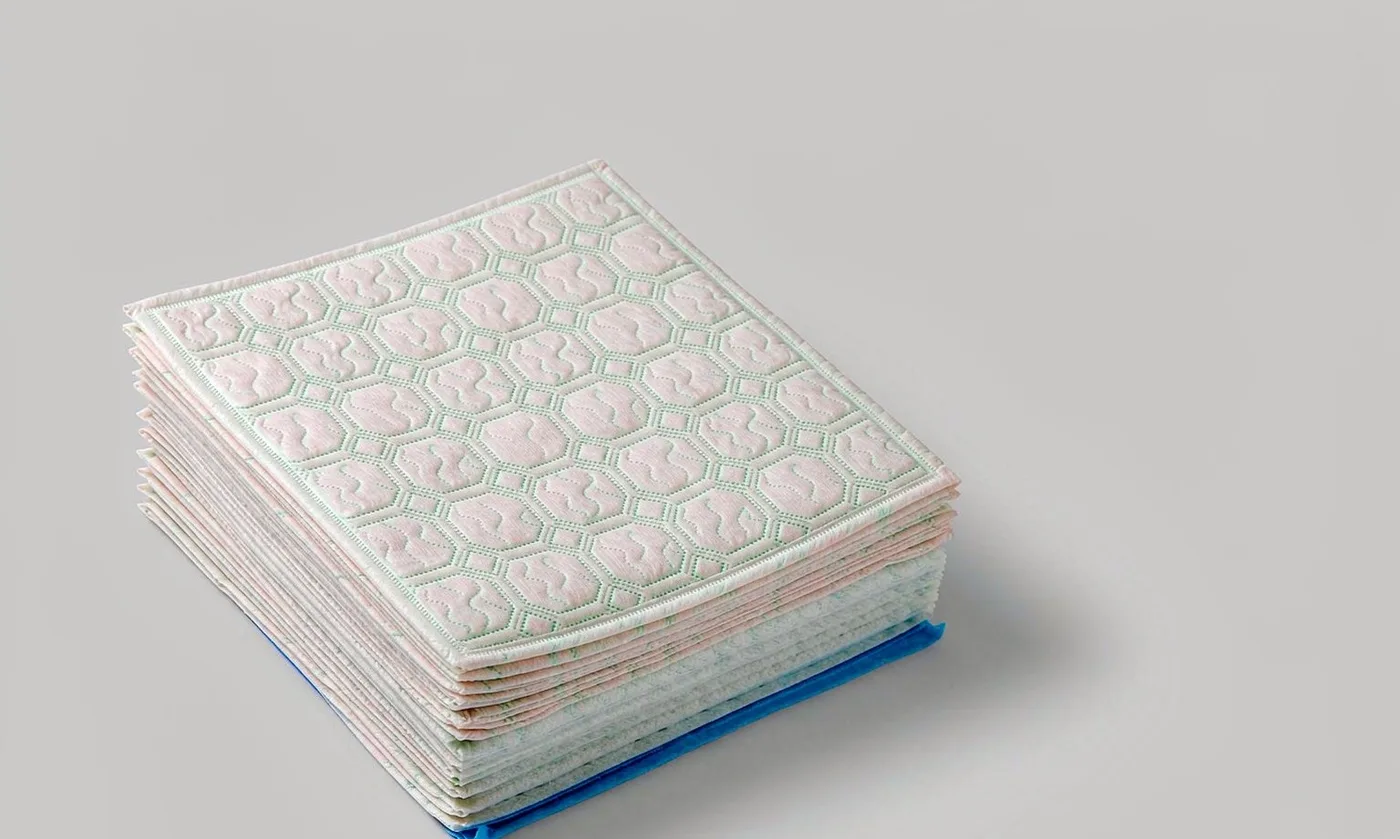
Quilted embossing is the final construction variable. Embossing channels liquid toward the core, reduces surface wetness and provides a visual cue of quality even before use. A defined quilt pattern also becomes a recognisable brand signature across sizes.
Absorbency Targets and Core Chemistry
Absorbency is the number that sells the pad and the number that sets its cost. It is governed by total core weight and by the ratio of fluff pulp to superabsorbent polymer, and the balance between those two determines how the pad behaves under real load rather than in a laboratory pour.
Fluff pulp acquires liquid fast but releases it under pressure. SAP holds liquid tightly even under load but acquires more slowly and gels on contact. A pad built mostly from pulp feels absorbent in a demo and fails under a dog standing on it, while a pad built mostly from SAP feels slow at first and then locks everything in. The right blend depends on the use case.
| Size | SAP loading | Target absorbency | Use case |
|---|---|---|---|
| 45 x 60 cm | 3 g | 400-550 ml | Small breeds, crate liner |
| 60 x 60 cm | 4 g | 600-750 ml | Everyday indoor use |
| 60 x 90 cm | 6 g | 900-1100 ml | Large breeds, overnight |
| 80 x 120 cm | 9 g | 1400-1700 ml | Multi-dog homes, recovery |
Testing should be specified as a method, not as an aspiration. Free absorbency under no load reads much higher than retention under load, and quoting the wrong figure on a pack creates a mismatch between expectation and experience. We verify against ASTM absorbency test methods and report both values so the marketing team can choose honestly.
Acquisition speed deserves as much attention as capacity. A dog does not wait, and a pad that absorbs slowly will be stepped in before the core takes the load. Top sheet treatment and a slightly higher pulp fraction improve acquisition, which is why the fastest pad is rarely the highest-capacity one.
Odour control is a chemistry decision layered on top of absorbency. A pH-buffering additive or a mild antimicrobial treatment extends the usable life of a pad in a room and supports a freshness claim on pack. Any additive intended for EU or UK retail should be checked against REACH chemical requirements before it enters the specification.
Attractant additives are a separate question. They help with training but they change the product claim and the regulatory position, so they should be a deliberate product decision rather than a default. Where used, the pack copy needs to be aligned with the actual formulation.
Printing and Embossing: Repeat Marks, Grid Patterns and Wetness Cues
Print on a pad is unusual because the substrate is white, highly absorbent and judged at floor level from standing height. That reverses the usual design logic: legibility at distance matters more than fine detail, and a small centred mark reads as an afterthought. A repeat pattern or a border treatment almost always outperforms a single logo.
Flexographic printing on the top sheet or on the back sheet is the standard method. Ink sits on the surface rather than soaking in when the formulation is matched to nonwoven, and a one-colour repeat pattern is both cheaper and more legible than a multi-colour graphic. Every additional colour adds a plate and a registration risk.
- Centred repeat mark: cheapest, clear brand presence, reads at floor level
- Border frame pattern: strongest shelf signal, uses more ink
- Grid or quilt print: communicates structure and absorbency visually
- Back sheet print: visible when folded, useful for size and count cues
Wetness cues are a genuinely useful design feature. A pattern printed with an ink that softens or shifts when wet gives the customer an unmistakable signal that the pad is used, and it supports a claim about changing frequency. It is a small chemistry addition with a large perceived-value return.
Embossing works alongside print rather than instead of it. A quilt or diamond emboss channels liquid into the core, improves surface dryness and creates a tactile quality signal that survives even when print is minimal. Many premium pads rely on embossing and a single small mark rather than on heavy printing.
Colour should be restrained. Two colours plus the natural white of the substrate is usually enough to differentiate a good-better-best structure, and restraint also reduces plate cost and ink coverage. A blue for standard, a green for extra-absorbent and a charcoal for premium reads instantly on shelf without artwork revision per tier.
Artwork must keep clear of the sealed border and the folded edge. Ink in the seal area interferes with bonding, and a design that disappears into the fold looks like a printing error. We supply a print-safe template per size as part of the tech pack.
Size Matrix and Pack Counts That Match Real Rooms
A pad range is a matrix, not a list. Sizes should map to the rooms and the dogs they serve, and pack counts should map to how fast a household consumes them. Getting both right is what makes the range feel designed rather than assembled from whatever formats were available.
Four sizes cover almost every brief. A 45 x 60 cm pad suits small breeds and crate liners, 60 x 60 cm is the everyday default, 60 x 90 cm serves large breeds and overnight use, and 80 x 120 cm serves multi-dog homes and recovery cases. Adding a fifth size rarely earns its shelf space unless a channel specifically demands it.
| Format | Pads per pack | Pack cube | Channel fit | Position |
|---|---|---|---|---|
| Try-me pack | 10-14 | Low | Impulse rail, e-commerce | Acquisition |
| Standard pack | 30-50 | Medium | Retail shelf, subscription | Core volume |
| Bulk pack | 100 | High | Club, online bulk | Value tier |
| Bundle kit | 20 plus accessory | Medium | Gift, starter set | Basket building |
Pack count drives both price perception and freight. A 30-pack feels like a considered purchase, a 100-pack feels like a chore to carry home, and the difference in cube between them is substantial. We model pack-out alongside unit cost because on a bulky absorbent product the freight line is frequently larger than the packaging line.
Retailers think in facing width, so pack dimensions should be chosen with shelf depth in mind. A pack that is 3 cm too deep will not sit on a standard pet aisle shelf, and the buyer will drop the line regardless of how good the pad is. Checking pack depth against the target retailer planogram avoids that entirely.
Count honesty matters for trust. Reducing pad count while holding pack size is the fastest way to lose a repeat customer in this category, and shoppers do notice. Where cost pressure forces a change, resizing the pad is more defensible than quietly reducing the count.
Bundle formats deserve particular attention for direct-to-consumer brands. A starter kit pairing pads with a mat or a travel blanket lifts order value and introduces a second product at the same time, and it can be assembled from existing SKUs with no new tooling beyond the outer pack.
Packaging Formats for Retail, Subscription and Veterinary Channels
Pad packaging carries more communication load than almost any other pet product. It has to state size, count, absorbency and use case in a glance, survive being carried home, and open cleanly in a room where the customer may be holding a dog. Those requirements point in different directions and should be resolved deliberately.
A printed polyethylene bag with a handle is the retail default. It is cheap, it protects against moisture in transit, and it offers a large printable face for the absorbency figure. The weakness is shelf presence, because a soft bag slumps, and slumping bags lose facings over time.
- PE bag with handle: lowest cost, best moisture protection, weaker shelf stance
- Printed carton: strongest shelf presence and messaging, highest cube
- Compressed bale: best freight efficiency, suited to bulk and subscription
- Kraft wrap: strongest sustainability story, weakest moisture barrier
Subscription and e-commerce formats should be optimised for the parcel network, not the shelf. A compressed pack in a mailer-friendly carton ships cheaper and arrives intact more often than a handled bag, and the outer surface can carry the brand block without needing retail-grade print.
Veterinary and professional channels want restraint. A plain pack with a stated absorbency figure, a clear size and a count reads as clinical and trustworthy, while decorative artwork reads as retail. Where a brand sells into both, a plain variant of the same product is usually cheaper than developing a separate line.
Moisture barrier is the technical packaging decision that gets missed. Pads are hygroscopic, and a pack stored in a damp warehouse can arrive already compromised. A film barrier or a desiccant strategy should be considered for any programme shipping into humid climates.
On-pack hierarchy should be decided by what the customer is actually choosing between. In a pad aisle that is size, count and absorbency, in that order, with brand third. Designing the pack around that hierarchy converts better than designing it around a logo.
Cost Structure at 500 Packs per Print Design
Pad cost is dominated by material weight, and the two heaviest inputs are fluff pulp and SAP. That makes absorbency the primary cost lever and means a brand can tune price directly by tuning the target figure. Understanding the split is what allows a range to be priced by tier rather than by guesswork.
| Cost element | Share of unit cost | Fixed or variable | Design lever |
|---|---|---|---|
| Fluff pulp and SAP | 30-42% | Variable | Absorbency target and blend ratio |
| Nonwoven and tissue | 14-20% | Variable | Top sheet gsm |
| Back sheet film | 8-13% | Variable | Film weight, kept above the floor |
| Printing and plates | 5-11% | Setup plus variable | Colour count and coverage |
| Conversion and packing | 10-16% | Variable | Pad count, fold format |
| Freight allocation | 12-20% | Variable | Compression and pack-out |
Compression is the quiet lever with the largest effect. Vacuum or mechanical compression before packing can meaningfully reduce carton cube, and on a product where freight runs 12-20% of unit cost that translates directly into margin. It should be evaluated during development rather than added later.
Plate amortisation explains the 500-pack minimum per print design in the same way it does for film products. A one-colour repeat keeps setup low; a three-colour illustrative design triples the plate charge that has to be recovered across the run.
Tiering by absorbency rather than by decoration is the most effective range strategy. A good-better-best structure built on 3 g, 4 g and 6 g SAP loadings gives buyers a clear ladder to merchandise and gives the brand honest differentiation, at a cost difference that is easy to calculate.
Raw material volatility is real in this category. Pulp and polymer prices move with commodity markets, so any quoted programme should carry a validity window and a review clause at reorder. Building that expectation into the commercial conversation avoids an awkward repricing later.
Pack-out should be read alongside raw material cost rather than after it. A programme that saves two percent on pulp and loses eight percent to a poorly packed carton ends up worse off, and that trade stays invisible unless both numbers sit on the same sheet. We present unit cost and landed cost together for exactly this reason, so tiering decisions are made against the number that actually reaches the warehouse.
Sampling, Test Methods and Replenishment Planning
Pad development runs on the standard clock: samples in 6-10 working days from an approved specification, bulk 35-50 days after approval, AQL 2.5 inspection before shipment, FOB Xiamen under T/T 30/70. What distinguishes this category is the amount of testing that should happen before approval rather than after.
Two sample rounds are standard. The first confirms layer build, handfeel and acquisition speed using a real pour test. The second confirms absorbency against the agreed target, emboss definition and pack fit. Approving on a single round leaves the performance figures unverified, which is the most expensive shortcut available in this category.
Test methods should be named in the specification so that both sides measure the same thing. We verify absorbency against ASTM standard methods, screen chemistry against REACH obligations and issue documentation under a ISO 9001 quality management system. A named method removes ambiguity from the acceptance conversation.
Inspection on pads focuses on weight consistency and seal integrity. A pad produced below core weight will meet the visual standard and fail the performance claim, which is why weight sampling belongs at in-line inspection rather than only at final AQL 2.5. We record core weight per batch for that reason.
Replenishment should be planned around consumption rather than around seasonality. Unlike accessories, pad demand is flat and predictable, so a rolling reorder triggered by sell-through works better than a seasonal buy. Brands that treat pads as seasonal consistently stock out in the months when demand is highest.
Long-term, the specification file is the asset. A documented build with recorded layer weights, absorbency results, emboss settings and pack-out data allows a brand to move volume between partner facilities without relearning the product, and it makes every subsequent launch faster than the last.
Brands should also agree an acceptance definition before the first bulk run. Naming what counts as a pass on core weight, seal integrity, print registration and pack count turns final inspection into a formality rather than a negotiation, and it protects both sides when a borderline batch appears. That agreement is cheap to write at sampling stage and expensive to improvise at shipment.
Why brands source here
- Pet carrier programs run since 2014; founding team in sewn goods since 2004
- SGS-verified production floor of 4,950 m² with 137 workers across 7 lines
- Monthly capacity of 200,000 units, audited to BSCI and ISO 9001
People Also Ask
What is the MOQ for custom pee pads?
The standard minimum is 500 packs per print design. Absorbency target, pack count and print plate charges all sit inside that minimum, and 500 packs spreads the fixed plate and setup costs across a viable base.
How absorbent should a custom pee pad be?
A 60 x 60 cm everyday pad typically targets 600-750 ml, a 45 x 60 cm pad around 400-550 ml, and a 60 x 90 cm pad 900-1100 ml. Absorbency is set by core weight and the pulp-to-SAP ratio.
How long does a custom pad sample take?
Samples take 6-10 working days once the layer build, absorbency target and artwork are approved. We recommend two rounds: one for handfeel and acquisition speed, one for verified absorbency and pack fit.
Can pads be printed with a brand pattern?
Yes. Flexographic printing on the top or back sheet handles repeat marks, border frames and grid patterns. One-colour repeats are cheaper and read better at floor level than multi-colour graphics.
What sizes should a pad range include?
Four sizes cover most programmes: 45 x 60 cm, 60 x 60 cm, 60 x 90 cm and 80 x 120 cm. Adding a fifth rarely earns shelf space unless a specific channel demands it.
Are odour-control additives available?
Yes. pH-buffering and mild antimicrobial additives extend in-room usable life and support a freshness claim. Any additive for EU or UK retail should be screened against chemical compliance requirements first.
What inspection standard applies to bulk pad orders?
Bulk runs are inspected to AQL 2.5 before shipment, with in-line core weight sampling as an earlier gate. Shipments move FOB Xiamen under T/T 30/70 terms.
Frequently Asked Questions
What layer build do you recommend for an everyday pad?
A five-layer build: hydrophilic nonwoven top sheet at 18-25 gsm, tissue wrap, fluff pulp core with 4 g SAP for a 60 x 60 cm pad, lower tissue and a PE back sheet above 20 gsm.
Why does back sheet weight matter?
The back sheet protects the floor. Film below roughly 20 gsm risks strike-through under a dog standing on the pad, and the resulting complaint costs far more in reputation than the film saves in unit price.
Should absorbency be quoted under load or free?
Both should be measured, and the pack should quote the figure the customer will experience. Free absorbency reads much higher than retention under load, and quoting the wrong one creates an expectation gap.
Do sealed edges make a difference?
Yes. A sealed border on all four sides contains sideways migration far better than a cut edge, reduces the bunching that causes most leak complaints and gives a more finished appearance on the floor.
Can adhesive corner tabs be added?
Yes. Tabs stop the pad sliding on hard floors, reduce bunching and give the packaging team a functional claim to print. They add a small cost and are usually worth it on a premium tier.
What pack counts work best by channel?
A 10-14 pad try-me pack suits impulse and acquisition, 30-50 suits retail shelf and subscription, and 100 suits club and online bulk. Cube and shelf depth should be checked against the target planogram.
How do you control odour in the core?
Odour control is layered on top of absorbency through pH-buffering or mild antimicrobial additives. The right choice depends on the claim the brand wants to make and on the destination market rules.
Is compression packing worth the extra step?
Usually yes. Compression meaningfully reduces carton cube, and on a bulky absorbent product where freight runs 12-20% of unit cost, that reduction converts directly into margin.
Can the same platform serve veterinary and retail channels?
Yes. A plain pack variant with stated size, count and absorbency reads clinical and trustworthy for professional channels, while a printed bag or carton serves retail, with no change to the pad itself.
How should a good-better-best range be built?
Tier by absorbency rather than by decoration. SAP loadings of 3 g, 4 g and 6 g give buyers a clear ladder and give the brand honest differentiation at a cost difference that is simple to calculate.
What causes pads to arrive damp in transit?
Pads are hygroscopic. In humid climates or damp warehouses a film barrier or desiccant strategy should be specified during packaging development rather than discovered after the first complaint.
How often should pads be reordered?
On a rolling trigger tied to sell-through rather than on a seasonal calendar. Pad demand is flat and predictable, and brands that treat it as seasonal stock out in the highest-demand months.
What should the specification file record?
Layer weights, SAP loading, verified absorbency results, emboss pattern, print references, size matrix and master carton pack-out. That file lets volume move between partner facilities without relearning the product.
Talk to QUANZHOU JUNYUAN BAGS about a pet carrier program: MOQ 500 pieces per colourway, samples in 6-10 working days, bulk production in 35-50 days under AQL 2.5 inspection.
Get a free quote Request a sample