Custom Halti: No Pull Solution
Customised pet carrier work differs from stock buying in one respect: the pattern is graded to your size ladder and held on file for reorders.
Anatomy of a head halter and where comfort fails
A head halter has four functional zones: the nose band that does the work, the throat latch that keeps it in position, the cheek pieces that connect them, and the connection point where the lead attaches. Comfort failures localise predictably, and knowing where makes the specification straightforward.
The nose band is where nearly all complaints originate. It sits over a sensitive area, it is the part the animal feels first, and it is the part that rubs if the edge is hard or the padding is thin. Specify the widest contact patch the silhouette allows, and treat edge finish as a first-order decision rather than a detail.
The throat latch is the retention mechanism and the part most often over-tightened by customers. If it has no clear adjustment limit, users will pull it snug, the animal will object and the product will be blamed. Design in a visible stop or a marked adjustment range so the correct fit is the easy fit.
Cheek pieces carry surprisingly little load but determine how the halter sits. Too short and the nose band rides up toward the eyes; too long and the whole assembly slides forward and loses authority. They should be specified per size, not shared across the run, which is a common cost shortcut with a predictable consequence.
The connection point should be positioned below the chin rather than to one side, so that steering input is symmetrical and the halter does not rotate around the muzzle. Rotation is the most common reason a well-fitted halter still feels ineffective to the handler.
Direction of pull matters as much as position. A connection that pulls straight back encourages the animal to brace, while one that redirects slightly downward encourages a turn. Decide which behaviour you are designing to encourage and specify the ring position accordingly.
Finally, plan for the fitting conversation. Unlike a collar, a head halter requires an introduction period, and the packaging is the only place most brands have to explain that. A product that is correctly designed but unexplained will be judged as a failure.
Nose band materials, padding and edge finish
Nose band construction is the single biggest determinant of whether the product is tolerated. The material stack is normally three layers: a structural webbing core, a padding layer and a covering that contacts the animal. Each layer has a job, and specifying only the outer fabric is the usual mistake.
The core should be a stable, low-stretch webbing that holds the band's shape without becoming rigid. Nylon gives a smoother surface and better abrasion life; polyester gives better ultraviolet stability and lower water uptake. Either is acceptable if the width and stiffness are matched to the size grading.
| Nose band build | Comfort | Durability | Drying speed | Cost index |
|---|---|---|---|---|
| Nylon webbing, 3 mm foam, brushed lining | High | High | Moderate | 1.2x |
| Polyester webbing, 3 mm foam, mesh lining | High | Very high | Fast | 1.15x |
| Neoprene padded sleeve | Very high | Moderate | Slow | 1.4x |
| Unpadded flat webbing with soft binding | Moderate | Very high | Very fast | 1.0x |
| Cotton webbing, light padding | Soft initially | Low | Slow | 1.1x |
Padding thickness is counter-intuitive. Very thick foam feels luxurious in the hand and can actually increase rubbing, because it creates pressure points at the edges where the padding ends. A medium density foam with a generous taper at each end usually outperforms a thicker pad with a hard transition.
The covering material deserves deliberate selection. A brushed tricot feels soft and immediately communicates comfort but holds moisture and dirt. A technical mesh dries quickly and suits wet climates but feels less luxurious. Choose against the climate you actually sell into rather than the photograph.
Edge finish is where quality is visible. A bound edge in a softer tape eliminates the hard line that causes chafing, and it also gives you a second colour position. Turning and topstitching an edge is cheaper and looks sharper in a studio shot but is more likely to rub in use.
Colour choice at the nose band should be practical. Light linings show dirt within days and look tired in customer photographs, while a mid-tone lining hides wear and keeps the product looking new. This is one of the few places where the practical choice also photographs better.
Sizing matrix and adjustable geometry
Five sizes cover the companion dog market properly, and four is workable if the grading is honest. The measurements that matter are muzzle circumference at the widest point, and the distance from that point back to the throat. Neck circumference is a poor proxy and should not be published alone.
Grading should step both dimensions together rather than scaling one from the other. A large muzzle on a short head and a small muzzle on a long head are both common, and a matrix that handles them separately will serve far more of your market than a single axis.
- XS: fine muzzles, small terrier and toy types.
- S: the most common small-breed fit and usually the highest volume.
- M: spaniel and medium cross proportions.
- L: broader muzzles with longer heads.
- XL: large breeds with substantial muzzle circumference.
Adjustment range within each size should be generous but bounded. A nose band that adjusts across a wide range tempts the customer to buy one size for several animals, which produces poor fit and bad reviews. Narrower ranges force better selection and better outcomes.
The throat latch should have a clearly marked correct position. A printed alignment mark, a contrast stitch at the right point or a physical stop all work, and all three cost almost nothing. This small detail prevents the most common misuse of the product.
Publish the measurements rather than breed names. Breed charts are convenient for marketing and dangerous for fit, because individual variation within a breed routinely exceeds the difference between breeds. A measurement diagram is less romantic and far more accurate.
Verify the matrix on head forms before tooling patterns, and photograph each size on a real animal. A size run that looks correct on paper frequently fails at the extremes, and discovering it during sampling is far cheaper than discovering it in reviews.
Hardware, safety release and load paths
Hardware on a head halter carries less absolute load than on a walking harness, but it is more consequential because it sits close to the eyes and because failure means loss of control in traffic. Specify it with the same seriousness as any safety-adjacent component.
The connection ring is the primary component. It should be a welded or solid ring rather than an open-formed one, positioned under the chin and sized so the lead clip moves freely. A ring that binds produces a rotating pull and undermines the whole geometry described earlier.
Adjustment hardware should be flat, low profile and quiet. Sliders that rattle or catch fur generate complaints that have nothing to do with function, and a matte finish hides the scratches that accumulate quickly on a product worn at ground level.
- Connection ring: welded, under-chin position, sized for free clip movement.
- Throat latch buckle: quick release, side-squeeze, matte finish.
- Adjusters: flat profile, low noise, corrosion resistant finish.
- Safety breakaway option: advisable where the product may be worn unsupervised.
Corrosion behaviour matters more than buyers expect, because the product is worn near the mouth and exposed to saliva. Plated zinc alloys can pit within a season; solid brass and stainless steel behave predictably. Choose against your actual markets and price points rather than against appearance alone.
A breakaway or quick-release throat latch is worth considering for any programme sold into general retail. It addresses the scenario the product is least suited to, unsupervised wear, and it is a defensible design decision rather than an admission of weakness.
Test the assembly as a unit rather than testing components separately. The failure point in a halter is almost always the stitching where hardware meets webbing, and a component certificate says nothing about how that join was sewn. Referencing published test methods from ASTM International gives the specification a common language.
Independent verification through a laboratory such as SGS converts supplier claims into documents buyers can file, and it is considerably cheaper when scheduled alongside sampling rather than requested afterwards.
Branding on a product with almost no flat surface
A head halter presents one of the most constrained branding canvases in the category. There is no large panel, the visible surfaces are curved and narrow, and anything applied to the nose band is in direct contact with the animal. The discipline is to choose two positions and execute them well.
The cheek piece is the most visible surface in normal use and the safest place for a mark. A woven label stitched flat along the cheek reads clearly, lies flat against the head and adds no bulk where it matters. It is also the cheapest durable option available.
The nose band can carry branding, but only by print or by knit-in pattern, because any applied label will rub. A subtle repeated pattern or a single small wordmark printed onto the outer face of the band works; a large logo does not.
- Woven cheek label: legible, durable, flat, the default choice.
- Printed nose band: subtle repeat or small mark only, tested for crocking.
- Contrast binding: a colour position rather than a logo, very effective.
- Hardware finish: a matte black or brass family reads as brand language.
- Packaging face: the only surface with room for a full identity.
Contrast binding is the underused option here. Because the nose band edge is already bound, choosing a contrast colour gives you a visible brand signature at no additional process cost, and it is legible from a distance in a way that a small label is not.
Hardware finish deserves inclusion in the identity system rather than treatment as a commodity. If the rest of your range runs matte black, keeping that finish here makes three separate products read as one family, which is exactly what a buyer evaluating a new brand wants to see.
Colour fastness on printed bands should be specified explicitly, because printed webbing in contact with light-coloured fur is a predictable source of complaints. Recognised textile methods maintained by AATCC provide the reference points, and the test should be run on the printed band, not on the base tape.
Packaging then carries the full identity. Because the product itself has so little room, the header card or box becomes the primary brand surface and should be designed with the same care as a product panel rather than left to a template.
Colour coding by size for shelf and warehouse clarity
Colour coding is unusually valuable on a fitting-critical product, because it helps three different people do the right thing: the customer selecting a size, the store assistant replenishing stock, and the warehouse picker assembling an order. One system serves all three.
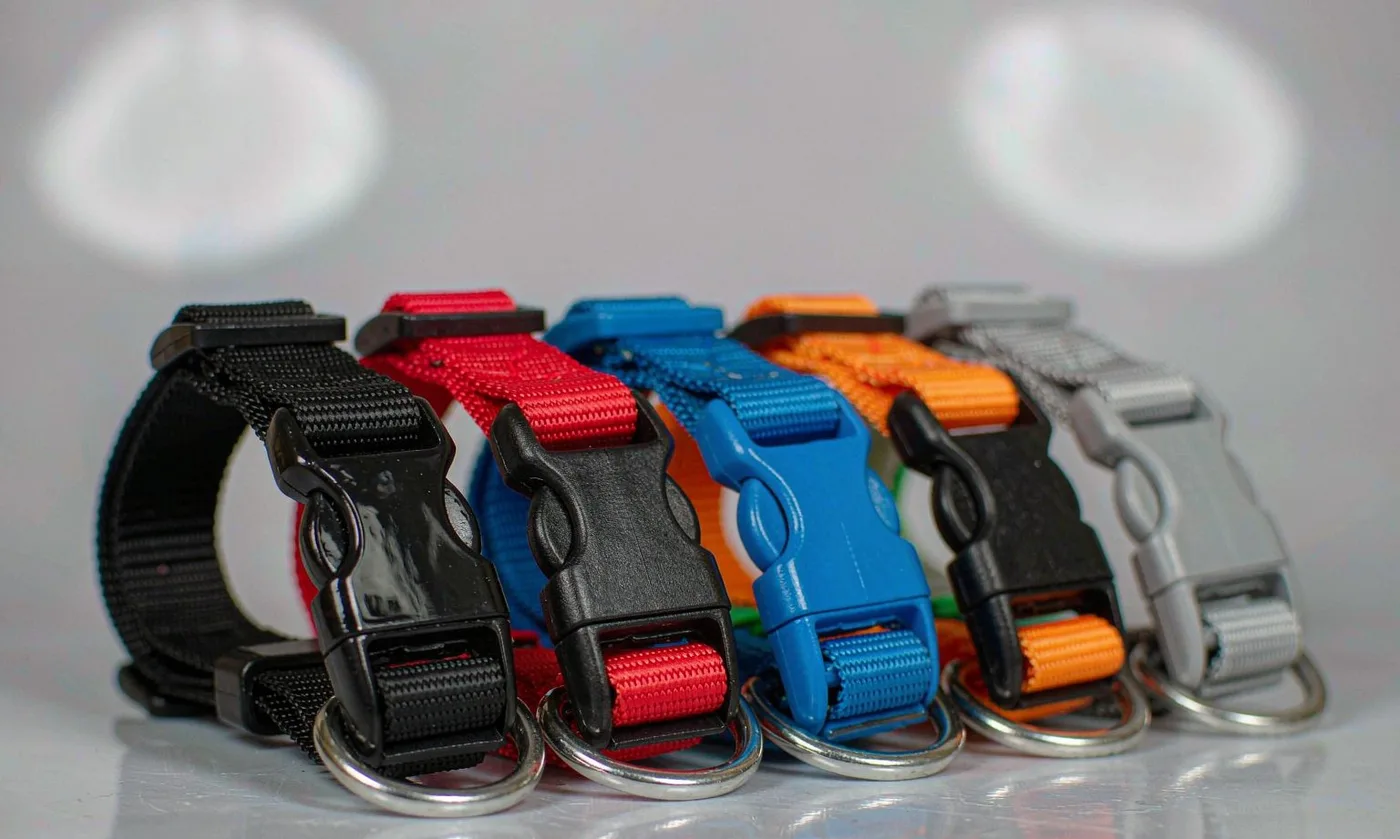
Assign one Pantone reference per size and repeat it across the binding, the woven label ground, the header card and the carton label. A customer standing at a fixture can then identify the right size from a metre away without reading small type, which materially reduces the selection errors that drive returns.
The system works best with a neutral track as well. Many handlers prefer a plain dark halter, so plan two parallel tracks: a coded colour per size and a black or charcoal option in every size distinguished by a small coded tab rather than by the whole product colour.
Tolerance matters more here than in most categories, because the same size in two production runs must be recognisably the same colour or the coding system fails. Write an acceptance range against a reference swatch and require dye-lot consistency within a size.
Bright and fluorescent tones are the most sensitive to drift and the most useful for coding, which is an awkward combination. The practical answer is to use them for the small coded elements and keep the main product colour in more stable mid-tones.
Document the system in a colour standard sheet that travels with the tech pack. It should name each reference, state where it appears and specify the tolerance, so that a reorder a year later reproduces the system rather than an approximation of it.
Finally, use the coding in your own content. Photography that shows the full size run together, each in its coded colour, communicates both the range and the sizing logic in a single frame and does more selling work than any paragraph of copy.

Sampling, testing and the fitting guide as a deliverable
Sampling on a head halter should include a fit set rather than a single sample. Because the product is graded across five sizes, approving only the middle size guarantees that the extremes will be discovered after production. Request the full run, even if the extremes are made in a single unit.
Testing should cover the joins rather than the materials. Finished-assembly tensile on the complete halter, cyclic loading at the connection ring, abrasion at the nose band edge and colour fastness on any printed component give a realistic picture of how the product behaves.
- Finished-assembly tensile: measures stitching and hardware joins, not just webbing.
- Cyclic loading: simulates the repeated steering input the product actually receives.
- Edge abrasion: the nose band edge is the first area to show wear.
- Crocking: printed bands must not transfer colour onto light fur.
- Hardware corrosion: relevant given proximity to the mouth and saliva.
Public guidance on how equipment should be evaluated carries weight with cautious buyers, and referencing frameworks such as those published by the Center for Pet Safety in your documentation signals that the programme was developed seriously.
The fitting guide is the deliverable most often neglected and most often decisive. It should show how to measure, how to set the nose band, how loose the throat latch should be and what the introduction period looks like. One well-designed diagram reduces the returns that otherwise dominate the category.
Plan the guide at the same time as the packaging artwork, not after it. The two share a format, a type hierarchy and a photographic set, and designing them together costs less than designing them twice and produces a pack that reads as one object.
Keep the approved construction record together with the test reports and the artwork files, one folder per SKU. When a retailer questionnaire arrives months later, or when a reorder is scheduled, that folder turns a research exercise into a same-day answer.
Range planning, packaging and launch cadence
A head halter rarely sells alone for long. It works best as the anchor of a no-pull family that includes a front-clip harness, a training lead and a treat pouch, because customers solving a pulling problem buy into a system rather than a single item.
Packaging should reflect that. A shared card format, shared iconography and shared colour coding across the family make three separate products read as one solution, and a buyer evaluating a new brand responds to that coherence more strongly than to any individual product feature.
- Header card: carries the measurement diagram, the fit note and the care instruction.
- Size coding: repeated from the product onto the card and the carton label.
- Introduction note: the short explanation of the fitting-in period.
- Family cross-reference: shows the matching harness and lead on the reverse.
Launch sequencing should lead with the two middle sizes, prove the fit with real reviews, then extend to the extremes. Sizes at the ends of the run carry the highest return risk and the lowest volume, so earning the right to stock them is better than launching with the full matrix.
Order planning follows the same discipline. With MOQ 500 pieces per colourway, a first buy is best weighted toward S and M, with a smaller allocation to L and a token quantity of XS and XL until your own data replaces the estimate.
Timing matters in this category because the product is bought to solve an immediate problem rather than as a gift. Availability therefore matters more than novelty: keep the core sizes continuously in stock and use seasonal colour drops for expression rather than as the main event.
Finally, plan the photography set around the fitting story. One frame showing correct fit, one showing the measurement points and one showing the product on the animal from the handler's viewpoint will answer the three questions a customer actually has before buying.
Where the head halter sits in a no-pull range
A head halter is a specialist product, and ranges that treat it as the default no-pull solution tend to disappoint customers who would have been better served by a harness. Its correct role is as the strongest option in a family rather than as the first one offered.
The practical architecture is a ladder. A front clip harness serves the majority of customers, a head halter serves the cases where pulling is severe or the handler needs finer control, and a training lead connects the two. Presented in that order, each product has a clear job.
- Front clip harness: the default recommendation for most pulling problems.
- Head halter: the stronger option where control needs to be finer or the animal is large.
- Training lead: the distance tool that makes both work during the learning phase.
- Treat pouch: completes the system and reinforces the training context.
Presenting the ladder honestly builds credibility. A brand that recommends the milder product first and explains why the stronger one exists is trusted more than one that leads with the most technical item in the range.
The fitting and introduction story is shared across the ladder, which is efficient. One well-designed fitting guide, adapted per product, covers the whole family and gives the range a consistent voice that customers recognise.
Finally, plan the range so the halter is never the only answer a customer can find. Customers arriving with a severe problem need it, but customers arriving with a mild one should be able to solve it more simply, and both should be visible in the same place.
Production capability
- SGS-verified production space of 4,950 m², 149 machines, 7 assembly lines
- Pet carrier and pet bag output since 2014 from a 137-person team
- 200,000 units shipped monthly under BSCI and ISO 9001 systems
People Also Ask
Where should a head halter sit on the muzzle?
High on the muzzle, behind the nose pad but well clear of the eyes, with the throat latch loose enough to admit two fingers. A printed alignment mark on the product makes the correct position obvious to the customer.
Is padding always better on a nose band?
Not always. Very thick foam creates hard pressure points at its edges and can increase rubbing. A medium density pad with a tapered end usually outperforms a thicker pad with an abrupt transition.
How do you measure for a head halter?
Take muzzle circumference at the widest point and the distance from that point back to the throat. Neck circumference alone is a poor proxy, and breed-based charts are inaccurate because individual variation exceeds breed differences.
Why does a halter rotate to one side?
Usually because the connection ring is positioned to the side rather than under the chin, or because the ring binds and prevents the lead clip from moving freely. Both are specification problems, not fitting problems.
Can a head halter match our existing brand colours?
Yes. Nominate a Pantone reference and approve webbing, binding and printed components together under one light source, because different substrates read the same reference at different values.
Should we launch all five sizes at once?
Better to lead with the middle two. Prove the fit, gather reviews, then extend to the extremes, which carry the highest return risk and the lowest volume in the first season.
Frequently Asked Questions
What is the MOQ for a custom head halter?
MOQ is 500 pieces per colourway, split across sizes. Most first programmes open with two colourways and weight the buy toward the middle sizes until real sales data replaces the estimate.
How many sizes should a head halter range carry?
Five, from XS to XL, graded on muzzle circumference and the distance back to the throat. Those two dimensions do not correlate, so publishing a single neck measurement is not sufficient.
Which nose band construction is most comfortable?
A medium density foam pad with a generous taper at each end, covered in either brushed tricot for softness or technical mesh for fast drying. Very thick padding often increases rubbing because it creates hard pressure points at its edges.
Can our logo be placed on the nose band?
Only by print or knit-in pattern, because any applied label will rub. The cheek piece is the better position: a flat woven label there reads clearly, lies flat and adds no bulk where it matters.
How long does sampling take?
6-10 working days including a fit set across the size run, one woven label strike-off and a hardware sample. Requesting the full size set rather than a single middle size is strongly recommended for fitting-critical products.
What is the bulk production lead time?
35-50 days after written sample approval. Inspection runs to AQL 2.5 on finished cartons before loading, and standard terms are T/T 30/70 against FOB Xiamen.
Should the throat latch have a quick release?
Yes for most retail programmes. A quick-release latch is convenient for the handler and addresses the unsupervised-wear scenario, which is the situation the product is least suited to.
What hardware finish lasts longest near the mouth?
Solid brass and stainless steel behave predictably when exposed to saliva. Plated zinc alloys look identical when new but can pit within a season, so choose deliberately against your price point and markets.
How do we reduce fit-related returns?
Publish measurements rather than breed names, include a measuring diagram on the packaging, and mark the correct throat latch position on the product itself. Most fit complaints are communication failures rather than pattern failures.
Can we colour code by size?
Yes, and it is recommended. One reference per size repeated across binding, label, card and carton helps customers select correctly, assistants replenish quickly and warehouse staff pick accurately.
Can a halter ship with matching harnesses and leads?
Yes. Consolidating the no-pull family into one shipment spreads freight and customs handling, and launching the products together makes the range read as a system rather than as separate items.
Do you archive specifications for reorders?
Yes. Patterns, approved webbing and foam references, artwork films and hardware specifications are archived, so a repeat run can be scheduled without re-sampling and reproduces the approved fit.
Talk to QUANZHOU JUNYUAN BAGS about a pet carrier program: MOQ 500 pieces per colourway, samples in 6-10 working days, bulk production in 35-50 days under AQL 2.5 inspection.
Get a free quote Request a sample