Custom Head Collar: Gentle Leader
A bespoke pet carrier brief is built from a tech pack: dimensions, fabric, hardware finish and the test standard the finished bag has to meet.
Designing for a nervous first fitting
The first thirty seconds decide everything about this product. An owner fitting a head collar for the first time is often uncertain, sometimes sceptical, and watching the animal closely for signs of distress. If the product feels fiddly, unclear or visually alarming at that moment, it goes into a drawer and generally stays there, regardless of how well it might have performed given another chance. Design, therefore, is not only about the article itself but about that half-minute, which nothing later can undo.
Start by reducing visual threat. A heavily engineered device covered in straps and hardware reads as equipment to be tolerated rather than worn. The strongest designs in this category use few visible components, soft lines and a deliberately calm colour palette for anything contacting the muzzle, since anything that reads as restraint equipment has already lost the argument at a glance.
Second, make the sequence obvious without instructions. Ideally there is literally one adjustment the owner must make, with everything else either pre-set or self-evident. Every additional strap introduced during development adds cognitive load at exactly the moment the customer can least afford it, and complexity of this kind is very rarely recovered later by better packaging.
Third, plan the sound profile. Buckles clicking, rings rattling and webbing scraping against itself all raise anxiety in a nervous animal. Quiet material choices at contact points are a genuine design feature here, and cost little when decided early rather than retrofitted after the first production run has shipped.
Consider also who is doing the fitting. In many sales the product is explained by a trainer or clinic nurse rather than read about at home, so the demonstration path should be as carefully designed as the retail card. Practise it with three people before locking the sample, and change whatever each of them misread rather than concluding they were unusually slow.
Finally, accept that some customers will abandon the first attempt. Packaging that supports a second try — a card that stays intact, instructions that remain attached, and a form that re-coils neatly rather than tangling — recovers a meaningful share of those abandonments. Packaging resilience is therefore a product decision rather than a print specification, and should be reviewed alongside the sample rather than after it is approved. A card that tears, curls or smears after one week in a jacket pocket quietly removes every instruction you paid to design, which is precisely why durability testing belongs in development rather than in quality control.
Contact points: padding, skin comfort and seam placement
A head collar touches thin skin over bone in several places, which makes material selection unusually consequential. Discomfort here is not a marginal issue that a customer tolerates; it ends the use of the product entirely, and afterwards the word used in reviews is never "uncomfortable" but rather "cruel".
The nose band carries the greatest risk. Too narrow and it concentrates pressure across a small area; too firm and it rubs. Neoprene laminated with a soft knit is the most forgiving choice, offering cushioning without bulk, though some brands prefer closed-cell foam covered in brushed tricot for a softer, more garment-like feel.
- Seams: must never sit on the skin side of any contact panel; specify seam orientation explicitly.
- Edges: bound rather than cut, because raw edges stiffen and abrade after washing.
- Hardware backing: any ring or adjuster near skin needs a soft facing behind it.
- Thread: soft-finish polyester or nylon thread chosen for flexibility rather than sheer strength.
The rear strap behind the ears deserves separate treatment. It is subject to different movement and generally carries less pressure, so it can be slimmer, but it must still lie flat rather than rolling. A rolled construction in this area is often more comfortable than a flat one and looks considerably tidier.
Wash behaviour should be verified on assembled samples because padding materials absorb differently from face fabrics, and damp padding is uncomfortable and slow to dry. Specify drying expectations explicitly on the care label rather than leaving owners to guess.
Where any material will be marketed as skin-safe or hypoallergenic, ask for documentation rather than adjectives. Independent textile criteria published by OEKO-TEX give both sides a common reference. Padding decisions should also be documented with photographs of the cross-section, since written descriptions of softness are impossible to compare reliably across two material suppliers. Standardise on one nominated padding reference per tier, then approve every subsequent substitution against photographs and swatches held together with the original lot.
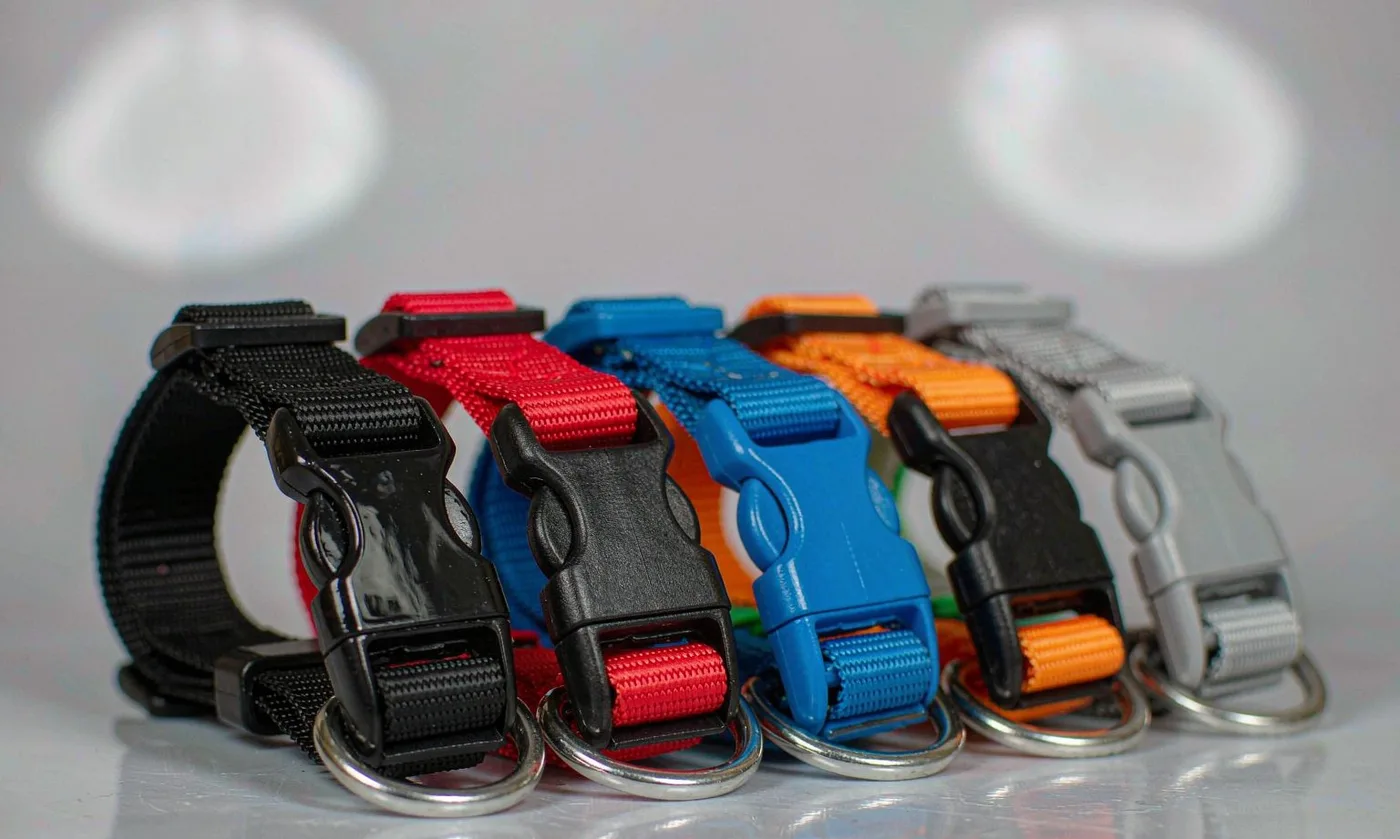
Nose-band geometry and the adjustment range
Every product of this type works by redirecting rather than restraining, which means the geometry of the nose band determines everything about how it performs. Specifying it properly requires three numbers rather than one: band length, allowable travel, and the distance between the nose band and the point where the strap meets under the jaw.
The nose band itself should sit high rather than low, resting just behind the muzzle's widest point where the bone provides a stable seat. A band that migrates down toward the soft cartilage becomes uncomfortable and loses leverage, which is why "one size fits most" claims in this category deserve scepticism.
Travel governs fit tolerance. Too much and the collar slides sideways and the dog can paw it off; too little and it applies pressure when relaxed. In practice, engineered products settle at a modest range, with most of the accommodation coming from graded sizes rather than from extreme adjustment.
Under-jaw connection geometry is where shortcuts show. The strap should meet the nose band at an angle that keeps both components stable rather than pulling one out of position, and that angle changes with size when the article is graded properly.
Specify how the adjustment behaves under load as well as at rest. Adjusters that creep gradually during use are the most frequently reported fault, and the remedy — a higher-quality slider with better tooth geometry — costs far less than the returns it prevents.
Finally, decide whether the nose band is removable or fixed. Removable bands simplify washing and colour swapping but introduce a join at the exact point where failure is most inconvenient. Fixed construction is generally preferable below premium price tiers, where the additional join tends to introduce more problems in service than the convenience resolves at home. Where a removable band is genuinely wanted, specify the attachment hardware carefully and validate it through repeated wash cycles, because a join that opens during laundering fails exactly when customers have least patience.
Size grading by head measurement
Head collars cannot be sized from neck data. This is the single most common specification error new programmes make, and it produces precisely the poor reviews that this category attracts. Size by head circumference measured at the widest point plus the muzzle's seated position.
Most ranges need four to five sizes, occasionally six where the brand targets both very small and very large breeds. Each size specifies head circumference, nose-band length and rear-strap length, all derived from one graded base rather than drawn independently.
| Size | Head circ. (mm) | Nose band (mm) | Break-force target | Run share |
|---|---|---|---|---|
| XS | 280-340 | 150 | 1.2 kN | 8% |
| S | 340-410 | 175 | 1.4 kN | 20% |
| M | 410-490 | 205 | 1.6 kN | 34% |
| L | 490-580 | 235 | 1.8 kN | 26% |
| XL | 580-690 | 270 | 2.0 kN | 12% |
Break-force targets should be specified per size rather than once for the range, because larger animals generate dramatically higher loads. Documented test methods issued by ASTM International provide a framework both sides recognise.
Publish measurement diagrams rather than text descriptions. Owners understand a drawing in seconds and misinterpret written instructions frequently, particularly where "widest point" must be interpreted on an unfamiliar shape.
Consider offering a fitting template to download. A printable gauge sized correctly against your grading wins trust quickly and reduces returns substantially, and it costs little more than the artwork time already budgeted. Include it in the standard pack rather than behind a link, because customers who need it most rarely look anything up before buying. Print it on heavy stock rather than thin paper as well, since a gauge that flops is read as a toy rather than as a measuring instrument.
Instruction assets belong in the product, not the box
Products of this type fail through misuse far more often than through defects. That reality makes the instruction set a functional component rather than a compliance afterthought, and it deserves the same level of design attention as the article itself.
Commission three assets at minimum: a printed quick-start card, a short demonstration film, and a durable diagram for the retail card. Together they cover the customer at home, the customer in store, and the professional who may be doing the fitting on someone else's behalf.
- Quick-start card: five illustrated steps maximum, printed on material that survives being left in a coat pocket.
- Demonstration film: ninety seconds, silent-friendly captions, showing a calm animal rather than a perfect one.
- Retail card: the same five steps condensed, readable from a metre away.
- Template insert: a paper gauge for head measurement, included rather than merely offered.
Test the assets before finalising. Ask three people who have never used such a product to fit it using only what is supplied, and watch what they get wrong. The resulting revisions are always obvious and always cheap compared with discovering the same problems through returns.
Professional endorsement adds disproportionate credibility here. Trainers and behaviourists carry enormous influence over purchase decisions, so consultative guidance — including resources such as those published by the American Veterinary Medical Association — belongs in your reference library and, selectively, on your packaging.
Finally, keep assets version-controlled alongside the product. When the geometry changes, the card must change too, and mismatched instructions are worse than none at all. Assign one named owner for that version control internally, because responsibility shared here tends to become responsibility avoided. Add a revision date to every asset too, so retail partners and professionals can see at a glance whether the guidance in their hands is current.
Colourlanguage and professional credibility
Colour choices in this category carry unusual weight. Bright, high-contrast and aggressive combinations may attract attention online, but they make an already unfamiliar product look more intimidating to the owner standing in front of it. Calm, low-contrast palettes reassure, and reassurance sells here.
A practical approach uses one neutral base for the core range and reserves brighter accents for either the strap edge or the packaging rather than the contact panels. That keeps the article visually calm while still letting the brand speak through the elements customers do not associate with the animal's face.
Where a range includes other walking items, matching colour language across them produces a coherent professional impression. A clinician recommending a brand is more likely to recommend one that looks considered than one that looks assembled from whatever fabric was cheapest that quarter.
Reflective detail deserves inclusion but should be placed away from contact panels, typically along the rear strap or as a printed element on the retail card rather than the article. Visibility after dark is a genuine benefit and a legitimate marketing line.
Hardware finish follows the same logic as elsewhere in your range: matte finishes read as professional equipment, bright finishes read as pet fashion. Choose once, apply consistently, and resist seasonal exceptions that fragment the range's identity.
Consider whether the professional channel needs a distinct package. Clinics and training schools frequently prefer a practical kit — spare instruction cards, a demonstration unit that can be handled, and clear reorder information — over attractive retail packaging that requires staff explanation. Margins through professional channels are frequently better as well, since recommendation replaces paid marketing almost entirely.
Sampling gates, MOQ planning and the timeline
Because this product is fit-critical, development warrants one more gate than most articles receive. Gate one checks nose-band geometry on the base size. Gate two verifies comfort and material behaviour. Gate three reviews every size in the grading, since errors in grading are invisible until each size is actually built.
That third gate is the one teams skip most often, and skipping it is why so many ranges have one size that fits poorly. Budget for a partial size set — typically XS, M and XL — rather than a single sample, and treat anything discovered there as representative.
MOQ is 500 pieces per colourway, distributed across the size curve. First programmes usually spread it roughly as an eighth in XS, a fifth in S, a third in M and the remainder across L and XL, adjusted once your own sales data exists.
- Sampling: 6-10 working days with artwork and materials ready.
- Bulk: 35-50 days after written approval of the golden sample.
- Inspection: AQL 2.5 on finished cartons before loading.
- Terms: T/T 30/70 quoted FOB Xiamen, full documentation set per shipment.
Documentation matters noticeably more here than elsewhere. Sizing charts, fit instructions and material declarations travel with the product through clinics and retailers alike, and a clean file shortens every subsequent conversation.
Plan reorders against archived patterns and approved lots. Once fit has been established, nothing about reordering should require redevelopment, and brands that hold that discipline can refresh colours annually without revisiting geometry at all. That stability is what eventually makes the product worthwhile: development cost amortised across several seasonal colour refreshes rather than absorbed by one. Treat the graded block as intellectual property belonging to the range and protect it accordingly in your own documentation.
Presenting to clinics, trainers and specialist retail
Distribution for this product differs from general pet retail, and treating it like an ordinary hanging accessory wastes its strongest channel. Clinics, behaviourists and training schools all influence purchase decisions heavily, and each prefers a different presentation.
Clinics value clarity and hygiene. A sealed unit with instructions visible, minimal loose paper, and reorder information printed rather than assumed will outperform attractive graphical packaging that requires staff explanation.
Trainers need something they can demonstrate. Supply a rugged demonstration unit that survives hundreds of fittings, ideally in a distinct neutral colour, and they will show it constantly. That single unit can be responsible for dozens of sales a year.
- Clinic packs: sealed, labelled, with reorder codes printed on the unit itself.
- Demonstration units: durable, clearly marked as non-retail, supplied free to active professionals.
- Training bundles: head collar plus lead plus card set, priced as a starter solution.
- Reorder cards: handed to the customer at the point of recommendation, not afterwards.
Specialist retailers sit between the two: they want attractive shelf presence but also staff confidence. Combine a clear retail card with two minutes of staff onboarding and both requirements are satisfied, since the obstacle is rarely the product and almost always uncertainty about how to present it.
whichever channel leads the range, keep one consistent story across all of them, because professional recommendation travels further when nothing needs re-explaining along the way. The measurement diagram, the colour names and the step sequence should be identical wherever the product is encountered, because inconsistency makes a carefully-recommended brand look careless, and professional recommendation is hard-won enough to protect carefully.
Selling it as part of a system rather than alone
Most brands treat articles of this type as standalone purchases and then wonder why repeat purchase stays low. In reality the collar sits inside a small system: the lead it attaches to, the pouch the handler reaches for, and the harness used on days when something gentler is wanted. Designing for that system is where loyalty actually comes from.
Start with the interface. The attachment point should accept every lead you sell without adapters or explanation, which sounds obvious until a customer discovers their existing hardware does not fit. Standardising connector geometry across the range costs nothing and removes an entirely avoidable frustration.
Consider whether a starter kit makes commercial sense. Bundling the collar with a short training lead and the instruction set at a modest discount raises average order value and, more importantly, guarantees the two items work together from the very first session.
Cross-sell in the other direction as well. Owners who already use a long training lead are the natural audience for this product, and a simple insert card in that packaging converts well because trust in the brand already exists.
Keep size guidance across the system as one story. If head and neck measurements appear on two charts in two separate places, customers reasonably conclude the brand is not certain either, and confidence collapses at exactly the wrong moment.
Finally, measure what happens after launch. Returns by size, returns by stated reason, and the timing of first repeat purchase together tell you within a single season whether the specification was right, which is far more useful than any redesign started without that evidence.
Why brands source here
- Pet carrier programs run since 2014; founding team in sewn goods since 2004
- SGS-verified production floor of 4,950 m² with 137 workers across 7 lines
- Monthly capacity of 200,000 units, audited to BSCI and ISO 9001
People Also Ask
Why do head collars need different sizing from ordinary collars?
Because they load the muzzle and behind the ears rather than the neck. Sizing must therefore be graded on head circumference or the nose band will not seat correctly.
What makes a head collar comfortable enough for daily wear?
Padding at every contact point, seams placed away from skin, bound edges that resists washing, and a nose band wide enough to spread pressure rather than concentrate it.
How can brands reduce misuse complaints?
By treating instructions as part of the product: a five-step printed card, a captioned demonstration film and a paper measurement gauge included in every pack.
Should reflective material appear on head collars?
Yes for visibility, but placed along the rear strap rather than on panels that touch thin skin. Reflective trims read as a genuine safety feature in this category.
Which channels sell head collars best?
Clinics, behaviourists and training schools, because purchase often follows a professional recommendation. Their packaging needs priorities differ from general retail.
Can we create a private label version without redeveloping fit?
Yes. Start from an existing graded block and change colour, material, hardware and packaging, keeping the validated geometry intact.
Frequently Asked Questions
What is the minimum order for custom head collars?
500 pieces per colourway, spread across your size curve. A first run typically distributes across four or five sizes rather than committing the full minimum to each size.
How many sizes should a launch range include?
Four to five sizes covers most breeds adequately. Each size must specify head circumference, nose-band length and rear-strap length, all graded from one base size.
Why is head measurement used instead of neck measurement?
Because the nose band seats on the muzzle and the rear strap behind the ears. Neck data has no reliable relationship to those dimensions, which is why misfits are so common when the wrong body map is used.
What padding material is most comfortable?
Neoprene laminated to a soft knit is the most forgiving common choice, with closed-cell foam under brushed tricot as a softer alternative. Either must be specified with seams away from the skin.
How long does head collar sampling take?
6-10 working days when artwork and materials are ready. Fit-critical products benefit from a partial size set rather than a single sample, which may add a few days.
Can we request a partial grading set for fit review?
Yes, and we recommend it. Reviewing XS, M and XL together reveals grading errors that remain invisible when only the base size is built.
Do you supply printable measurement templates?
Yes. We can prepare a paper gauge matched to your approved grading, suitable for inclusion in the pack or for download from your own site.
What break-force should we specify?
Generally between 1.2 and 2.0 kN depending on size and target breeds. These should be specified per size rather than once for the whole range.
Can reflective detail be added?
Yes, typically along the rear strap or as an element on the retail card. We recommend keeping reflective components away from panels that contact skin.
What inspection standard applies?
Inspection runs to AQL 2.5 on finished cartons. Fit-related faults are treated as critical, and any non-conforming units are reworked before the shipment loads.
Do you provide professional demonstration units?
We can produce durable units marked as non-retail for trainer and clinic use. Most programmes find this the most cost-effective route to professional recommendation.
What are the payment and shipping terms?
T/T with a 30% deposit and 70% before shipment, quoted FOB Xiamen. Clinic packs can be packed separately within the same consignment for direct distribution.
Talk to QUANZHOU JUNYUAN BAGS about a pet carrier program: MOQ 500 pieces per colourway, samples in 6-10 working days, bulk production in 35-50 days under AQL 2.5 inspection.
Get a free quote Request a sample