Custom Slip Lead: Quick Control
Most private label pet bags fail on compliance paperwork rather than on construction, so the document pack is scheduled alongside the sample, not after it.
The slip lead as an exercise in subtraction
The most useful thing a designer can do before specifying a slip lead is decide what to leave out. A harness asks the customer to make four adjustments; a slip lead asks for none. That simplicity is the entire product argument, and every component added during development quietly erodes it. Teams that stay disciplined usually end with four parts: rope, stopper, ring and stitch termination.
This constraint is commercially valuable. Fewer components means fewer failure points, lower return rates and a unit cost that supports either aggressive pricing or strong margin, depending on where the brand sits. It also means the product can be reordered in small capsules without reopening a complex tooling conversation, which is exactly how modern accessories brands manage inventory risk.
Simplicity should not be confused with sameness, though. Within those four components there is genuine room for design expression: braid pattern, rope diameter, stopper material, ring finish, colour placement and termination detail are all levers. The most successful private label slip leads use three of them deliberately and leave the rest standard, because restraint is what separates a considered range from a catalogue assembled opportunistically over several seasons.
Consider also what customers are comparing you against. Because the category is visually simple, buyers read the quality signals very closely: how cleanly the rope end is finished, whether the stopper slides smoothly, whether the braid holds its pattern under load. Those three details decide perceived value far more than branding does.
Finally, be clear about the intended use in your own brief. A lead designed for shelter volunteers needs durability and quick release; one designed for suburban walking needs soft handling and attractive colours. Those are different products wearing the same name, and confusing them produces a mediocre version of both. Decide which audience owns the product and let the other be served by a different SKU instead.
Write that intent into the tech pack as one sentence. When a later change request arrives, checking it against that sentence takes seconds and prevents the slow drift that leaves a range without a clear identity after two seasons of well-intentioned tweaks. Set it down before the first sample is cut, then revisit the intent once a year rather than once a month, because stability is itself a product feature for customers who repurchase by colour name. The reverse is also true: ranges that drift every season train customers to wait for the next version, which quietly suppresses full-price sales.
Rope construction: braid, diameter and the hidden seam
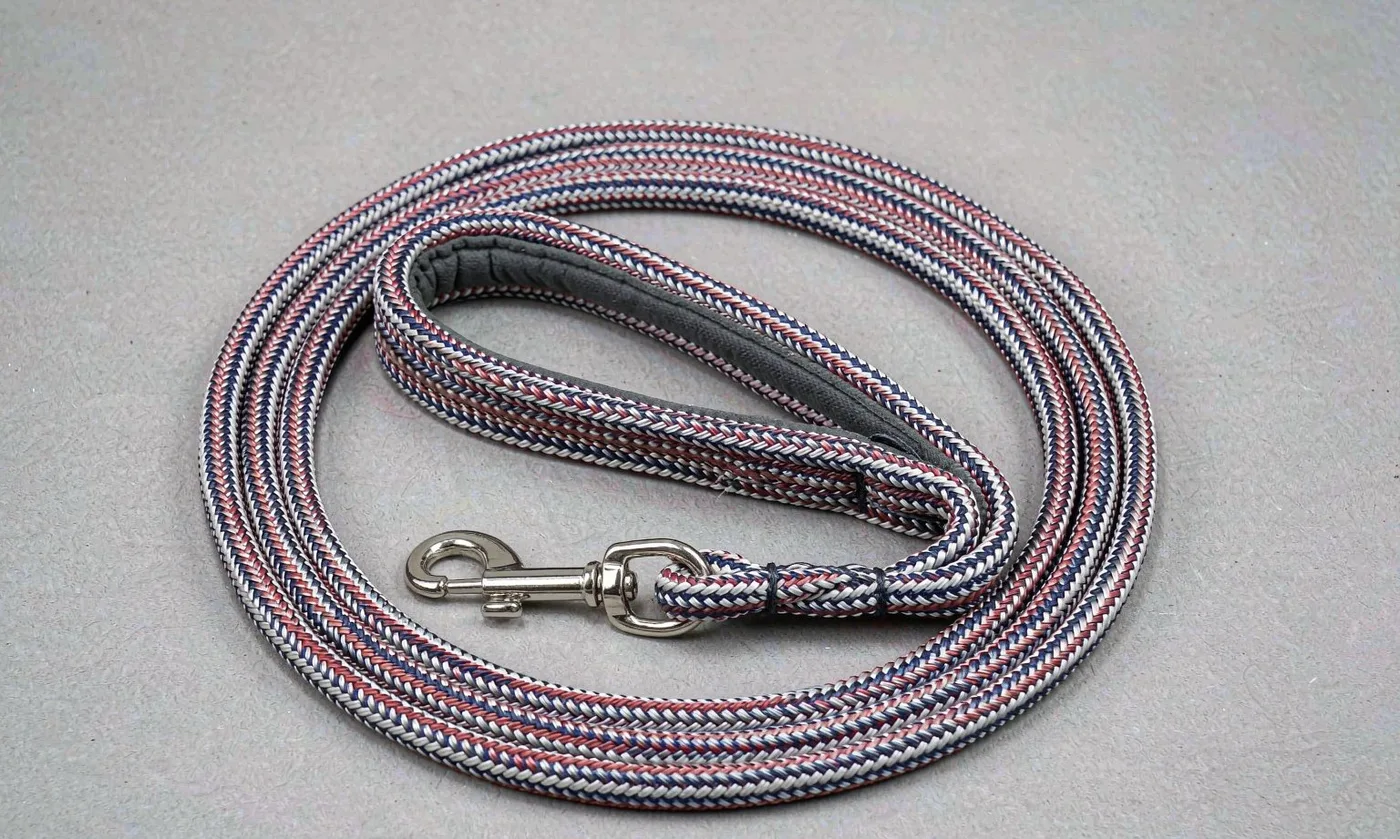
Rope is the product. Unlike a webbing lead where tape is one input among several, here the rope defines handling, durability and price almost entirely, so it deserves the largest share of development attention. Three families dominate, and each produces a distinctly different feel in the hand.
Kernmantle construction — a load-bearing core inside a braided sleeve — is strongest and most predictable. It holds round under load, resists abrasion, and allows the sleeve to carry colour while the core carries strength. It is the right choice for larger breeds and for professional use where failure is not an option.
- Solid braid, 8 mm: light, supple, best for toy and small breeds, least expensive.
- Solid braid, 10 mm: the volume sweet spot for medium breeds and most retail capsules.
- Kernmantle, 12 mm: premium feel, high break load, standard for large-breed programmes.
- Two-tone braid: visible colour play at no cost premium where both yarns are stocked.
The termination where rope meets hardware is where quality actually shows. A whipped binding using heavy bonded thread, covered by a heat-shrink sleeve, is the standard professional finish; it protects the cut end and signals care. Cheaper programmes simply melt the end, which works but looks exactly like what it is.
Diameter interacts with length in ways worth modelling before costing. Most slip leads run 1.2 to 1.5 m, and moving from 10 mm to 12 mm at that length adds meaningful weight and material cost. If your range targets smaller breeds, resist the temptation to over-specify; heavier rope reads as clumsy rather than reassuring on a five kilogram dog.
Ask for a wash and abrasion test on the finished rope rather than the yarn alone. Braid structure determines how much grit a lead retains and how quickly it stiffens, and those two properties drive both review scores and repeat purchase in every market we supply. Specify a minimum wash-cycle expectation now so later claims can be measured against something. Agreed targets also make supplier conversations faster, because both sides are comparing numbers rather than opinions. And remember that shipping legibility belongs on the card too: both body-weight guidance and breed guidance help, because owners rarely know their dog's neck measurement but always know its breed.
Stoppers and rings: two parts carrying the whole decision
If rope is the product, the stopper is the mechanism. It determines whether the collar portion can be adjusted, whether adjustment holds reliably, and how the whole item feels when used one-handed. There are three standard approaches, and selecting between them is largely a question of price architecture.
A simple leather or synthetic stopper is the classic solution: economical, quiet, and attractive when made from a contrasting material such as full-grain leather against a bright braid. Its weakness is drift — under repeated load the stopper can migrate slightly, so the fit changes subtly through the walk.
A metal stopper grips more firmly and reads considerably more expensive. It requires a specified finish and corrosion behaviour, and it adds both unit cost and compliance questions discussed in the next section. Programmes positioned at mid-to-premium retail almost always choose it.
| Specification | Entry | Mid | Premium |
|---|---|---|---|
| Rope | 8 mm solid braid | 10 mm solid braid | 12 mm kernmantle |
| Stopper | Synthetic slider | Leather wrap | Metal cam |
| Ring | Plated steel | Brass | Stainless steel |
| Braid colours | Single | Two-tone | Custom pattern |
| Retail band | 8-12 USD | 14-22 USD | 25-35 USD |
The ring deserves more thought than it usually receives. Its inside diameter governs how freely the rope travels, which is the entire operating principle of the product. Too tight and the lead binds; too loose and it rattles. Specify both outside and inside diameter, then test with the actual rope, because tolerance stacks between two suppliers are the common cause of inconsistent feel.
Finally, consider whether the programme needs a secondary safety element. Some brands add a small retaining loop that keeps the collar from loosening beyond a set point. It is not universal, but where it is used it becomes a genuine point of difference that customers understand immediately when demonstrated in store. It also photographs clearly, which matters because this is the kind of product people watch being demonstrated rather than read about. Where possible, include a small card diagram too, because retail staff learn faster from pictures than from a specification sheet.
Compliance documentation that metal choices trigger
The moment a metal component enters a pet product, documentation follows. This is not bureaucracy for its own sake — it is how a retailer protects itself, and programmes that arrive with a complete documentation set clear vendor onboarding in days rather than weeks. Plan for it during sampling, not after the purchase order.
For the United States, the regulatory baseline for children's products is often used as a reference even where the legal classification differs, because buyers are familiar with it. The Consumer Product Safety Commission publishes the testing and certification expectations, and laboratories work to standard methods issued by ASTM International.
California adds a separate layer that applies to essentially every product sold there. Any listed substance above a threshold requires a warning unless the seller can demonstrate exposure below it, and the responsible state authority is the Office of Environmental Health Hazard Assessment. In practice most buyers simply request a documented assessment and move on.
- Metal component declarations: base alloy, plating composition and total lead content.
- Coating assessment: especially for coloured or rubberised finishes.
- Textile declaration: fibre content plus any finish applied to the rope.
- Country of origin marking: required on both product label and retail packaging in most markets.
European buyers will ask about chemical restrictions on substances in articles, and the Scottish facility check introduced earlier means the same input may require two different declarations depending on destination. Ask us to build one combined documentation pack covering all target markets rather than separate sets requested piecemeal.
The commercial benefit of doing this once is significant. Documentation prepared for the first capsule usually remains valid for subsequent runs using identical components, so reorders and seasonal recolours inherit the whole file at no additional cost or delay. Programmes that prepare documentation early rarely find compliance blocking a shipment later. That is the pragmatic reason to front-load it, quite apart from any regulatory obligation. It also protects you if a component supplier changes: with declarations on file, a substitution is visible rather than silent. Most of the cost here is discipline rather than money, which is why even small programmes can support a professional documentation set from the first season.
Colour capsules rather than endless colourways
Slip leads reward a capsule strategy more than any other product in the range. Because the item is small, inexpensive and given as a gift frequently, customers buy several at once, and that behaviour should shape how you plan colour rather than following it reluctantly.
A capsule is a set of four to six colours released together, sharing one rope construction and one hardware finish, and merchandised as a family rather than as separate SKUs. Six colours presented as a capsule outsell six unrelated colourways presented individually, because the set reads as intentional and encourages multiple purchases.
Within a capsule, deliberately mix risk levels. Two core neutrals carry steady volume, two seasonal colours create display interest, and one or two experimental tones test what your audience actually wants. Sales data from the experimental positions then informs next season's core promotions.
Two-tone braid is the most efficient way to expand perceived variety without multiplying inventory. Twisting two stocked yarns produces a third visual option at almost no incremental cost, and it photographs far better than solid colour under retail lighting.
Packaging should reinforce the capsule logic. A shared belly band with the capsule name, a numbered sequence, or a simple collect-them-all message turns individual purchases into a set-building habit. This works particularly well for brands selling through independent pet shops where staff can talk about the collection.
Plan capsules a season ahead rather than reacting to sales. Lead times reward decision discipline: confirming next season's colours at the same time as this season's bulk means nothing is rushed, and archive specifications can be reused immediately. Seasonal capsules also structure your own marketing calendar, giving the team something new to photograph and post at predictable intervals. Predictability is underrated: content teams plan months ahead, and a known capsule rhythm fits their calendar. When launch dates slip, content quality suffers first and sales follow shortly afterwards.
Cost structure, MOQ planning and the calendar
The economics of a slip lead are unusually transparent, which makes it a good training ground for understanding how costing works across the rest of a range. Four cost drivers — rope, stopper, ring and labour — account for almost everything, and each can be modelled quickly once you understand their behaviour.
Rope cost scales with diameter and length and typically represents the largest share of material spend. Stopper and ring costs are fixed per unit regardless of length, so they dominate percentage terms on short leads and recede on longer ones. Labour is modest because the operation count is genuinely small.
| Driver | Behaviour | Levers | Typical impact |
|---|---|---|---|
| Rope | Linear with length | Diameter, braid type | 0.9-2.4 USD |
| Stopper | Fixed per unit | Material, finish | 0.15-1.30 USD |
| Ring | Fixed per unit | Alloy, plating | 0.10-0.85 USD |
| Labour | Fixed per unit | Termination method | 0.35-0.90 USD |
| Packaging | Fixed per unit | Belly band, card | 0.12-0.60 USD |
MOQ is 500 pieces per colourway, which most brands split across a capsule rather than repeat per colour. Two approaches work well. Either launch four colours at roughly 125 units each, accepting slightly higher unit cost, or launch two colours at 250 and expand the capsule once the first sells.
The calendar is short compared with the rest of a range. Sampling takes 6-10 working days, bulk takes 35-50 days after approval, inspection runs to AQL 2.5 before loading, and terms are T/T 30/70 against FOB Xiamen. Because the item is compact, air freight becomes economically plausible for urgent capsules in a way it never is for bulkier goods.
Plan reorders against the core neutrals only. Seasonal experimental colours should be treated as a single purchase with no automatic repeat, which keeps working capital available for the pieces that genuinely turn. Over time, this discipline produces a smaller catalogue with a considerably healthier cash position.
Impulse fixtures and partnership programmes
Where a slip lead is displayed determines how well it sells, and this product has more placement options than almost anything else in a pet range. Small, low-priced, immediately understandable, and genuinely giftable — it works at the counter as well as on the wall.
Counter units are the classic impulse placement. A compact display holding twenty units next to the till converts browsers who came in for something else entirely, and it works particularly well for independents where the staff can describe the product in ten seconds.
- Hook cards: the default wall placement; keep the hanging hole position consistent across the capsule.
- Counter caddies: highest impulse conversion, best for seasonal colours.
- Gift bundles: lead plus treat pouch, boxed or banded, for holiday periods.
- Shelter partnerships: donation-based programmes that build genuine local brand loyalty.
Shelter and rescue partnerships deserve particular attention because they produce unusual goodwill for very little cost. Supplying a capsule in a neutral colour with your logo costs less than most advertising, gets your product into thousands of hands, and generates return on investment that paid advertising rarely matches. Pair the gift with a short sales script so staff can explain it in seconds.
Ask about donation pricing on capsule runs.
Whatever the placement, one instructional line matters more than the rest of the card: how to fit the collar portion correctly. Misuse is the main source of dissatisfaction in this category, and a well-drawn diagram on the back of the card prevents it more effectively than any other investment.
Finally, plan the photographic asset at the same time. Because the product is visually simple, one strong image showing the lead in use — correctly fitted — will carry your entire online listing, and it costs less to produce than most lifestyle photography. Fit accuracy in that image prevents returns more cheaply than any wording adjustment. Show the collar portion high on the neck, the stopper clearly visible, and enough slack that nothing looks restrictive.
Using a simple SKU to anchor the launch calendar
Because slip leads are quick to sample and cheap to make, they are the best tool a brand has for testing ideas that later apply across the whole range. A capsule can be designed, sampled and shipped while a harness programme is still in development, which means market feedback arrives months earlier.
Use that speed deliberately. Launch a capsule six to eight weeks ahead of a seasonal range and treat it as reconnaissance: which colours sell through fastest, which price points move without discounting, which packaging language customers respond to. Those answers then inform decisions on far more expensive tooling.
Collaboration editions work particularly well in this format. An artist pattern, a charity colourway or a retailer-exclusive braid can be produced at capsule scale without committing the rest of the range, and the scarcity genuinely supports limited-release pricing.
There is a training benefit too. Staff understand simple products quickly, and a new collection is far easier to sell if retail teams have handled it themselves for a few weeks before the larger launch arrives. Several of our strongest programmes schedule capsules precisely for that reason.
Consider a two-wave structure for every season. Wave one is the capsule, small and seasonal. Wave two is the core range, timed to land while the capsule has already generated attention and footfall. The rhythm keeps shelves changing without overwhelming either your team or your working capital.
Finally, archive everything. Keep the approved rope lot, stopper reference, ring drawing and artwork file together under one capsule code so that a successful collector pattern can be reproduced next year without redeveloping anything at all. Treat the archive as a brand asset in its own right, alongside the photography and copy. Version control matters too: label each archive entry with the capsule season so nobody redevelops something already built.
Production capability
- SGS-verified production space of 4,950 m², 149 machines, 7 assembly lines
- Pet carrier and pet bag output since 2014 from a 137-person team
- 200,000 units shipped monthly under BSCI and ISO 9001 systems
People Also Ask
Why do brands include a slip lead in a training range?
Because it uses very few components, carries low return risk and supports either sharp pricing or healthy margin, while still telling a full brand story through braid, colour and hardware finish.
What length should a slip lead be?
Most programmes spec 1.2 to 1.5 metres, which gives enough lead length for walking while keeping the collar portion manageable. Longer versions suit larger breeds and open-space work.
How many colours should a first capsule include?
Four to six. Two neutrals carry steady volume, two seasonal tones create display interest and one or two experiments reveal what your audience genuinely wants next season.
Is a leather stopper better than metal?
Leather is quieter, cheaper and attractive against bright braid but drifts slightly under load. Metal grips more firmly and reads more expensive, though it adds finish and documentation considerations.
What makes a slip lead look premium?
Clean terminations, consistent braid tension and careful ring sizing. Buyers read those three signals closely because the product is otherwise visually simple.
Can we create a private label capsule without supplier branding?
Yes. Braid colour, stopper material, ring finish, labels, belly band and barcodes are all produced under your identity with no reference to the production base.
Frequently Asked Questions
What is the minimum order for custom slip leads?
MOQ is 500 pieces per colourway. Because the rope base is shared, two colourways at 250 units each can be produced with a modest unit-cost premium, which suits brands testing a capsule. Volume committed across the whole programme matters more than volume in any single colour.
Which rope diameter should we specify?
Use 8 mm for toy and small breeds, 10 mm for medium dogs and 12 mm for large breeds. Kernmantle construction is recommended above about 25 kilograms body weight for predictable strength.
How long does a slip lead sample take?
6-10 working days including the rope strike-off and one hardware sample. If you request a custom-plated stopper rather than a stock finish, allow an extra week for component supply.
What stopper materials are available?
Synthetic sliders, leather wraps and adjustable metal cams are the three standard families. Choice is primarily a price-positioning decision, followed by the compliance documentation each material triggers.
Can we use two-colour braided rope?
Yes, and it is one of the most cost-efficient upgrades available. Twisting two stocked yarns creates a third visual option with almost no incremental material cost.
What compliance documents can you supply?
Metal alloy and plating declarations, coating assessments, textile content declarations and origin marking. We can assemble one combined pack covering US, California and EU requirements for the initial shipment.
Is air freight realistic for this product?
Yes. Slip leads are compact and light relative to value, so air freight is often viable for urgent capsules where it would be uneconomic for larger sewn goods.
What inspection standard applies?
Inspection runs to AQL 2.5 on finished cartons. Critical defects such as rope splitting or damaged terminations are zero-tolerance and reworked before loading.
Can the capsule include gift packaging?
Yes. Belly bands, printed boxes and bundled sets are all available; artwork must be finalised roughly eight weeks before shipment to avoid costly hand-applied labelling.
Do you support shelter and rescue programmes?
Yes. Donation pricing is available on capsule runs, and we can supply neutral colourways with your logo for onward distribution or resale through partner organisations.
What are the payment and shipping terms?
Standard terms are T/T 30 deposit and 70 balance before shipment, quoted FOB Xiamen. Lighter shipments can be consolidated with other items from your range to share freight.
Can reorders match the original capsule exactly?
Yes. Rope lots, hardware references and artwork are archived, so repeat capsules are produced without re-sampling and ship on the same specification.
How should we price across the tier ladder?
Set prices across the ladder rather than applying a uniform margin. Entry tiers recruit customers while premium tiers carry the margin, and a mixed ladder usually outperforms either extreme.
Talk to QUANZHOU JUNYUAN BAGS about a pet carrier program: MOQ 500 pieces per colourway, samples in 6-10 working days, bulk production in 35-50 days under AQL 2.5 inspection.
Get a free quote Request a sample