Eco Line Pet Carriers: Sustainable Material Planning
An eco line is defined by documented material choices rather than by a green colourway, and it can be produced at MOQ 500 pieces per colourway with samples in 6-10 working days and bulk in 35-50 days. A credible first eco capsule uses two certified substrates, one recycled shell and one natural lining.
Executive summary
Sustainability in a pet carrier programme is a documentation discipline before it is a material choice. The line has to prove three things: what the material is, where that claim comes from, and how long the product will last. Products that answer those three questions can state a claim confidently; products that cannot should stay silent, because unsubstantiated environmental marketing is the fastest route to a costly correction.
Programme terms match the rest of the range: MOQ 500 pieces per colourway, samples in 6-10 working days, bulk in 35-50 days, inspection at AQL 2.5, T/T 30/70 and FOB Xiamen. Our production team sources certified substrates through partner facilities and holds the transaction certificates for each production run.
- Durability is the strongest sustainability argument: a carrier that lasts five years outperforms a biodegradable one that lasts one.
- Recycled content, natural fibre content and chemical safety are three separate claims needing three separate documents.
- Choose two certified substrates for a first eco capsule rather than five unverified ones.
Custom pet carrier programmes run at MOQ 500 pieces per colourway, with samples in 6-10 working days and bulk production in 35-50 days under AQL 2.5 inspection.
What an eco line has to prove before it can say anything
An environmental claim is a factual statement about a product, and it carries the same obligations as any other product claim. Before a hangtag says recycled, organic or low impact, three questions need documented answers: what proportion of the material carries the claim, which standard or certificate supports it, and which parts of the finished product are excluded. Answering those three honestly usually produces a shorter claim than the marketing team drafts first, and a much safer one.
The structure of the product matters here. A carrier is an assembly: shell fabric, lining, mesh, webbing, foam, board, hardware, zipper and thread. A recycled shell does not make a recycled carrier. Stating recycled shell fabric with conventional trim is accurate; stating recycled carrier is not. The most credible eco lines specify which components carry the claim and state the percentage.
Percentages need a defined denominator. Recycled content can be calculated by weight of the fabric, by weight of the whole product, or by the shell fabric alone, and those three numbers can differ by half. Choosing the calculation method deliberately, stating it on the label, and using the same method across the line prevents the accidental inconsistency that regulators and retailers look for first.
Chemical safety is a separate claim from recycled or natural content and is frequently confused with it. A natural fibre can be finished with substances that fail a restricted substance list; a recycled fibre can be perfectly clean. European regulators publish guidance on chemical restrictions through the European Chemicals Agency, and textile safety certification such as OEKO-TEX addresses the finished article rather than the fibre.
The last thing to establish is the product's expected life. A carrier used weekly for five years displaces more environmental cost through longevity than any material substitution can save. Recording the durability specification, and testing to it, converts a marketing statement into a defensible one and gives the eco line its strongest argument.
There is also a question of audience. A retailer's compliance team, a marketplace reviewer and an end customer read the same claim differently: the first wants a certificate number, the second wants a percentage, the third wants one sentence. Writing three versions of the same claim, at three levels of detail, satisfies all of them without overstating anything.
Finally, decide who holds the evidence. Certificates have scope and expiry dates, and a certificate issued for a fabric lot is only valid for that lot. Keeping a certificate folder per production run, aligned to the materials actually used, is what allows a claim to survive a retailer's audit two years later.
Choosing the material mix: recycled, natural and low-impact
Eco lines generally build from three families. Recycled synthetics, principally recycled polyester from bottle flake, deliver performance close to virgin material and are the easiest substitution to make without redesign. Natural fibres, including organic cotton, hemp and bamboo-derived cellulosics, deliver a different story and a different hand. Low-impact process choices, such as dope dyeing or water-reduced finishing, reduce footprint without changing the material at all.
The practical approach is to assign each family to the component where it performs best. Recycled polyester suits the shell, where abrasion and water resistance matter. Natural fibres suit linings and comfort surfaces, where the hand is felt. Process choices suit the whole product, because they apply at the mill rather than at the panel. Assigning by function avoids the common error of putting a beautiful low-abrasion natural fabric on a high-wear zone.
| Substrate | Primary claim | Hand feel | Abrasion | Cost index | Documentation | Best position |
|---|---|---|---|---|---|---|
| Recycled polyester (rPET) | Recycled content | Close to virgin | High | 105-125 | Transaction certificate per lot | Shell, webbing |
| Organic cotton canvas | Organic fibre content | Dry, natural | Moderate | 120-160 | Fibre certificate plus scope | Shell, lining |
| Hemp blend canvas | Low-input natural fibre | Textured, crisp | High | 130-180 | Fibre declaration | Shell, base panel |
| Bamboo-derived cellulosic | Renewable source | Soft, cool | Low to moderate | 140-190 | Process and safety certification | Lining, pad cover |
| Recycled nylon | Recycled content, high strength | Smooth, technical | Very high | 150-200 | Transaction certificate per lot | High-wear zones |
| Dope-dyed polyester | Reduced water and energy | Standard | High | 110-130 | Mill process statement | Any polyester component |
Two certified substrates is the right size for a first capsule. It keeps documentation manageable, keeps the range coherent, and gives the brand two clear sentences to say. Five substrates with five different certificates usually produces a confused message and an unmanageable audit trail.
Availability and minimum quantity differ by substrate. Certified natural fibres frequently carry higher fabric minimums and longer lead times than conventional equivalents, which affects the 6-10 working day sampling window. Confirming availability before the design is frozen is the single step that prevents an eco line from stalling at sampling.
Sampling strategy should differ for a first eco capsule. Building one reference sample in each shortlisted substrate, rather than three samples in the favourite one, lets the brand compare hand feel, drape and shade side by side before committing. That comparison costs a few extra days inside the sampling window and prevents the most expensive kind of change, which is a material switch after bulk has started.
Finally, match the substrate to the customer's actual use. A carrier used for air travel, wet walks and airport floors needs abrasion resistance and cleanability above all. Specifying a delicate natural fabric for that use produces a product that looks right in the studio and fails in the field, which is the worst possible outcome for a sustainability claim.
Certification and documentation for a credible eco claim
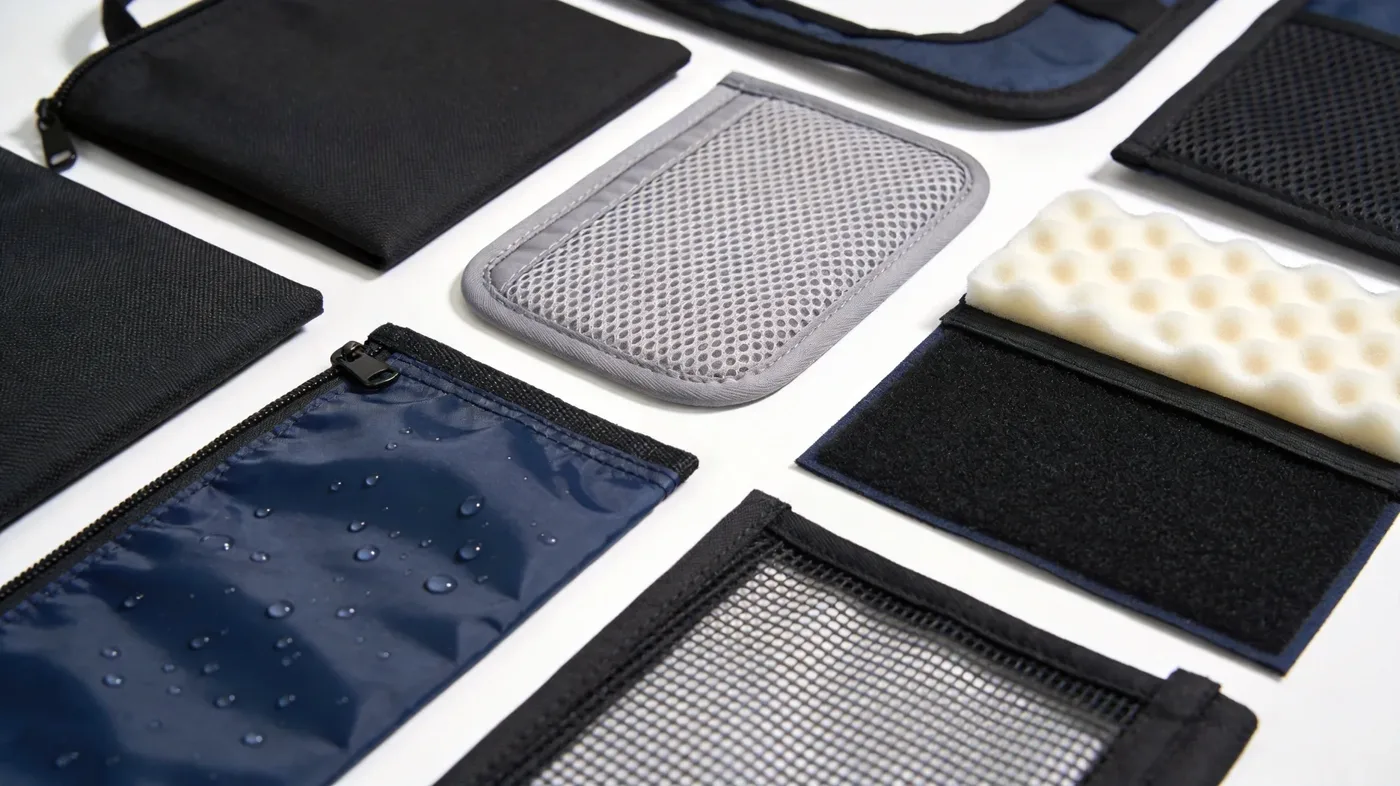
Certification in this category falls into three groups, and a credible programme usually needs documents from more than one. Fibre or content certification establishes what the material is. Process or chemical certification establishes how it was finished. Social and quality certification establishes where and how it was assembled. None of the three substitutes for another.
Content certification is the one most brands know. For recycled polyester it typically takes the form of a transaction certificate tied to a specific fabric lot; for organic fibres it takes the form of a fibre certificate with a defined scope. Both have expiry and both have to be requested at the time of the order rather than retrofitted afterwards, which is why documentation planning belongs in the tech pack stage.
Chemical and process certification covers the finished article. Textile safety standards test the article as sold, which is the only way to know whether the dyes, coatings and finishes are acceptable. Independent verification through a laboratory such as SGS produces a report a retailer can file, and our production team requests those reports against the specific material set rather than against a generic reference.
Social and quality systems complete the picture for brands selling into regulated retail. Partner facilities operate under BSCI social compliance and ISO 9001 quality management, which supports statements about how the product was made. These claims should be stated precisely, for what is audited, and not extended to cover anything that is not.
The discipline is to treat each document as a claim with a boundary. A certificate covers a material, a lot, a supplier and a period. Marketing language written inside those boundaries is safe; language written outside them is not. Reviewing copy against certificates before print is the cheapest risk control available.
Supplier scope is a frequent gap. A certificate held by a fabric mill covers the fabric; it does not cover the finished product assembled from that fabric plus ten other components. Where a brand needs article-level assurance, the testing has to be commissioned on the finished article, and that decision should be made before bulk rather than after a challenge.
Retention matters as much as collection. Keeping the certificate set with the tech pack, the inspection report and the signed reference sample means any future question is a lookup. Brands that do this well can answer a retailer's questionnaire in an afternoon instead of reopening a two-year-old supply chain.
Designing for durability: the strongest sustainability argument
The largest environmental lever in a soft goods programme is service life. A carrier that survives five years of weekly use displaces four purchases; a carrier that fails in eighteen months adds three. That arithmetic usually outweighs any material substitution, which is why durability specification belongs at the centre of an eco line rather than at the edge.
Durability is designed in specific places. Reinforced strap attachment, a base that resists sagging, mesh that resists claw abrasion, a zipper chain that survives thousands of cycles and seam construction that holds under load are the five items that determine whether a carrier is kept or replaced. Each has a testable specification and each should appear in the tech pack with a target.
Repairability is the second lever. A product designed so a zipper can be replaced, a strap can be restitched and a pad cover can be washed separately stays in service longer and generates goodwill. Designing for repair costs little, mostly requiring accessible construction and a decision to avoid fully sealed assemblies.
Cleanability extends life as well. A carrier that can be cleaned thoroughly is a carrier that gets kept; one that harbours odour gets replaced. Specifying a lining and a pad cover that tolerate the recommended cleaning method, and stating that method clearly, prevents the slow loss of products to a problem that was never a safety issue.
Timelessness is the last lever and the one designers control most directly. A neutral palette and a restrained silhouette stay acceptable for years; a strongly seasonal colourway dates within a season. Eco lines benefit from a palette that will still look intentional in five years, which is also the palette that makes re-orders economical.
Spare parts extend service life in the same way repairability does. Holding a small quantity of zippers, buckles and strap webbing at the time of the bulk order allows a worn component to be replaced years later instead of the whole product, and the holding cost is trivial against the goodwill it generates.
Finally, say it. A hangtag line stating the expected service life, the repairability of the product and the care method converts durability from an internal engineering goal into a communicated value. Very few pet brands do this, and it is the most credible sustainability message available.

Packaging, labelling and end-of-life communication
Packaging is the first place a customer judges whether an eco claim is sincere. A product made from certified materials and shipped in a glossy laminated box with a plastic sleeve sends a contradictory message that customers read immediately. Aligning the packaging with the claim is a small design task with an outsized credibility effect.
The practical sequence is to reduce first, then substitute. Removing an outer carton, eliminating a polybag or consolidating two cards into one reduces material before any substitution decision is made, and reduction is the easiest claim to substantiate. Substituting recycled or paper-based materials comes second, because those carry their own certificates and their own cost.
Labelling carries the substance. Fibre content, care symbols, origin and the specific environmental claim should appear on a permanent label rather than only on a removable hangtag, because the label survives the life of the product. The claim wording should match the certificate scope exactly, including the percentage and the component it refers to.
End-of-life communication should be honest about local reality. Saying a product is recyclable in a market without collection infrastructure for it is a claim that will eventually be challenged. A safer statement describes what the product is made of, how to care for it, how to repair it and where to return it if the brand operates a take-back scheme.
Transport packaging deserves the same attention as retail packaging. Master carton quantity, void fill and pallet efficiency affect the footprint of getting the product to market, and they are usually decided by the logistics team rather than by the design team. Bringing them into the eco conversation is a cheap improvement that most brands never make.
Ink and adhesive choices are a small detail that auditors notice. A claim about materials sits awkwardly beside a hangtag printed with solvent-based inks on a laminated board. Specifying water-based inks, uncoated recycled board and a simple construction keeps the printed matter consistent with the product it describes.
Finally, prepare the answer to the obvious question. Customers will ask what happens when the product wears out. Having a considered position, whether it is a take-back scheme, a repair service or simply honest care guidance, is the difference between an eco line and eco packaging on a conventional line.
Cost, MOQ and lead-time reality for eco materials
Certified materials cost more, and the premium is not uniform. Recycled polyester typically carries a modest uplift over virgin, while certified organic cotton and hemp can carry a significantly larger one, and low-volume speciality cellulosics more again. Budgeting a single sustainability multiplier across the line produces an inaccurate cost model, so each substrate should be costed separately.
Minimum quantities are the second reality. Certified fabrics often carry mill minimums well above the 500-piece garment equivalent, and a small brand can find that the fabric minimum, not the product MOQ, sets the order size. Confirming fabric availability and minimum before design freeze is the step that prevents a costly redesign.
Lead time follows availability. If the certified fabric is not held in stock, the sampling window of 6-10 working days starts only once material arrives, and bulk production of 35-50 days is measured from approval. Eco programmes therefore need a longer planning horizon than conventional ones, not because production is slower but because sourcing is.
Certification itself has a cost and a schedule. Transaction certificates, laboratory testing and scope checks each carry fees and each takes time. Including them in the development budget rather than treating them as an afterthought avoids the situation where a product is ready and its documentation is not.
There is a pricing upside. A substantiated eco line can carry a retail premium, typically 15-35% over a conventional equivalent, and it opens channels that screen for documentation. The premium is available to brands with certificates and unavailable to brands with adjectives, which is the commercial case for doing the paperwork first.
Scale changes the economics. A certification fee or a laboratory test is largely fixed, so it represents a much larger share of cost on a 500-piece run than on a 5,000-piece one. Brands planning to grow an eco line should cost the first run and the third run separately, because the second number is materially better.
The final cost consideration is inventory risk. Certified materials are harder to re-source quickly, so a re-order is slower and a stockout lasts longer. Holding material for a re-order at the time of the first buy is usually the right decision for an eco line, even though it ties up working capital.
Building the eco line into the wider range architecture
An eco line should be a tier in the range, not a separate brand with a separate language. Customers who buy the eco piece and the conventional piece should recognise both as coming from the same design hand. Sharing the silhouette language, the hardware family and the mark application keeps the eco tier inside the brand while letting the material tell its own story.
Sizing the tier is the second decision. Two to four pieces is usually right: one hero that carries the story, one volume piece that carries the units, and optionally one accessory that gives a low-commitment entry. More pieces than that spread the certification budget and complicate the message without adding much commercial return.
Colour strategy should differ from the conventional range in a deliberate way. Eco palettes built from undyed, natural and low-saturation tones communicate the material honestly and reduce dye load. Where a strong colour is wanted, checking that it is achievable on the chosen substrate with acceptable fastness prevents the common problem of a muddy result on a natural fibre.
The relationship with the conventional range needs a defined rule. If the eco piece is better in every respect, the conventional range loses; if it is worse in every respect, the eco piece looks like a compromise. The cleanest structure is equivalence in function and difference in material story, with the eco tier priced above and positioned as a considered choice.
Measurement closes the loop. Tracking sell-through, return rate and the questions customers ask about the eco pieces tells a brand whether the tier is being bought for the material or for the design. Both are valid, but they imply different next seasons, and knowing which is happening is worth more than any certificate.
Internal education is an underrated part of launching the tier. Sales staff, retail partners and customer service all need one accurate sentence about what the eco piece is and is not. A single-page brief circulated before launch prevents the improvised claims that create the most risk.
Over time, the most successful programmes migrate what they learn upward. A recycled shell proven on the eco line becomes the default shell on the core range two seasons later. That migration, rather than the existence of a separate tier, is usually where the real environmental improvement happens.
The four documents an eco line should hold per production run
Four documents per run: the fibre or recycled content certificate with lot reference, the chemical safety report for the finished article, the inspection report at AQL 2.5, and the signed reference sample. Together they substantiate every claim an eco line needs to make and answer most retailer questionnaires without further work.
Order and quality terms
- MOQ 500 pieces per colourway; samples in 6-10 working days
- Bulk production 35-50 days after approval; AQL 2.5 inspection standard
- T/T 30/70 terms, FOB Xiamen, full document set per shipment
People Also Ask
What makes a product line sustainable?
Documented material content, verified chemical safety, a durability specification that extends service life, and packaging and labelling aligned with the claim.
Are recycled materials better for the environment?
They reduce demand for virgin feedstock and are the easiest high-performance substitution, but the larger lever is usually how long the finished product lasts.
How do I avoid greenwashing in product marketing?
State only documented facts, name the component and percentage, keep certificate scope in view and never let a material claim imply a whole-product claim.
What certification should sustainable bags have?
Content certification for the fibre or recycled input, chemical safety testing for the finished article, and audited social and quality systems for assembly.
Do sustainable materials cost more?
Yes, with a wide spread. Recycled polyester carries a modest uplift; certified natural fibres carry more; speciality cellulosics more again.
Can a small brand launch an eco line?
Yes at MOQ 500 pieces per colourway, provided the line concentrates on two certified substrates rather than many unverified ones.
What is the most sustainable bag material?
The one that survives the intended use for the longest. Service life usually dominates material choice in the environmental arithmetic.
Frequently Asked Questions
What is the MOQ for an eco line pet carrier?
MOQ is 500 pieces per colourway. Note that certified fabrics can carry their own mill minimums, so fabric availability should be confirmed before design freeze.
Can a carrier be described as fully recycled?
Rarely. A carrier is an assembly of shell, lining, mesh, webbing, foam, board, hardware and thread. The accurate claim names the component and the percentage.
Which certification do we need for recycled polyester?
A transaction certificate tied to the specific fabric lot, held with the production record. Request it at order stage rather than after production.
Is organic fibre automatically safer chemically?
No. Natural content and chemical safety are separate claims. The finished article should be tested for restricted substances regardless of fibre origin.
How much more do certified materials cost?
Recycled polyester typically carries a modest uplift, while certified organic cotton and hemp carry a larger one. Each substrate should be costed separately rather than using one multiplier.
How long does an eco programme take?
Sampling takes 6-10 working days once material is available and bulk takes 35-50 days. Sourcing certified fabric can add weeks before either clock starts.
Should eco packaging be recycled or reduced?
Reduce first, then substitute. Removing a layer is cheaper and easier to substantiate than replacing it with a certified alternative.
Can we put the environmental claim on a hangtag only?
It is better on a permanent label, because the label survives the life of the product and the claim should remain verifiable after purchase.
What inspection standard applies to eco runs?
AQL 2.5 final inspection, the same as any other run, with the report retained alongside the material certificates.
How do we avoid greenwashing accusations?
State only what is documented, name the component and percentage, match the certificate scope exactly, and review marketing copy against certificates before print.
Is durability part of a sustainability claim?
Yes, and it is usually the strongest part. A carrier that lasts five years displaces more environmental cost than most material substitutions save.
Can eco treatments migrate into the core range?
Yes. Proving a recycled shell or low-impact dye on the eco line, then adopting it as the core default two seasons later, is where most real improvement happens.
How should an eco piece be priced?
A retail premium of 15-35% over a conventional equivalent is commonly achievable, but it depends on holding the documentation that supports the claim.
Talk to QUANZHOU JUNYUAN BAGS about a pet carrier program: MOQ 500 pieces per colourway, samples in 6-10 working days, bulk production in 35-50 days under AQL 2.5 inspection.
Get a free quote Request a sample