Tote Shape Pet Carrier: Handbag Style Programmes
A tote shape pet carrier is an open-top, flat-bottomed carrier with two parallel handles, typically 38-46 cm wide with a 22-28 cm handle drop and a 6-8 kg rating. It needs a framed base and reinforced handle runs rather than a complex shell, and at MOQ 500 it costs roughly USD 6.80-11.40 per unit - the lowest structural cost of any carry form in this series.
The tote is the cheapest shape to make and the easiest to make badly, because it has almost no structure to hide behind. A backpack can carry a mediocre shell on the strength of its harness; a tote is just a box, a base and two handles, and every weakness is visible the moment it is picked up. That simplicity is also the opportunity: the tote gives a brand the largest uninterrupted print area in the category, the fastest development route, and a silhouette that customers already understand from fashion. Programmes that win with totes win on material, print and handle comfort rather than on engineering - which is a different budget allocation, and a much faster one.
- Sampling: pattern with a loaded handle and base test in 6-10 working days.
- Minimums: MOQ 500 pieces per colourway; canvas and webbing sourced to one specification per colour.
- Schedule: bulk runs 35-50 days from approved sample, the shortest cycle in the carry-form range.
- Quality: handle anchorage, base board fit, print adhesion and seam burst inspected to AQL 2.5.
- Terms: T/T 30/70, FOB Xiamen, units nested flat where the base board allows.
Bespoke pet carrier development runs 6-10 working days to a first sample and 35-50 days to bulk after approval, both measured from a confirmed tech pack.
The four signals that make a carrier read as a tote
A tote is defined by absence: no lid, no shoulder strap, no shaped panels. What remains is a set of proportions customers recognise instantly, and they are worth specifying rather than assuming.
The first signal is the flat, wide base. A tote stands on its own footprint and the base is visibly wider than it is deep. In practice that means a width to depth ratio of roughly 2:1 or greater; a squarer footprint reads as a box and loses the fashion reference entirely.
The second is vertical sides. Totes do not taper, or they taper very slightly outward toward the top. Any inward taper reads as a bucket, and any significant outward flare reads as a shopping bag. Sides within three degrees of vertical is the working rule.
The third is two parallel handles set close to the sides. Not one, not four, and not a single centred arch. Handle placement at roughly 15-20 percent in from each side is what customers read as tote rather than as basket.
The fourth is proportion: a tote is usually wider than it is tall. Height at about 0.75-0.95 of width keeps the fashion reading; above that it becomes a shopper, which is a different - and less premium - reference.
Those four signals cost nothing to respect and they are the whole reason a tote sells at a higher price than a generic open carrier. When a tote programme fails, it is usually because one of them was compromised for interior volume.
One more absence is worth noting: the tote has no obvious front. Both large faces are identical, which is a merchandising problem and a branding opportunity, and it is the reason print placement deserves its own section below.
That absence of a front also affects how the product is made. With two identical large faces, any construction detail that breaks symmetry - a pocket, a seam, a label - immediately establishes a front whether the designer intended one or not. Decide deliberately which element does that job, because whichever it is will be the side customers photograph and the side retailers face outward on a shelf.
Structure without a frame: making a soft box stand up
An unlined tote is a sack. Making it stand requires three interventions, and choosing between them sets both cost and how the product behaves in a customer's home.
The base board is the primary one. A removable framed panel, 5-8 mm, cut to the footprint and held in a sleeve, gives the unit a flat floor for the pet and a flat base for the product. It is the same component used across the shaped families in this series, and it is the single most important structural element here, because without it the base becomes a curve and the pet braces continuously.
The second intervention is side and base stiffening. A bonded interlining on the side panels, or a narrow perimeter stay at the base seam, keeps the walls from bowing outward under load. Bowing is the visible quality signal on a tote: two carriers side by side, one with straight walls and one bulging, and the difference reads as a price difference whether or not it is one.
The third is the handle run. Tote handles should continue down the side of the body as a webbing run rather than stopping at the top seam. A continuous run distributes load into the shell instead of concentrating it at two points, and it is the cheapest structural improvement in the entire specification - one extra bar-tack per handle end and about 20 cm of webbing each.
| Structure level | Cost add at 500 (USD) | Stands unloaded | Best channel |
|---|---|---|---|
| Base board only | 0.75 - 1.20 | Partially | Value, ecommerce |
| Board plus bonded sides | 1.40 - 2.10 | Yes | Pet retail |
| Full perimeter stiffening | 2.20 - 3.30 | Yes, rigidly | Fashion and department |
| Removable liner insert | 2.80 - 4.10 | Yes, washable | Premium, gifting |
There is one decision that changes how the product ships: a removable base board allows flat packing. For ecommerce-led programmes that is worth real money in freight, and it is why the value row above is not as much of a compromise as it looks.
Finally, consider a removable liner. It converts a wash problem into a washable part, it adds perceived value disproportionate to its cost, and it is the feature most often mentioned positively in tote reviews.
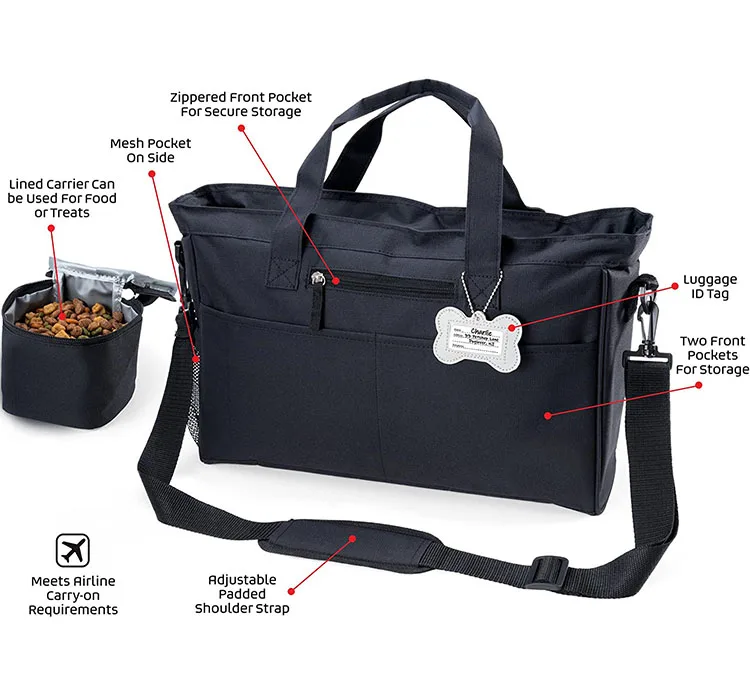
Handle drop: the comfort arithmetic nobody publishes
Handle drop - the distance from the top edge of the body to the underside of the handle at its highest point - is the specification that decides whether a tote is comfortable, and it is almost never discussed because it looks like a style decision.
Three carrying positions matter. Hand-carried at the side, the drop needs to clear the knuckles with the arm straight: about 18-24 cm for most adults. Carried in the crook of the elbow, it needs 25-32 cm. Carried on the shoulder, which customers attempt with totes constantly whether or not the design intends it, it needs 40 cm or more - and a tote that cannot be shoulder-carried will be criticised for exactly that by people who never read the product description.
The commercial answer for a pet tote is a drop of 22-28 cm. It suits hand and elbow carry, it keeps the unit stable and close to the body, and it discourages shoulder carry, which is the position where an open-top pet carrier is least secure.
Handle width is the second half of the comfort equation. A flat webbing handle of 20-25 mm carries comfortably at 6 kg; below 15 mm it cuts into the hand. Padded or wrapped handles feel better and look more premium, and on a tote they are visible from every angle, which is why they are worth the additional cost here more than on any other carry form.
Handle material should relate to the body. Webbing reads technical, self-fabric reads fashion, and wrapped cord reads premium. Mixing a technical webbing handle with a canvas body is the most common styling error in this shape - it makes a fashion product look like a piece of equipment.
Attachment deserves a specific note. Handles should be bar-tacked through a reinforcement patch that extends at least 40 mm below the top edge, because the failure mode is not the webbing breaking but the fabric tearing away from it under a moving animal.
Open top: closure strategy and containment
An open top is the defining feature of the shape and the defining risk of the product. Customers buy a tote because it is open and easy; they return it if the pet can leave it.
Four closure strategies exist, and they sit at very different points on the convenience and security axes. A full top zip gives security and destroys the tote reading - it makes the product a box with handles. A partial zip across the centre leaves the ends open, which is worse than either extreme because it promises containment it does not deliver.
A magnetic or snap closure at the centre of the top edge is the most common compromise. It keeps the silhouette, it allows one handed opening, and it reduces accidental escape. It does not prevent a determined animal from climbing, which is why it must be paired with an interior tether.
A roll-down or fold-over top is the strongest solution that still reads as a tote, because a folded top edge is a recognised tote convention. It adds a little height and a little cost and it gives genuine containment, which makes it the right choice for programmes where the pet is large relative to the opening.
The tether is non-negotiable regardless of closure. An interior clip anchored to a structural point - not to a lining seam - is what makes an open carrier defensible, and it should be specified and tested at rating like any other safety component.
Height relative to the pet is the design variable that makes all of this easier. A tote tall enough that the pet cannot reach the top edge with its forepaws while standing solves most escape problems structurally, and since the tote is already the widest shape in the range, adding 3-5 cm of height is usually cheaper than engineering a closure.
Finally, state the limitation honestly in copy. An open-top carrier is for settled, trained animals, and saying so protects the brand better than any closure.
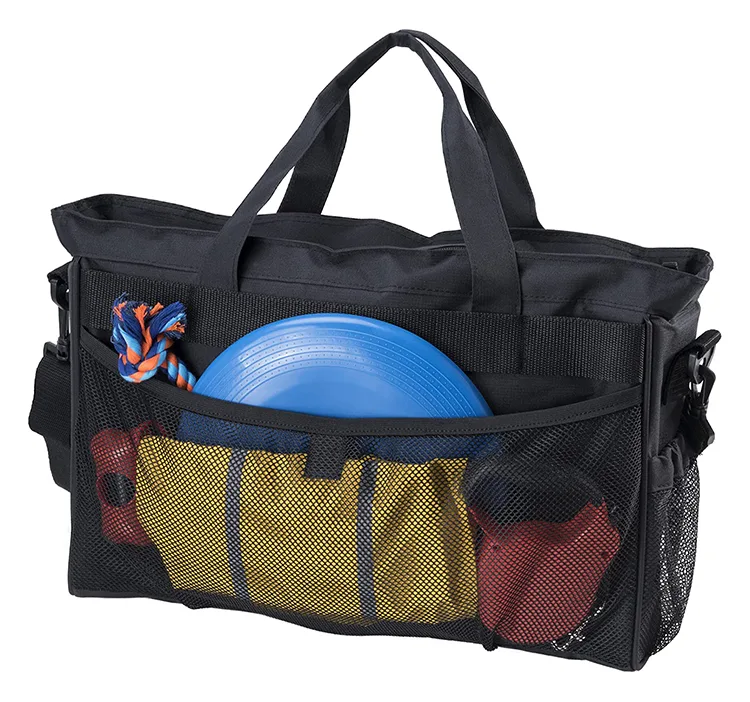
The largest print canvas in the category
A tote's two large flat faces are the biggest uninterrupted branding surface of any carry form, and they are flat, which means every print and embellishment technique is available without the registration problems that shaped panels create.
That abundance is also a trap. Large flat areas invite large graphics, and large graphics date quickly and fight the retail environment. The most durable tote programmes treat the face as a poster - one dominant element, generous negative space, and a restrained palette - rather than as a billboard.
Technique selection should follow positioning. Screen printing is the default for canvas and gives a saturated, durable result at low unit cost at volume, with a per-colour plate charge that makes single-colour artwork the economic choice. Heat transfer suits photographic and gradient artwork and is the right answer for short-run seasonal designs, because it avoids plates entirely.
Embroidery reads premium and is the default for fashion-led totes, but it stiffens the panel and on a tote that stiffness is actually welcome - it helps the wall stand. It is also the most expensive per unit and the slowest to sample.
Woven labels and small rubber patches work best placed low and to one side on the face, or on the handle run, where they read as a fashion label rather than as a logo slap. Placement low and off-centre is consistently more premium-looking than centred, and it leaves the upper face free for the graphic.
Colour control should be specified against Pantone references with an approved strike-off, and durability against recognised AATCC fastness procedures, because a printed tote face rubs against clothing, car seats and shop fittings constantly and a print that transfers is a product that gets returned.
One practical note: print both faces or neither. A single-sided tote looks unfinished and, because the shape has no defined front, customers will present the blank side in photographs.
Interior organisation in an open box
The interior of a tote is a rectangular volume with an open top, which sounds easy to plan and is not - because everything inside is visible from above and everything that is not secured moves.
Start with the floor. A framed board with a wipe-clean surface, covered by a removable washable pad, is the standard. The pad should be attached with a simple fixing so it does not bunch, and it should be dark, because an open top means the floor is the surface customers see most.
Pockets are the organisational tool and they are underused. Two slip pockets on one end wall and one on the other hold a lead, waste bags and a phone without intruding on the pet's space. On a tote they are especially valuable because there is no lid to hold anything - a point worth remembering when comparing this shape with the duffle silhouette, which solves the same problem with end compartments.
Tether anchorage should be on the end wall rather than the centre of the floor, so the clip does not sit under the animal. It should run to a structural webbing point, and it should be tested at rating.
Wall height and lining colour do the rest. A dark lining hides wear and makes the interior recede visually, which matters more on an open top than anywhere else. A light lining shows every mark within a week and looks old by the second month.
Finally, consider a partial top panel - a mesh or fabric panel covering part of the opening. It reduces the visual exposure that makes open carriers look unfinished in photographs, it gives shade, and it costs one panel.
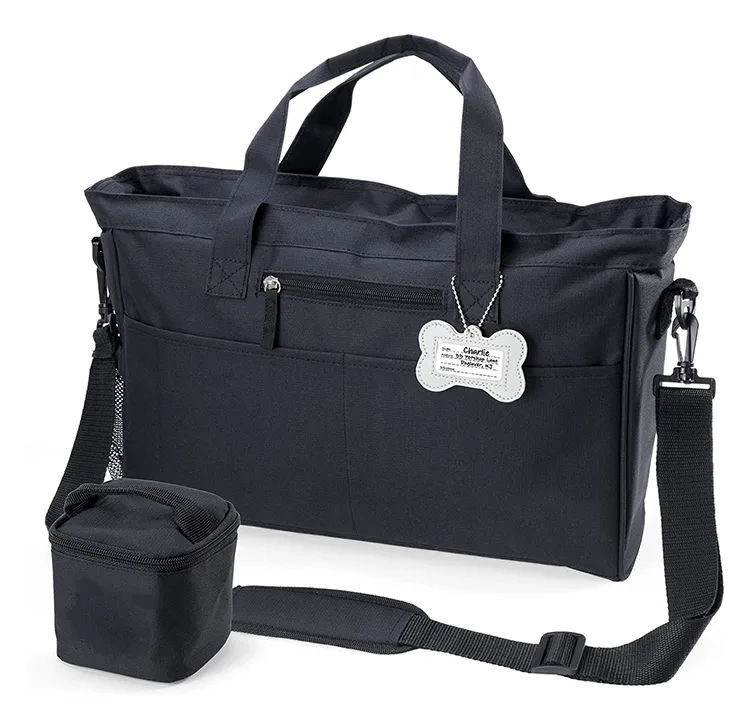
Canvas, coated cotton and recycled content
Material carries the tote's positioning more than any other element, because with so little structure the fabric is the product. Three families dominate, and each implies a different retail price.
Cotton canvas, 10-16 oz, is the default. It prints beautifully, it reads honest and natural, and it suits the fashion reference perfectly. It absorbs water, it stains, and it softens with use - which customers either love or dislike, and which should be matched to the brand's voice rather than treated as a defect.
Coated or waxed canvas solves the water and stain problem and adds a premium hand-feel. It costs more, it creases in a way that is either character or damage depending on the finish, and it is the right choice for a tote positioned above mid-market.
Polyester canvas or a recycled polyester equivalent gives consistent colour, better abrasion resistance and lower cost, and it is the practical answer for programmes that need colour accuracy across many colourways. Recycled content is now a routine retail requirement rather than a differentiator, and it should be declared with documentation rather than implied.
Weight matters structurally as well as aesthetically. Below about 10 oz the walls will not stand even with interlining; above 18 oz the product becomes heavy and stiff and loses the softness that makes a tote appealing. The 12-14 oz band is where most successful programmes sit.
Substance declarations should be prepared regardless of material. Body-contact and pet-contact products attract retailer questionnaires, and certification through OEKO-TEX standards, held on file, converts a two-week account review into an administrative task.
Retail presence: shelf, hook and the flat-pack question
Totes merchandise well because they are familiar, and they merchandise badly for the same reason - a tote on a shelf competes with every fashion tote the customer has ever seen, and the pet function is not visible.
The remedy is to show the function in the presentation. A hangtag or a belly band carrying the size, weight rating and ventilation information answers the pet question at the shelf, while the product itself carries the fashion argument. Two jobs, two pieces of print, and neither should do the other's work.
Display format depends on structure. A tote with perimeter stiffening stands on a shelf and looks like a bag, which is the premium presentation. A tote with only a base board slumps slightly and is better hung by its handles, which is the value presentation. Both are legitimate; presenting a slumping unit on a shelf is not.
Flat packing is the ecommerce decision. A removable base board allows the unit to ship flat, which cuts freight substantially and is the main reason value totes are competitive online. If flat packing is chosen, the base board must be re-insertable without instructions - a sleeve with an obvious opening and a board with a rounded leading corner.
Photography should include one shot with the top open and the interior visible, because the open top is both the selling feature and the customer's main question. One shot showing a pet settling in is worth more than three studio silhouettes.
Finally, consider nesting sets. Totes nest naturally, and a three-size set merchandised as a family is one of the few genuinely strong gift propositions in this category - it also happens to be the cheapest set to produce, since all three share one construction.
Building a tote family and the second-season plan
Because a tote has so few structural parts, the family logic is unusually clean: hold the construction constant and vary size, fabric and print. That is a programme that can be run for years without new tooling.
Size first. Three sizes sharing a base board specification, a handle webbing and a pocket layout give a retailer a range and give the brand three price points. Grading a tote is simple - no motif to distort - but handle drop should be graded too, since a small tote with a large tote's drop looks wrong.
Fabric second. One construction in canvas and the same construction in recycled polyester gives two price tiers with no development cost, and it lets a brand serve both a natural and a technical positioning from one pattern set.
Print third, and this is where the range earns its keep. Because heat transfer needs no plates, seasonal and limited designs are cheap to produce at MOQ 500, and a tote programme can run four or five graphic drops a year on one construction. That cadence keeps the range current in a way that structured shapes cannot match.
The discipline is the same as elsewhere in this series: freeze the construction - base board, interlining, handle run and pocket layout - and let only fabric and print rotate. Programmes that do this reach their third season with a proven product; programmes that revise structure every launch spend their budget re-learning the same lessons.
Incoming lots are verified to AQL 2.5 against that frozen specification, with handle anchorage, base board fit and print adhesion as the three checks that predict field performance.
Order and quality terms
- MOQ 500 pieces per colourway; samples in 6-10 working days
- Bulk production 35-50 days after approval; AQL 2.5 inspection standard
- T/T 30/70 terms, FOB Xiamen, full document set per shipment
People Also Ask
Why does my tote bulge at the sides?
No bonded interlining and no perimeter stiffening. Bowing under load reads as a quality difference even when the product is structurally sound.
Can a tote be carried on the shoulder?
Only with a 40 cm or greater drop, which is unusual for a pet tote by design. A shorter drop keeps the unit stable and discourages the least secure carry position.
Is canvas or polyester better for a pet tote?
Canvas reads fashion and prints beautifully but stains; recycled polyester gives colour consistency and abrasion resistance at lower cost. Many programmes run both as two price tiers.
Should I add pockets inside?
Yes, two on one end wall and one on the other. An open top has nowhere else to put a lead or a phone, and pockets do not intrude on the pet's floor space.
Are nesting sets worth producing?
Yes. Totes nest naturally, three sizes share one construction, and a nested set is one of the strongest gift propositions available at this cost level.
How often can graphics rotate?
Four or five drops a year if heat transfer is used, because there are no plates. That cadence is the main competitive advantage of the tote over structured shapes.
Does a partial top panel help?
Yes. It reduces the unfinished look of an open top in photographs, gives shade, and costs one panel.
Frequently Asked Questions
How much does a tote pet carrier cost?
Roughly USD 6.80-11.40 per unit at MOQ 500 depending on material and structure level, moving toward USD 4.60-7.80 at 5,000 units. It is the lowest structural cost of any carry form.
What handle drop should I specify?
22-28 cm. It suits hand and elbow carry, keeps the unit stable and discourages shoulder carry, which is the least secure position for an open-top carrier.
How do I make a tote stand up?
A removable 5-8 mm framed base board, bonded interlining on the side panels, and handle webbing continued down the body as a reinforcing run.
Should a pet tote have a zip?
Not a full top zip - it destroys the shape's reading. A centre magnetic closure or a roll-down top gives containment while keeping the silhouette, and an interior tether is required either way.
What canvas weight is right?
12-14 oz is the working band. Below 10 oz the walls will not stand even with interlining; above 18 oz the product becomes heavy and stiff.
Can a tote ship flat?
Yes, if the base board is removable. Design the sleeve with an obvious opening and the board with a rounded leading corner so re-insertion needs no instructions.
Where should the logo go?
Low and off-centre on the face, or on the handle run. Centred logos look less premium and occupy the area the graphic should use.
Should both faces be printed?
Yes, or neither. A tote has no defined front, so a single-sided design means customers will photograph the blank side.
What size pet suits a tote?
6-8 kg in the standard size. The limiting factor is escape rather than strength, so wall height relative to the pet matters more than load rating.
How do I keep the interior clean?
A framed board with a wipe-clean surface plus a removable, dark-coloured washable pad fixed so it does not bunch.
Is recycled content expected?
It is now a routine retail requirement rather than a differentiator. Declare it with documentation rather than implying it.
What fails first on a tote?
Handle attachment tearing away from the body fabric, then wall bowing, then print abrasion. Reinforce handles at least 40 mm below the top edge.
How long does a tote programme take?
Samples with a loaded handle and base test in 6-10 working days, then 35-50 days bulk - the shortest cycle in the carry-form range.
Talk to QUANZHOU JUNYUAN BAGS about a pet carrier program: MOQ 500 pieces per colourway, samples in 6-10 working days, bulk production in 35-50 days under AQL 2.5 inspection.
Get a free quote Request a sample