Sling Pet Carrier: Crossbody Design Programmes
A sling or crossbody pet carrier is a single-strap carrier worn diagonally across the torso with the pet pouch resting at the hip or front, typically 30-40 cm wide and rated for 4-6 kg. It needs an anti-rotation strap system and a shaped body panel, and at MOQ 500 it costs roughly USD 7.20-12.10 per unit - cheaper than a backpack because there is only one strap, more expensive than a tote because the strap system is complex.
The crossbody sling is the most polarising carry form in the category: owners who like it use it constantly, and owners who dislike it never use it again. Almost every negative review traces to one cause - the pouch rotates around the body instead of staying where the wearer put it. That is a solvable engineering problem, not an inherent flaw, and solving it is the entire design brief. Brands that treat the sling as a fashion accessory with a strap attached produce the complaints; brands that treat it as a load-positioning problem produce a product that owners keep on the hook by the door and reach for every day.
- Sampling: pattern plus a loaded wear test for rotation in 6-10 working days.
- Minimums: MOQ 500 pieces per colourway; strap webbing and padded sleeve are the main shared components.
- Schedule: bulk runs 35-50 days from approved sample, with custom hardware the longest-lead item.
- Quality: strap anchorage, rotation behaviour, seam burst and zip function inspected to AQL 2.5.
- Terms: T/T 30/70, FOB Xiamen, strap packed coiled so the padding is not creased.
A custom pet travel bag has to reconcile two limits at once: the airline under-seat envelope and the ventilation the animal actually needs.
What a crossbody carrier is genuinely for
Being honest about the use case is the first and most valuable decision in a sling programme, because the shape is excellent at one thing and poor at several others. It is excellent for short trips with small animals: a vet visit, a café, a market, a train platform. It is poor for long walks, for large animals, and for any situation where the wearer needs both hands free for more than a few seconds.
Defining the use case sets the weight rating, and the weight rating sets everything else. A crossbody load is carried on one shoulder, which means the effective limit is set by wearer comfort rather than by material strength. In practice that lands at 4-6 kg total, and programmes that push beyond it generate the shoulder-pain reviews that give the whole category its reputation.
Size follows weight. A sling for a 4-6 kg animal has a usable floor of roughly 30-38 cm by 18-22 cm, which is materially smaller than a tote or a backpack and which is why the interior planning has to be precise rather than generous.
The buyer is different too. Sling buyers are disproportionately urban, walk more, use public transport, and care more about how the product looks on the body than about feature lists. That has a direct consequence for specification: strap comfort, body-hugging shape and material hand-feel matter more here, and pocket count matters less.
One more use case is worth designing for, because it is the reason many slings are bought: carrying a pet in a place where a carrier would not be allowed or would be awkward. A sling reads as a bag rather than as pet equipment, and that discretion is a selling point that should be protected by keeping the silhouette restrained.
Finally, decide front or hip carry. Front carry suits anxious animals and gives the wearer a hand on the pet; hip carry is more comfortable for longer periods and looks more like a bag. Most successful programmes make the strap adjustable enough to allow both, which is a strap-length decision rather than a body-shape one.
Rotation: the one problem that defines the shape
A strap crossing the torso at an angle, carrying a mass hanging at one point, will rotate. Gravity pulls the pouch to the lowest point available, which is usually behind the wearer's hip, and every step adds an impulse. Owners describe the result as "it keeps sliding round," and they are describing physics rather than a defect.
Three mechanisms control rotation, and they work best in combination. The first is strap friction: a wider strap with a higher-friction contact surface resists sliding across clothing. A 38-50 mm strap with a soft, slightly grippy underside performs markedly better than a narrow webbing strap, and it is also more comfortable, which makes it the cheapest double win in the specification.
The second is the stabiliser strap - a short secondary strap running from the pouch under the wearer's arm to the main strap. It converts the system from a pendulum into a triangle, and it is the single most effective anti-rotation component available. It costs perhaps forty cents and it is the difference between a product that works and one that is returned.
The third is body shape. A pouch that curves to match the torso contacts the body over a larger area, and that contact resists rotation. A flat pouch touches at one line and swings freely. The curved body panel is therefore an anti-rotation device as well as a comfort feature.
| Solution | Cost add at 500 (USD) | Rotation reduction | Comfort effect |
|---|---|---|---|
| Narrow webbing strap | baseline | None | Digs into shoulder |
| Wide padded strap | +0.90 - 1.50 | Moderate | Much better |
| Wide strap plus curved body | +1.60 - 2.40 | Good | Contacts torso |
| Full system with stabiliser | +2.10 - 3.20 | Excellent | Stays in place |
The stabiliser strap should be removable or at least adjustable, because not every body shape needs it and some wearers find it restrictive. Making it removable costs one buckle and removes the objection.
Testing rotation is straightforward: load to rating, wear for twenty minutes including a flight of stairs, and measure how far the pouch has travelled from its start position. Anything beyond about 40 mm of drift per twenty minutes will be noticed.
Strap specification: contact area and shoulder comfort
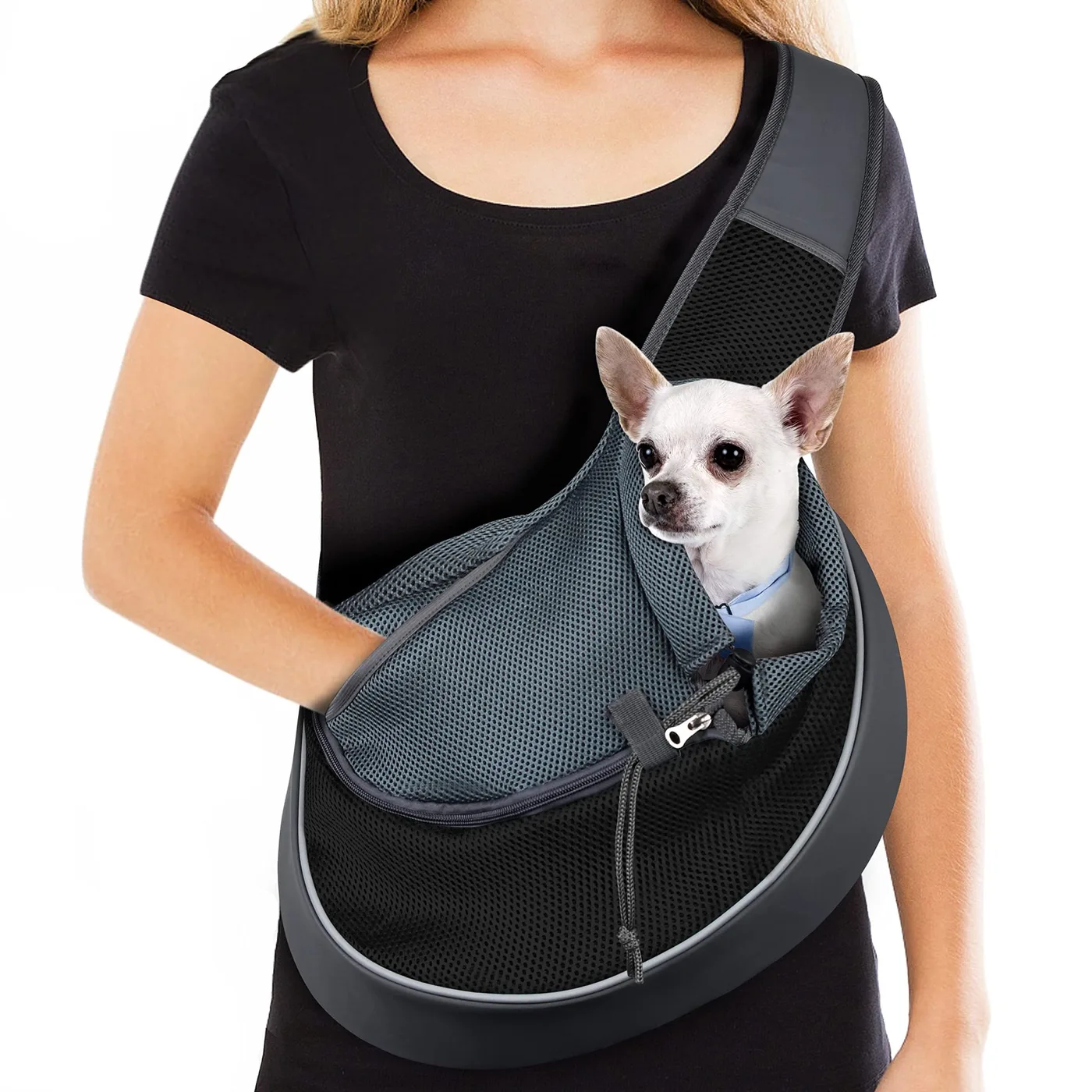
One shoulder carries everything on this shape, so the strap is the product. Three properties decide whether it works: width, padding and where the load line falls.
Width should be 38-50 mm for a 4-6 kg load. Below 38 mm the pressure per square centimetre becomes noticeable within fifteen minutes; above 50 mm the strap starts to interfere with the neck and with arm movement. Width is more effective than padding at this load, and it is cheaper, so it should be spent first.
Padding of 6-10 mm with a soft face layer completes the comfort work. The padding should be tapered at the ends where the strap crosses the collarbone and at the neck, because constant thickness at those points causes rubbing. A tapered pad costs the same as a constant one - it is a cutting decision, not a material one.
The load line is the property most often missed. The strap should sit on the top of the shoulder, not on the side of the neck, which means the padded section has to be positioned for the individual wearer or made long enough to allow adjustment. A sliding pad with a long adjustment range is the practical answer and costs nothing extra.
Adjustment range deserves a number: 300-400 mm of usable travel covers most adult torso sizes and both front and hip carry positions. A sling that cannot be adjusted across that range will fit one body type well and be reviewed badly by everyone else.
Attachment is the failure point. Like every carry form, the strap does not break - the fabric tears away from it. Bar-tacked reinforcement extending at least 50 mm into the body, plus a webbing loop rather than a direct stitch, is the minimum sensible specification, and it should be pull-tested at several times the rated load.
Finally, hardware. A single-handed adjuster is worth specifying, because a wearer with a pet in the pouch cannot use two hands to tighten a strap.
Body geometry: hugging the torso without crushing the pet
The pouch has to be curved to match a human torso and simultaneously be a comfortable space for an animal. Those two requirements pull against each other, and the resolution is a shaped panel with an internal floor.
The body-side panel should curve inward, with a radius roughly matching an adult torso - around 140-200 mm. That curve is what stops rotation and what makes the pouch feel like part of the wearer rather than a bag bumping against them. It is achieved with a shaped seam and a light interlining rather than with foam, which keeps weight down.
The floor is what protects the animal. A framed board, 4-6 mm, cut slightly smaller than the pouch footprint and held in a sleeve, gives a flat surface for the pet while the panel around it curves. This is the same principle used in the shaped families elsewhere in this series: interior flat, exterior shaped.
Depth is the dimension that needs discipline. A pouch deeper than about 20 cm pushes the pet away from the body and increases the lever arm on the shoulder; shallower than about 14 cm and a cat cannot settle. The 15-18 cm band is where the shape works.
Compression is the risk of a body-hugging design, and it should be tested rather than assumed. Load the pouch to rating, put it on, and check that the pet's space is not reduced - a simple test with a soft block of the rated dimensions reveals whether the curve is crushing the volume.
Openings should face away from the body. A top or outer-side opening lets the wearer look at the pet without rotating the pouch inward, which is the instinctive movement and the one that produces the least disturbance.
Ventilation on the body side is effectively nil, so the outer face and the top must carry the whole airflow requirement - 30-40 percent open area across those two surfaces, with the largest panel at the top where the pet's head is most likely to be.
Weight limits and the honest rating
Rating a sling generously is the fastest way to damage a brand in this category. The temptation is to match the rating of a tote or a backpack so the range looks consistent, but the physics is different and customers feel the difference within minutes.
One shoulder carries roughly a third of what two can carry comfortably over time. That is not a strength statement - it is about pressure on the trapezius and about the asymmetric load on the spine. A 6 kg animal on one shoulder for thirty minutes is uncomfortable for most adults; the same animal in a backpack is fine.
The practical commercial rating is therefore 4-6 kg, with the top of that band reserved for the largest size in a range. Anything above 6 kg should be directed to a backpack or a wheeled format, and saying so in the range architecture is better than selling a product that generates discomfort reviews.
Pet guidance supports the conservative approach. Veterinary bodies including the American Veterinary Medical Association publish general guidance on transporting small animals safely, and the consistent theme - secure containment, adequate ventilation, limited duration - aligns with a modest rating and a well-ventilated pouch rather than with maximum capacity.
Duration matters as much as weight. A sling is a short-duration format, and the product page should say so. Twenty to forty minutes is a reasonable honest statement, and it prevents the mismatch between expectation and use that drives most negative reviews.
Finally, publish the empty weight. On a one-shoulder product every hundred grams is felt, and a sling above about 1.1 kg empty is noticeably less pleasant than one at 0.8 kg - a difference customers describe even when they cannot explain it.
Entry, closure and one-handed operation
A sling is used in public, often while standing, often with the pet already in the wearer's arms. Every closure decision should be tested against that condition: can it be opened and closed with one hand while holding an animal?
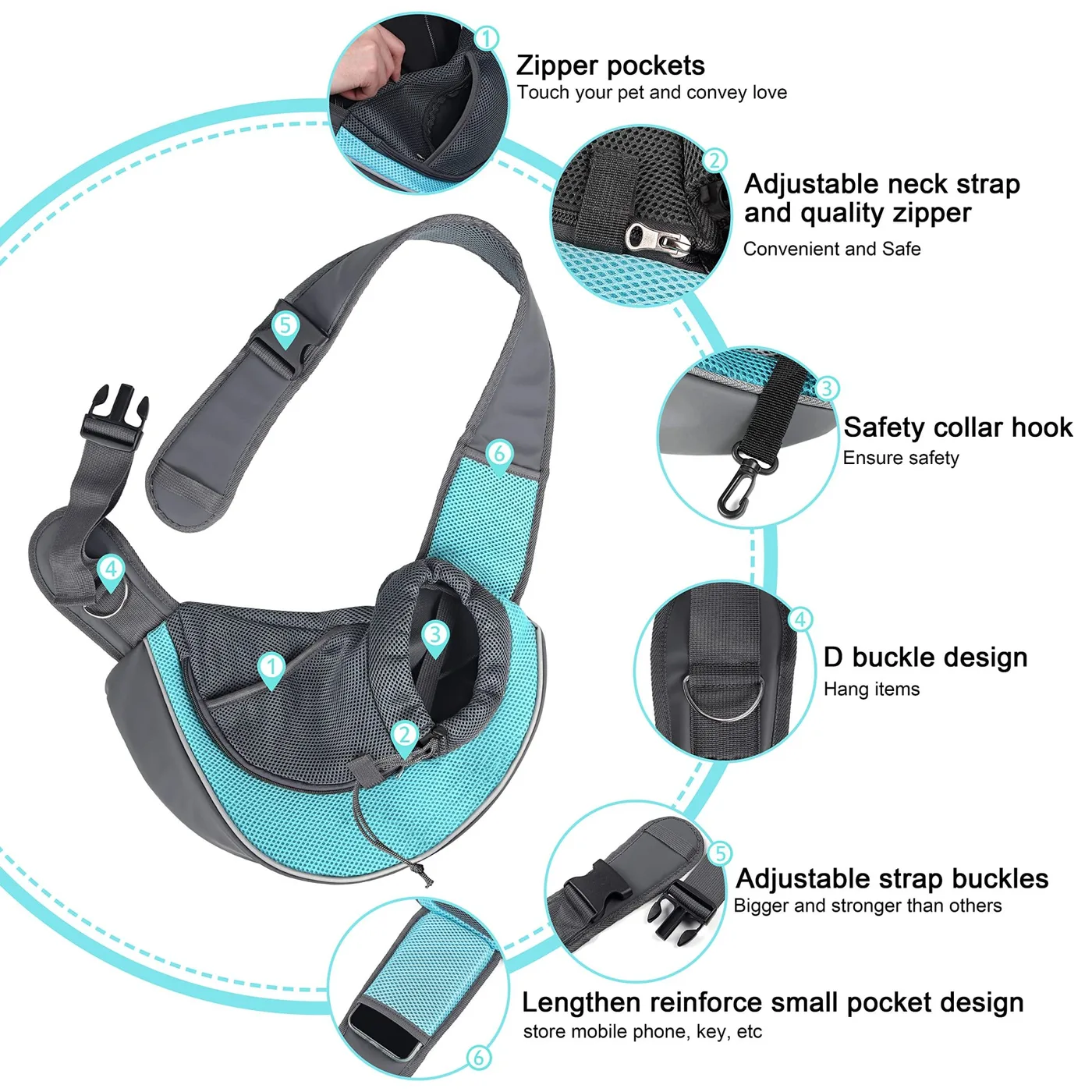
A top zip running along the outer edge is the most common and the most practical. It gives a wide opening for placing the pet in, it can be closed one-handed with a grab puller, and it keeps the body-side panel uninterrupted so the anti-rotation curve stays intact.
A magnetic flap closure reads more like a handbag and is genuinely faster, but it is weaker at containment and it should only be used together with an interior tether. On a body-worn product an escape attempt is a balance event, so containment matters more here than on a carried shape.
A drawstring top is the fastest to open and the least secure, and it also reduces the opening width at the moment it matters. It suits very small animals in a calm-use programme and little else.
The tether is required in every case and should be anchored to a structural webbing point on the outer side, so the clip is reachable without rotating the pouch. It should be tested at rating like any safety component.
Consider a partial mesh panel under the main opening. On a sling it does two jobs - it allows air without an escape route and it lets the pet see out, which is the difference between an animal that settles and one that works at the closure for the whole journey.
Finally, one small pocket on the outer face is worth including for a phone or a ticket. On a body-worn product there is no handbag to put things in, and the absence is felt immediately.
Branding on a small, curved, body-worn surface
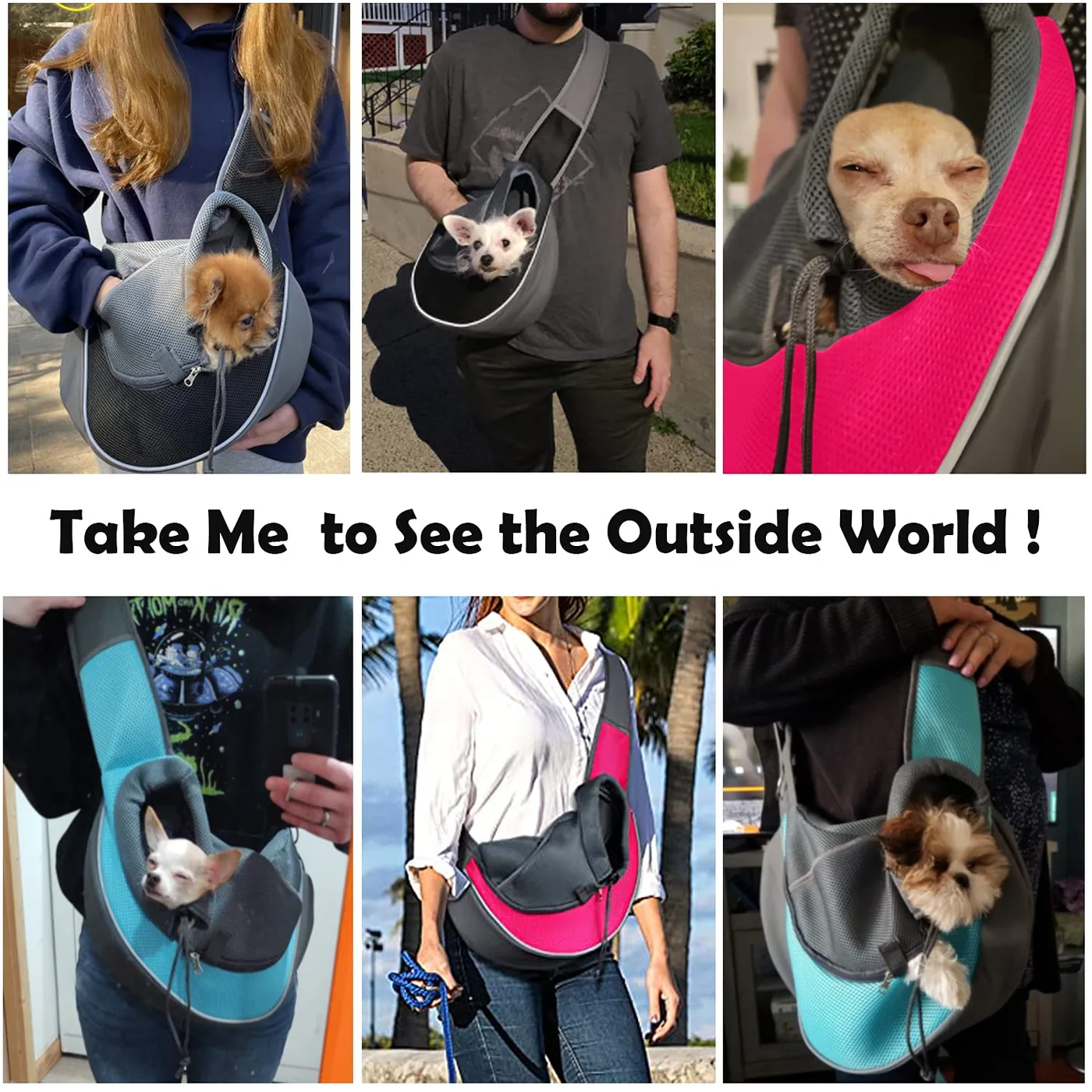
A sling offers the least brand real estate of any carry form - one visible outer face, part of it mesh, on a curved panel that is moving when it is worn. That constraint should change the branding strategy rather than frustrate it.
Think of the visible area as a badge rather than as a poster. A mark of 30-50 mm placed on the upper third of the outer face, away from mesh panels, reads at the distance a passer-by sees it and leaves the rest of the surface to material and shape. Large centred graphics on a sling look like a promotional bag.
Technique should suit a curved, flexible surface. Embroidery on a curved panel puckers unless stabilised, and the stabiliser adds stiffness that fights the body-hugging shape. Small woven labels, rubber or TPU patches, and heat-transfer marks all work better because they flex with the panel.
Placement also needs to survive the strap. In wear, the strap crosses part of the outer face, and a mark positioned under the strap line is permanently obscured. Mark the strap path on the pattern and place the brand clear of it - a check that takes two minutes and prevents the most common branding mistake on this shape.
Colour discipline helps. On a small product, three colours is the practical maximum: body, trim and one brand accent. More than that and a sling looks busy exactly where it needs to look calm enough to wear with anything.
Substance and colour documentation should be prepared as standard: references to Pantone standards for the trim, and content certification through OEKO-TEX for a product worn against clothing for an hour at a time.
Materials, lining and the wash question
A sling is worn against clothing and holds an animal against the body, which makes it the most demanding product in the range for material comfort and for cleanability.
Outer fabrics should be soft rather than technical. A brushed polyester or a cotton-rich blend feels better against the arm and reads less like equipment; a coated nylon is easier to clean but feels clinical and, on a body-worn product, feels warm. Most programmes land on a soft-shell woven with a light water-repellent finish, which is a reasonable compromise.
The body-side panel deserves separate specification. It is the surface pressed against the wearer for the whole journey, so it should be a smooth, low-friction fabric that does not grip clothing - a grippy back panel makes rotation worse by dragging, and it makes the wearer's shirt twist.
Lining should be dark, removable and washable. On a sling the lining is closer to the animal than in any other format, and it takes the majority of the soiling. A removable liner pad plus a wipe-clean floor panel is the minimum; a fully removable lining is better and adds perhaps a dollar.
Mesh specification matters more here than elsewhere because the top opening is the primary airflow path and it is also the surface customers touch. A soft, snag-resistant mesh with a fine weave reads as quality where a coarse one reads as laundry bag.
Care labelling should be explicit. Owners of small animals wash these products more often than any other carrier, and a "wipe clean only" instruction on a product that will inevitably be machine washed is a complaint waiting to happen. Either specify construction that survives washing or say clearly that it does not.
Range planning and the fit problem
Slings have a range-planning problem that other carry forms do not: they are worn on the body, so fit varies by wearer as well as by pet. A range that ignores body fit will fit one demographic well and review badly everywhere else.
The solution is adjustment rather than multiple sizes. One pouch size per pet-size class, with a long strap adjustment range and a sliding pad, covers most of the market at one SKU. Multiple strap lengths per pouch size is unnecessary complexity and fragments the MOQ.
Two pet sizes is the sensible range: a small for animals up to about 4 kg and a medium up to 6 kg. Both share the strap system, the hardware and the lining construction, so the second size costs only the pattern and the cutting die.
Directionality is worth considering. A reversible or ambidextrous design - wearable on either shoulder - doubles the addressable market for a small cost, and it is one of the few product decisions in this category that converts directly into sales rather than into satisfaction.
Colourways should be restrained and neutral at the top of the range. A body-worn product is judged against the wearer's wardrobe, so two neutrals and one seasonal accent per year is the workable rhythm at MOQ 500 per colourway.
Programmes operated under ISO 9001 frameworks keep the strap, hardware and body specification documented, which is what lets a second season reuse a proven construction instead of rediscovering it - and incoming production is verified to AQL 2.5 against the same document.
Why brands source here
- Pet carrier programs run since 2014; founding team in sewn goods since 2004
- SGS-verified production floor of 4,950 m² with 137 workers across 7 lines
- Monthly capacity of 200,000 units, audited to BSCI and ISO 9001
People Also Ask
Why does my sling keep sliding around my body?
Narrow strap, flat pouch and no stabiliser. Gravity moves the pouch to the lowest point; a curved body panel and a stabiliser strap convert the pendulum into a triangle.
Is a sling suitable for a long walk?
No. It is a short-duration format for small animals. Above twenty to forty minutes, or above 6 kg, a backpack or wheeled format is more comfortable.
Should I offer different strap lengths?
No. One pouch size per pet class with a long adjustment range and a sliding pad covers most of the market without fragmenting the MOQ.
Does padding or width matter more for comfort?
Width. It increases contact area and friction, which reduces both pressure and rotation, and it costs less than additional padding.
Can embroidery be used on a curved pouch?
Only with stabiliser, which adds stiffness and fights the body-hugging shape. Woven labels, rubber patches and heat transfer flex with the panel and work better.
Should the back panel be grippy or smooth?
Smooth. A grippy panel drags on clothing, which makes rotation worse and twists the wearer's shirt.
How many colourways should a sling range have?
Two neutrals and one seasonal accent per year. A body-worn product is judged against the wearer's wardrobe, so restraint sells better than variety.
Frequently Asked Questions
How much does a crossbody pet carrier cost?
Roughly USD 7.20-12.10 per unit at MOQ 500 depending on strap system and materials, moving toward USD 4.90-8.30 at 5,000 units.
What weight should a sling be rated for?
4-6 kg. One shoulder carries roughly a third of what two do comfortably, and slings are a short-duration format of about twenty to forty minutes.
How do I stop the pouch rotating?
Three mechanisms together: a wide high-friction strap, a removable stabiliser strap under the arm, and a body panel curved to match the torso.
How wide should the strap be?
38-50 mm for a 4-6 kg load. Width is more effective than padding at this weight and cheaper, so spend it first.
Should the stabiliser strap be removable?
Yes. Not every body shape needs it and some wearers find it restrictive. Removability costs one buckle and removes the objection.
How much strap adjustment is needed?
300-400 mm of usable travel, covering most adult torso sizes and both front and hip carry positions.
How deep should the pouch be?
15-18 cm. Deeper pushes the pet away from the body and increases the lever arm; shallower and a cat cannot settle.
Where should the opening be?
Top or outer side, facing away from the body. That lets the wearer check the pet without rotating the pouch inward.
Where should the logo go?
Upper third of the outer face, clear of the strap path and clear of mesh. Treat the area as a badge, 30-50 mm, not as a poster.
Can a sling be reversible?
Yes, and it is worth doing. Wearable on either shoulder doubles the addressable market for a small additional cost.
What lining is best?
Dark, removable and washable, over a wipe-clean floor panel. The lining takes most of the soiling on a body-worn product.
What fails first on a sling?
Strap attachment tearing from the body fabric, then zip separation under load, then lining wear. Reinforce the strap at least 50 mm into the body.
How long does development take?
Samples with a loaded rotation wear test in 6-10 working days, then 35-50 days bulk from approved sample.
Talk to QUANZHOU JUNYUAN BAGS about a pet carrier program: MOQ 500 pieces per colourway, samples in 6-10 working days, bulk production in 35-50 days under AQL 2.5 inspection.
Get a free quote Request a sample