Flat Pet Carrier: Low Profile Design Guide
A flat pet carrier with a low profile is built to a finished height of 20-26 cm instead of the usual 30-35 cm, which is what allows it to clear under-seat rails and stack three deep on a shelf. The trade is interior headroom: expect 15-25 percent less internal height and a unit cost index of 102-110.
Low profile is the shape that solves a clearance problem rather than a comfort problem, and it should be briefed that way. A flat shell earns its place by going where a taller bag cannot - under a seat, into a shallow shelf, three units deep in a stack - and it pays for it with interior headroom that has to be recovered through floor length and smarter openings. Brands that position the flat shape honestly as a travel and storage shape get repeat purchase; brands that sell it as a general-purpose bag get returns.
- Sampling: structural samples with the stiffened top panel and revised floor in 6-10 working days.
- Minimums: MOQ 500 units per colourway, rising to 800 where a moulded top frame is specified.
- Schedule: bulk production runs 35-50 days after sample approval, tooling included in that window.
- Quality: panel dome, zip path flatness and corner squareness are inspected to AQL 2.5.
- Terms: T/T 30/70, FOB Xiamen, with units nested or stacked as the carton plan allows, since nesting is what converts the shape into a freight saving.
- Design note: publish clear interior height rather than exterior height, because it is the figure that decides whether the product works.
Custom cat carrier shells come in soft, vacuum-formed and injection-moulded variants, and each one carries its own tooling and MOQ pool.
What low profile means in millimetres
Low profile is a height specification before it is a style. Standard soft carriers finish at 30-35 cm; a low-profile build finishes at 20-26 cm, and the commercially interesting zone is 22-24 cm. That band is low enough to clear the under-seat rail on most narrow-body aircraft and shallow enough to stack three deep on a 60 cm retail shelf, while still leaving enough interior height for a pet to sit without its back contacting the top panel.
Below 20 cm the shape stops being a carrier and becomes a mat. Interior height has to accommodate the pet's sitting height plus a clearance margin, and for most cats and small dogs that means a minimum of 17-19 cm of clear internal height after the top panel structure and any padding are accounted for. This is the number to design from, not the exterior height.
Recovering volume in a flat shell happens on the floor. Every centimetre of height removed has to be replaced by floor area, and the usual exchange rate is roughly 1 cm of height for 3-4 cm of combined length and width. That is why flat designs are visibly longer than tall designs of equivalent capacity, and why the floor panel becomes the dominant structural element.
The second consequence is the opening. A shallow height means the top aperture cannot be approached from above at a useful angle, so flat designs almost always use a long zip path that wraps the front and both ends, converting almost the entire upper third into a lid.
Third is compression. A flat shell has less vertical material to resist crushing, so anything placed on top of it - another unit in a stack, luggage in a boot - presses directly onto the pet space. Structure has to be designed against top load, which is a different load case from the side tension that taller bags are engineered for.
The measurement discipline that follows: specify interior height, not exterior height, and publish it. It is the dimension that determines whether the product works.
One more practical marker. A flat carrier that keeps its shape when empty and does not dome in the middle is the visible signal of a properly specified top panel - and it is the first thing a buyer tests by pressing a hand on the lid.
Flat as a design position
A low-profile horizontal shape reads as architectural, modern and restrained. It shares a visual vocabulary with laptops, slim luggage and flat-pack furniture: clean edges, long lines, minimal hardware. For a brand built around design literacy rather than pet-themed cuteness, flat is arguably the strongest silhouette available, because it borrows credibility from categories that are taken seriously.
The position works best when it is held consistently. A flat carrier with rounded novelty corners, cartoon graphics and chunky plastic hardware sends three contradictory signals at once. The disciplined version uses a single accent, a sans-serif wordmark, and hardware finished to match the body rather than contrast with it.
Colour strategy for flat shapes should exploit the broad lid plane, which is the surface seen from above in a photographed flat-lay and on a shelf viewed from a standing position. A two-tone treatment - body in the core neutral, lid panel in the seasonal accent - gives a range a recognisable identity without retooling anything.
There is a demographic argument too. Flat, minimal product language skews toward urban, design-conscious buyers who are more likely to buy online, more likely to photograph the product, and more likely to accept a premium for something that looks considered. For private label programmes targeting that customer, the shape is doing positioning work that advertising would otherwise have to pay for.
The risk is coldness. A completely flat, hard-edged object can feel clinical in a category where warmth matters. Mitigations are cheap: a soft-touch coating on the handle, a pale warm lining, a rounded corner radius of 30-40 mm rather than a hard right angle.
Flat shapes also travel well between channels. The same unit reads as premium in a boutique, technical in an outdoor catalogue and practical in a travel assortment, which makes it the safest shape for a brand that is still deciding which channel it belongs in.
Finally, flat is the easiest silhouette to extend. Because the pattern is essentially a shallow tray, the same tooling supports a range of sizes by changing length alone, which is the cheapest possible route to a three-size family.
Stiffening a shallow top panel
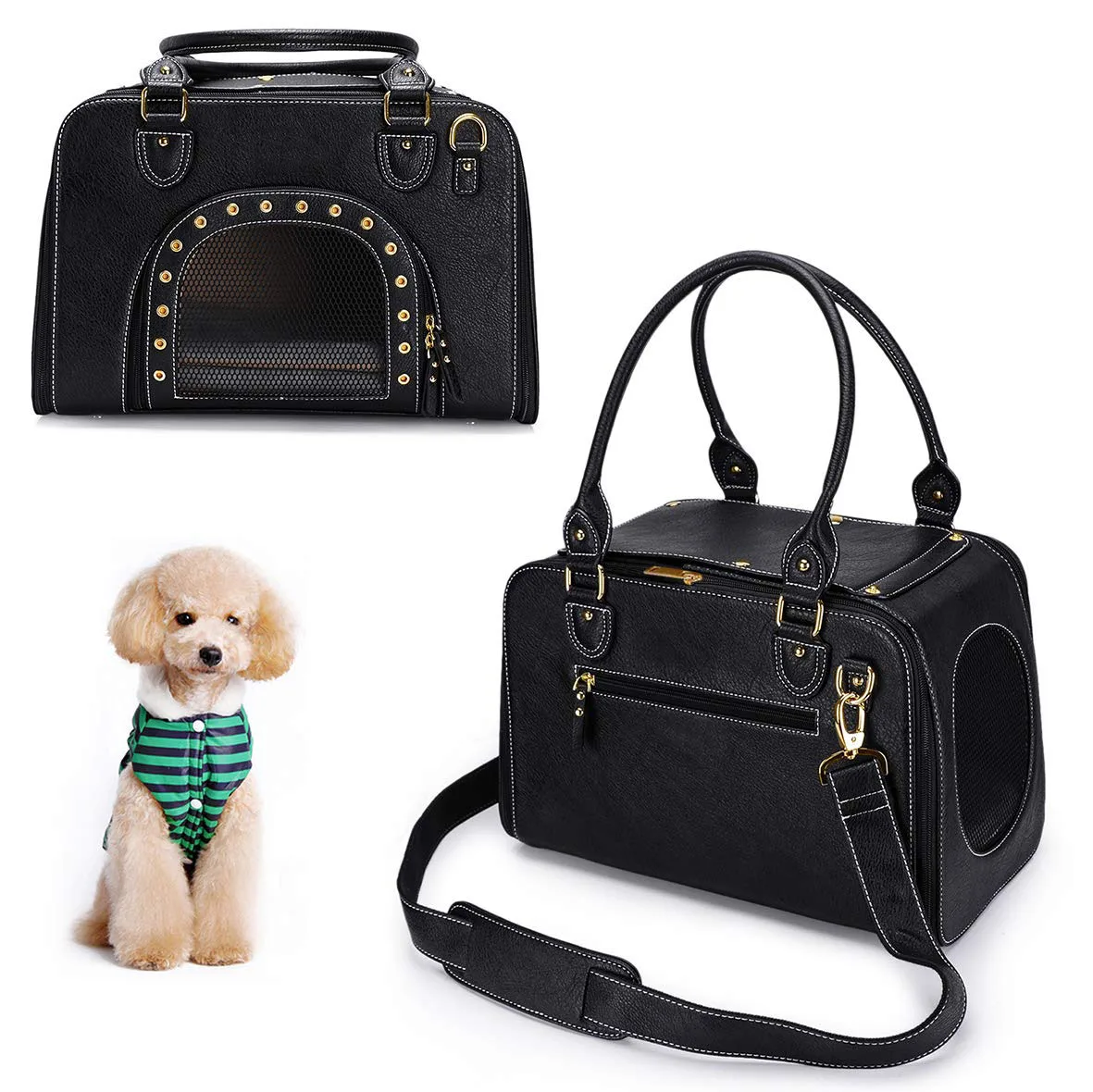
The top panel of a flat carrier carries loads that a taller bag never sees: stacking weight, luggage on top, and the compression of being carried under a seat. A shallow panel also has less natural curvature to resist doming, so it needs help. This is the single most important structural decision in a low-profile programme.
Three solutions cover most briefs. A laminated panel with 4-6 mm foam bonded to the underside of the cover fabric is the baseline and suits heights of 24-26 cm. An inserted board - 2-3 mm PP or a laminated paperboard cut to the lid - suits 20-24 cm and adds roughly USD 0.30-0.60 per unit. A moulded polymer or wire perimeter frame is used where the unit must survive stacking three high, and adds USD 1.20-2.40.
The failure to design against is doming: the lid rising in the centre by 8-15 mm after a season of use, which makes the product look tired and, worse, reduces the interior clearance the pet needs. Doming is usually a bonding problem rather than a thickness problem - adhesive that creeps under sustained load. Specifying a heat-activated adhesive film rather than a spray adhesive typically halves the permanent set.
Corner treatment matters because a shallow flat shape concentrates handling loads at the corners. Reinforcing corner patches in a heavier fabric, turned and double-stitched, costs little and prevents the frayed-corner return that flat shapes are prone to.
Handles on flat shells should be specified as load-spreading elements rather than as straps. A webbing handle whose ends continue under the lid panel as a continuous tape distributes the lift load across the whole lid; a handle sewn only to the top cloth will eventually tear out of a shallow panel.
Verification is straightforward and worth writing into the specification: apply 10 kg evenly across the lid for 24 hours, release, and measure. Permanent deformation above 4 mm means the panel build needs another step.
Where the programme has a travel claim, structural checks aligned with ASTM mechanical test methods give the claim a document behind it.
Ventilation and outlook when height is scarce
Height is where ventilation usually lives, so a flat shell has to relocate it. With only 20-26 cm of side wall, mesh panels move to the lid and the two ends, and the engineering question becomes how to keep airflow without weakening the panel that is carrying the stack load.
The workable answer is a framed mesh window: a mesh panel set inside a bound aperture with a reinforcing tape around the opening, rather than a full panel of mesh. A framed window of 180 x 120 mm on the lid plus a matching window on each end delivers more airflow than a narrow side strip, and the binding tape restores much of the stiffness the aperture removes.
Mesh specification matters at this geometry because the mesh is now the surface people look at. A fine honeycomb or micro-ripstop mesh reads as technical and premium; a coarse mosquito mesh reads as cheap. Black mesh is the default and the worst choice for a pale body - a tone-on-tone or grey mesh looks deliberate, and a custom-dyed mesh matched to the body colour is available from about 800 units.
Outlook is a welfare point that also sells. A pet in a flat carrier cannot see over the sides, so the end window becomes the view. Positioning the end window at the height of a sitting pet's eye line - typically 10-14 cm above the floor - is a small specification detail with a visible effect on how the product is reviewed.
Privacy panels are worth considering. A zip-away or roll-down cover over the end window lets an owner close the carrier down in a busy terminal, and it gives the design a second visual state, which is useful for photography.
Finally, airflow should be tested rather than assumed. A simple smoke or ribbon test in a still room with the carrier closed gives a pass or fail in minutes, and it is the kind of evidence a retail technical file appreciates.
Where the programme makes a travel claim, cabin and ventilation expectations are worth checking against the guidance published by IATA for live animal transport.
Nesting, stacking and retail presentation
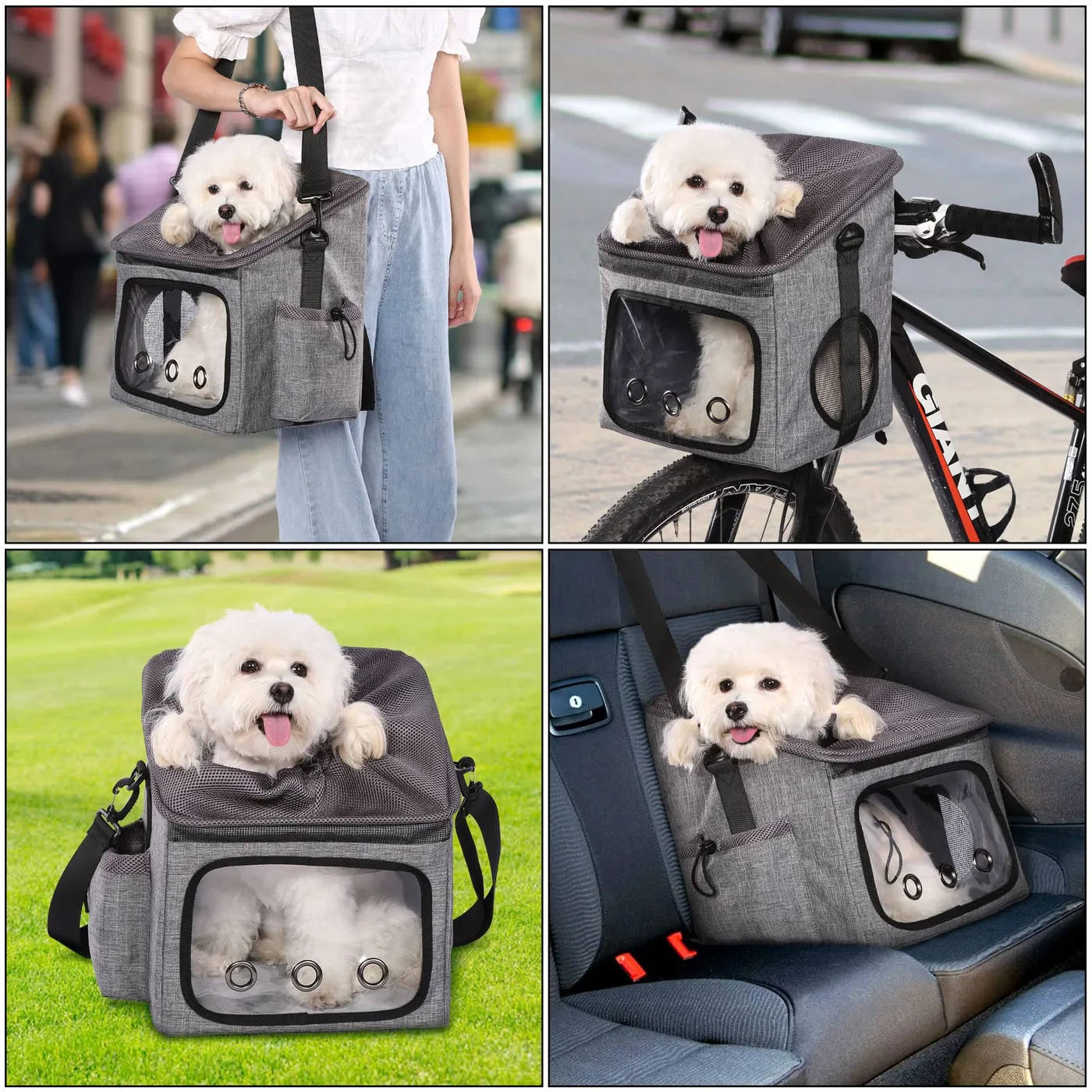
A flat shape earns its keep in the supply chain. Three low-profile units occupy the shelf height of two conventional carriers, and empty units nest into roughly 45-55 percent of their assembled height, which changes both the freight maths and the retail conversation.
Nesting requires the top frame to be soft or removable. If the lid carries an inserted board, the board should be in a slip pocket rather than bonded, so it can be lifted out for shipping and reinserted by the retailer or the customer. That single decision can cut shipped volume by a quarter, and it also allows a flat-pack e-commerce carton.
Stacking is the retail-side opportunity. A low-profile unit with a flat, stiff lid and a slightly recessed base can be stacked three high on a shelf without a fixture, which is a genuine argument in a range review: the retailer gets three facings in the space of two. The base needs a non-slip treatment and a small registration lip to make this work safely.
Shipper design should follow the same logic. A carton sized to three nested units with a divider sheet is cheaper per unit than three individual cartons, and it reduces the corrugated spend by roughly 20-30 percent. Where retail requires individual cartons, a printed sleeve over a plain shipper keeps the cost down while still presenting branded.
On-shelf communication is the part flat shapes make easy. Because the lid is a broad, visible plane from above, a top-facing printed panel or a hangtag positioned on the lid communicates size, weight rating and interior dimensions without anyone lifting the unit. Put interior dimensions on the lid.
Planogram discipline matters: flat shapes look best in a horizontal run rather than stacked vertically, and a range of three sizes presented left to right communicates the ladder more clearly than three units in a column.
Returns handling is the quiet benefit. Flat, nested units ship back cheaply and store cheaply, which matters more than most range plans acknowledge for an e-commerce-led brand.
Low-profile variants: tooling, cost and cube
Low-profile programmes are quoted on lid structure, floor area and carton cube. The table compares the common variants on a private label basis quoted FOB Xiamen, with the standard rectangle set at an index of 100.
| Low-profile variant | Height | Lid build | Tooling | Unit cost index | MOQ | Sampling |
|---|---|---|---|---|---|---|
| Soft flat | 24-26 cm | Laminated 4 mm foam | USD 200-400 | 102 | 500 | 6-10 working days |
| Flat with slip board | 22-24 cm | Removable 3 mm board pocket | USD 300-550 | 106 | 500 | 6-10 working days |
| Flat framed lid | 20-24 cm | Moulded perimeter frame | USD 700-1,300 | 110 | 800 | 8-10 working days |
| Flat travel (under-seat) | 20-22 cm | Slip board, wrap zip path | USD 450-850 | 108 | 500 | 6-10 working days |
| Standard rectangle (baseline) | 30-35 cm | Conventional top gusset | Existing dies | 100 | 500 | 6-10 working days |
Unit cost index understates the real comparison, because the cube saving works in the opposite direction. Soft flat units nested three per carton can reduce per-unit freight by 20-35 percent, which on a long-haul sea shipment usually exceeds the 2-10 point index premium. The correct way to compare is landed cost per unit, not FOB unit price.
Tooling is modest across the range because flat patterns are simple - the cost sits in the lid treatment, not in the shape. This makes low profile one of the most affordable silhouettes to develop, and a sensible first shape for a brand building a new private label range on a limited development budget.
The variant to think carefully about is the framed lid. It is the most expensive to tool and it removes the nesting advantage entirely, so it should be reserved for programmes where retail stacking is a stated requirement rather than chosen as a default upgrade.
Programme economics improve further when one flat pattern supports three sizes. Because only length changes, the second and third sizes carry no additional tooling, and the range reaches three price points for one development spend.
Branding a shallow face
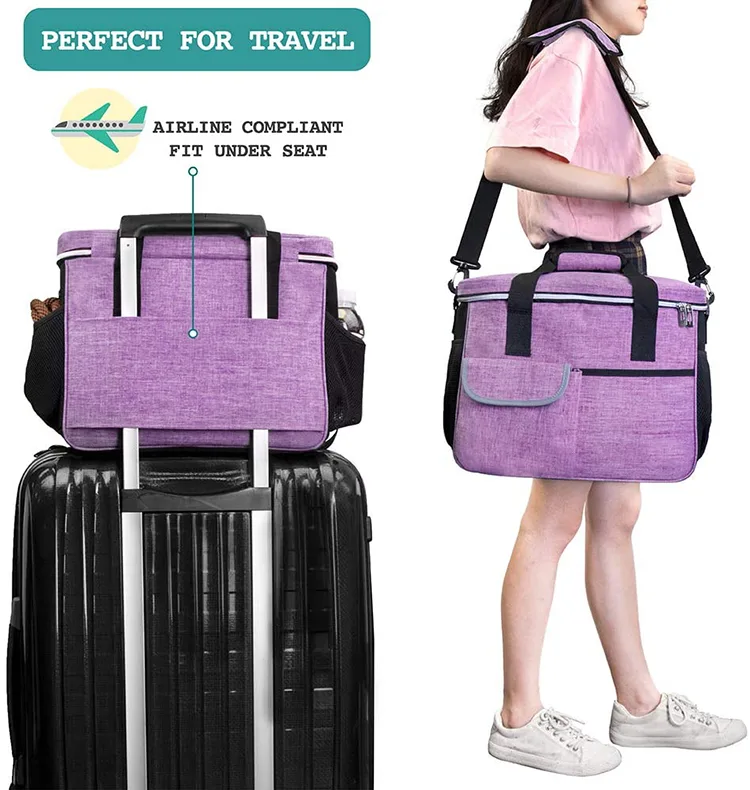
A flat carrier offers less front-facing area and more lid area than any other silhouette, which reverses the usual branding logic. The mark that would sit on the front panel of a tall bag has to move upward, or the brand becomes invisible when the product is on a shelf viewed from above or photographed in a flat-lay.
The default solution is a two-position identity: a small mark on the front end panel for close identification and a larger mark on the lid for distance and overhead recognition. They do not have to be the same treatment - a woven label on the end and a tonal print on the lid, for example - but they should be the same proportion system, or the range will look inconsistent across sizes.
Print on a lid panel needs to consider the stack load. A heavy plastisol deposit on a lid that is designed to carry weight will crack along the fold of a nested unit. Low-build inks, heat transfers, or embroidery with a soft backing are safer on lid surfaces than thick screen deposits.
Embroidery on a stiffened lid is excellent if the panel is flat, because there is no tension distortion; this is one of the few silhouettes where dense embroidery behaves well. The constraint is access - a bonded or inserted board limits the hoop area, so the design should be placed before the panel is laminated, or a pocket constructed so the board can be removed for hooping.
Hardware on a flat body should sit flush. Recessed D-rings, low-profile sliders and flat webbing handles keep the silhouette clean and stop the product catching on other units in a stack. Anything that protrudes above the lid plane will interfere with stacking and will be flagged in a retail technical review.
Finally, the unboxing. A flat, nested unit presented in a flat carton with a single printed insert reads as designed and premium, and the flat format makes an A5 or A4 instruction card cost almost nothing to include.
Colour control across the lid panel is worth specifying explicitly: a lid is one large plane, and dye-lot variation across it is more visible than anywhere else on the product. Methods published by AATCC give the reference for crocking and light fastness acceptance.
Sampling and quality gates for flat builds
Sampling a low-profile programme should start with the lid, not the shell. Round one is a structural sample built in bulk cover fabric with the specified lid build - laminated, slip board or framed - produced in 6-10 working days. It is the sample that gets the 10 kg top-load test, the stacking test and the nesting check.
Round two introduces the openings and the ventilation layout, because on a flat body these are interdependent: the wrap zip path and the lid mesh window compete for the same panel area. Seeing them together on a real unit is the only way to judge whether the airflow and the access both survive.
Round three is the pre-production sample from bulk materials with final branding, and it is the unit sent for third-party testing. For flat shapes the relevant reports are top-load deformation, zip strength on the wrap path, and restricted-substance screening, which a laboratory such as SGS can issue against the written specification.
On the line, four gates are specific to flat builds. Lid doming after 24 hours under load; corner squareness, which drifts when shallow panels are sewn quickly; zip path flatness where the line turns around the end radius; and board pocket alignment, where a misplaced pocket makes the slip board impossible to insert.
These are inspected to AQL 2.5 alongside standard appearance criteria, and they are the four defects that generate the majority of returns in low-profile programmes.
Packing verification closes the process: confirm the nested height actually matches the carton, because a 10 mm error multiplied across three units per carton changes the pallet height and invalidates the freight quote.
Documentation should then be consolidated - pattern file, lab dip, test reports and approved sample - so that the next season's reorder reproduces this season's product rather than drifting from it.
Production capability
- SGS-verified production space of 4,950 m², 149 machines, 7 assembly lines
- Pet carrier and pet bag output since 2014 from a 137-person team
- 200,000 units shipped monthly under BSCI and ISO 9001 systems
People Also Ask
Will a low-profile carrier fit under an airline seat?
A 20-22 cm finished height clears the under-seat envelope on most narrow-body aircraft, but the allowance is soft-sided and policies differ by carrier. Confirm the specific airline's cabin rules before travel and design to 20 cm where air travel is the primary claim.
Are flat carriers comfortable for cats?
They suit cats that rest rather than sit upright, because floor area replaces headroom. For cats that prefer to sit tall, a 26 cm variant is the better compromise.
How do you stop a flat bag looking clinical?
Soften three things: a 30-40 mm corner radius instead of a hard right angle, a warm-toned lining, and a soft-touch coating on the handle.
What mesh colour suits a pale flat carrier?
Tone-on-tone grey or a custom-dyed mesh matched to the body, available from roughly 800 units. Black mesh on a pale body reads as an unconsidered default.
Should a flat carrier have a privacy cover?
A zip-away or roll-down cover over the end window is worth specifying for travel-led ranges, and it also gives the design a second visual state for photography.
How many flat units fit in one carton?
Three nested with a divider sheet is the usual plan, reducing corrugated spend by 20-30 percent against individual cartons.
Frequently Asked Questions
What height counts as a low-profile pet carrier?
A finished exterior height of 20-26 cm, against 30-35 cm for a conventional soft carrier. The commercially useful band is 22-24 cm, which clears most under-seat rails while preserving usable interior height.
How much interior height does a pet actually need?
Depending on the animal, 17-19 cm of clear internal height after the lid structure and any padding. Design from the interior figure, not the exterior one, and publish it in the specification.
Why do flat carriers need a stiffer lid?
A shallow shell has no vertical material to resist crushing, so stacking weight and luggage press directly onto the pet space. Lids need a laminated foam build, a slip board or a moulded frame.
What causes lid doming and how is it prevented?
Adhesive creep under sustained load rather than insufficient thickness. A heat-activated adhesive film typically halves the permanent set compared with spray adhesive.
What is the MOQ for a low-profile programme?
MOQ 500 units per colourway for soft and slip-board builds. A moulded perimeter frame moves the figure to 800 units because the tool needs a larger run to amortise.
How long does sampling take?
Structural samples are produced in 6-10 working days, with framed-lid variants at 8-10 working days. Bulk production runs 35-50 days after sample approval.
Can flat carriers nest for shipping?
Yes, if the lid stiffener is in a removable slip pocket rather than bonded. Nested units occupy roughly 45-55 percent of assembled height and cut per-unit freight by 20-35 percent.
Where does ventilation go when height is limited?
Framed mesh windows on the lid and both ends. A bound aperture with reinforcing tape restores the stiffness the opening removes and delivers more airflow than a narrow side strip.
Where should the logo go on a flat body?
Two positions: a small mark on the front end panel for close identification and a larger mark on the lid for overhead and flat-lay recognition.
Which print methods survive on a lid panel?
Low-build inks, heat transfers and embroidery with a soft backing. Heavy plastisol deposits crack along the fold line of a nested unit.
How is a flat production run inspected?
Lid doming, corner squareness, zip path flatness at the end radius and board pocket alignment are the four specific gates, inspected to AQL 2.5.
Do flat shapes stack on a retail shelf?
Three high is realistic with a stiff lid, a non-slip base treatment and a small registration lip. That gives a retailer three facings in the space of two.
Can one flat pattern support a size range?
Yes. Because only length changes between sizes, the second and third sizes carry no additional tooling, making flat the cheapest silhouette to extend into a family.
Talk to QUANZHOU JUNYUAN BAGS about a pet carrier program: MOQ 500 pieces per colourway, samples in 6-10 working days, bulk production in 35-50 days under AQL 2.5 inspection.
Get a free quote Request a sample