Custom Pet Comb: Detangling Tool Design and Branding Guide
A custom pet comb is defined by four specifications: tooth geometry, material and finish, handle balance, and branding method. Set those before tooling or sourcing begins and a 500-piece colourway runs from approved sample to packed cartons in 35-50 days, with a physical sample in 6-10 working days and finish held to a signed reference chip on reorders.
Our production team treats a comb as the precision instrument of a grooming range - narrower in function than a brush, judged more harshly, and more revealing of whether a brand understands materials. The brief therefore runs from tooth geometry and coat type through material, finish and balance to a landed cost, and nothing moves to bulk until a physical sample has been handled and pulled through a real coat. MOQ 500 pieces per colourway. Samples take 6-10 working days from approved artwork; tooling and bulk run 35-50 days after sign-off, inspected to AQL 2.5 with a written report attached to the packing list. Finish is approved against a physical reference chip that is retained, so reorders land inside the same tolerance. Terms are T/T 30/70, FOB Xiamen. The SGS-verified production base covers 4,950 m² with 137 people across 7 lines, audited to BSCI and ISO 9001, and pet programs have run there since 2014. For a first program we recommend one geometry in two sizes rather than two geometries, because the size split is what customers actually choose between. We also recommend testing tooth geometry on a real coat before tooling, because spacing that looks correct on a drawing behaves differently in use.
A custom pet travel bag has to reconcile two limits at once: the airline under-seat envelope and the ventilation the animal actually needs.
The Comb as a Precision Tool in a Grooming Range
A comb does one thing and is judged entirely on how well it does it. There is no cushion to soften a bad decision, no bristle to hide behind - the tooth either passes through a coat or it catches. That expose makes the comb the most honest product in a grooming range and the one most worth specifying carefully.
Commercially it plays a different role from a brush. It is cheaper, smaller, more frequently lost and more frequently replaced, and it is bought as a companion rather than as a primary tool. That makes it the natural add-on and the natural bundle partner, and it means the comb earns its place through attach rate rather than through standalone margin.
It is also the product most likely to be bought in a set. A wide-tooth and a narrow-tooth comb sold together cover most coat types, and a two-piece set at a modest premium over a single unit is one of the highest-conversion structures available in grooming. Design the set first and the single units follow.
From a design standpoint the comb is where material honesty shows. A metal comb feels like a tool and is judged on finish and balance; a moulded comb feels like an accessory and is judged on colour and shape. Both are legitimate, but the choice has to be deliberate, because a mid-range product that hesitates between the two satisfies neither expectation.
The opportunity in the category is that most combs are generic. Standard tooth spacing, standard steel, standard black handle. A comb with considered spacing, a real finish, a proper balance point and a mark applied as part of the design is visibly different on a shelf where nothing else has been considered.
Tooth Geometry: Spacing, Taper and Length
Tooth geometry is the product. Spacing determines which coat types the comb works on, taper determines how it enters and releases the coat, and length determines how deep it reaches into the undercoat. Everything else is packaging.
Spacing is the primary specification. Wide spacing around 6 to 8 mm between tooth centres works through thick coats and undercoat; medium spacing around 3 to 4 mm suits general detangling; fine spacing below 2 mm suits finishing work and fine coats. A single comb cannot cover all three, which is why the set structure is the right commercial answer.
Taper matters more than most briefs acknowledge. A tooth that tapers from a thicker root to a finer tip enters a mat without forcing it and releases without pulling; a parallel tooth of the same width drags. Specifying a taper is a small manufacturing detail with a large effect on how the tool feels in use.
| Geometry | Tooth spacing | Tooth length | Coat type | Use stage | Cost index |
|---|---|---|---|---|---|
| Wide rake | 6-8 mm | 25-30 mm | Thick, double, undercoat | First pass | 1.0 |
| Medium detangler | 3-4 mm | 20-25 mm | Medium, wavy, curly | Working pass | 1.0 |
| Finishing comb | 1.5-2 mm | 15-20 mm | Fine, short, smooth | Finishing | 1.05 |
| Dual-density comb | 3 mm and 7 mm | 22 mm | Mixed and double | Combined | 1.3 |
| Flea or fine-tooth | Under 1 mm | 12-15 mm | All, inspection | Checking | 1.1 |
A dual-density comb - two spacing zones on one head - is the strongest single-product design in the category. It lets one tool serve a first pass and a working pass, it justifies a higher price than a single-spacing comb, and it genuinely reduces the number of tools a customer needs. It is the recommended core product for a first program.
Tip treatment is a comfort and safety requirement. A rounded or polished tip glides across skin; a cut or burred tip scratches and catches. Specify tip finishing explicitly and inspect it, because burrs on cut teeth are the most common defect in low-cost production and the most common cause of discomfort complaints.
Length should match the coat, not the tool. A long tooth on a short coat is awkward and unnecessary; a short tooth cannot reach an undercoat. Publishing the recommended coat type for each geometry on the packaging is what lets a customer choose correctly.
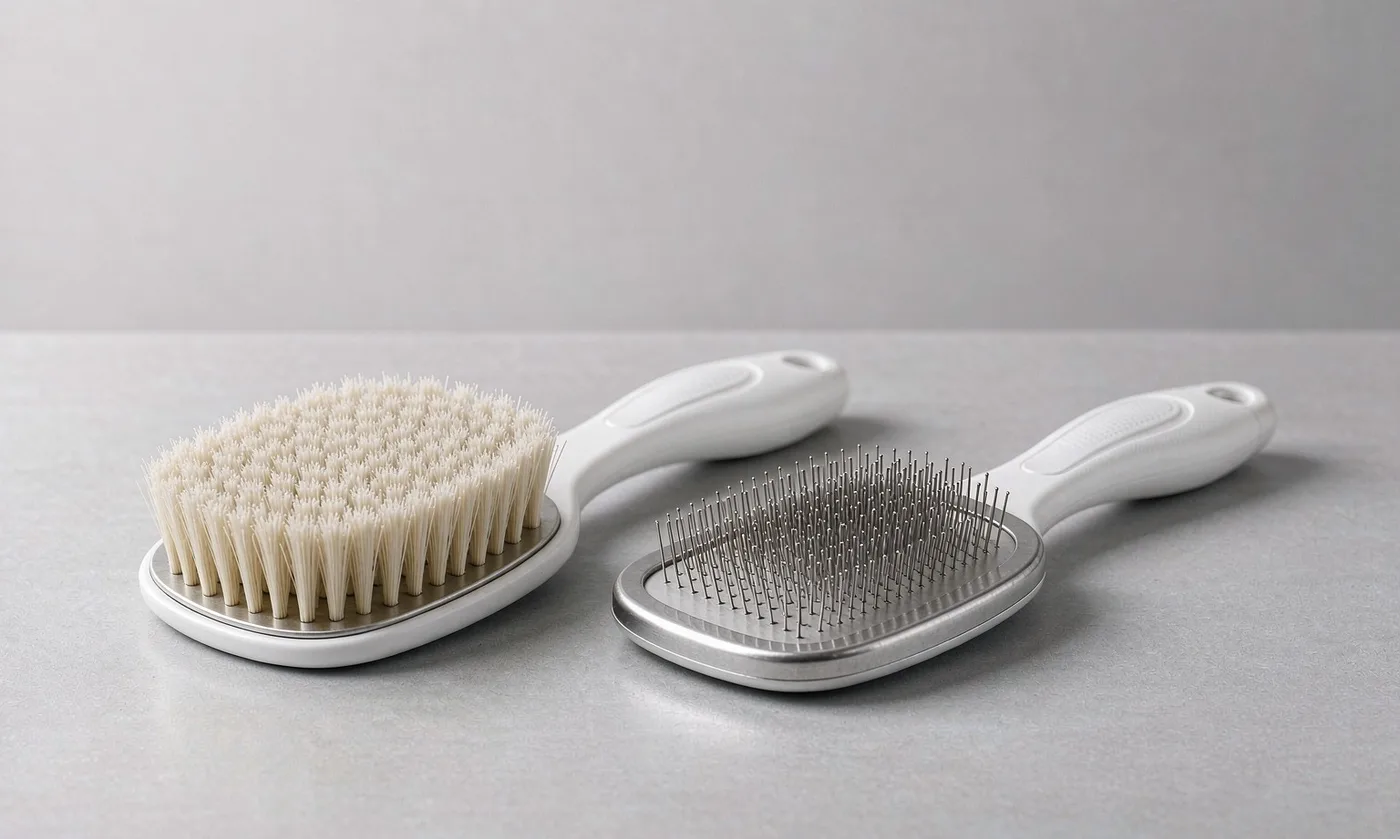
Material Routes: Stainless, Carbon, ABS and Wood
Material determines the finish options, the weight, the durability and the price position, and it should be chosen together with the brand's wider material language rather than in isolation.
Stainless steel is the professional standard. It is durable, it takes a high polish or a coloured physical vapour deposition coating, it can be laser marked cleanly, and it reads as a tool rather than as an accessory. It is heavier than plastic and more expensive per unit, and it is the right choice for premium and professional positioning.
Carbon steel is the traditional alternative for fine combs. It takes a sharper tooth profile and holds a very fine tip, which suits finishing work, but it requires a protective finish to resist corrosion and it needs to be specified with that coating as part of the material.
| Material | Weight | Finish options | Branding | Cost index | Positioning |
|---|---|---|---|---|---|
| Stainless steel | Heavy | Polish, brushed, PVD | Laser, etch | 1.5 | Professional, premium |
| Carbon steel, coated | Heavy | Coated, blackened | Laser, etch | 1.3 | Traditional finishing |
| ABS or nylon moulded | Light | Any matched colour | Pad print, moulded relief | 1.0 | Volume, colourful |
| Aluminium, anodised | Medium | Anodised colour range | Laser, engrave | 1.7 | Design-led, technical |
| Hardwood with steel teeth | Medium | Stain, oil, lacquer | Laser on wood | 1.6 | Natural, heritage |
Moulded combs are the volume answer and they have one advantage metal cannot match: colour. A comb moulded in a brand colour, with a matched handle and a coordinated package, reads as proprietary in a way a plain steel comb does not. For lifestyle-led brands the moulded route is usually correct despite the lower perceived quality.
Hybrid construction is the strongest compromise: a moulded handle in a brand colour with a steel tooth set. It gives colour where customers see it and steel where performance matters, and it is the structure most mid-to-premium ranges should consider first.
Corrosion resistance should be specified for any metal component, because grooming tools are washed and left damp. A stainless grade appropriate to that environment, or a protective coating on carbon steel, prevents the rust spots that otherwise appear within months and destroy a premium impression.
Handle Design and Balance for a Precision Tool
A comb is used with a finer grip and more wrist movement than a brush, which changes the ergonomic requirements. The tool has to be controllable at the tip rather than comfortable in the palm, and that argues for a narrower grip section and a balance point closer to the head than would be right for a brush.
Grip section geometry follows from that. A flattened or faceted grip allows a pencil-style hold and precise control; a fully round grip encourages a looser hold that is less precise. For a detangling tool where control matters, a flattened or oval section is the better answer.
Weight distribution should put the balance point between the grip and the head rather than in the hand. A head-heavy comb feels precise and controlled; a handle-heavy comb feels unbalanced and imprecise. Specify a target balance point and check it on the physical sample.
Length affects both control and reach. A shorter handle gives finer control for face and paw work; a longer handle gives reach into a thick coat. A comb intended for detail work should be shorter than a comb intended for body work, which is another argument for a two-size set.
Surface texture should support a wet or damp hand. Grooming often happens after a bath, and a glossy handle that is slippery when wet is a genuine usability failure. A matte texture, a soft overmould or a moulded grip pattern solves it and costs very little.
Finally, specify a hanging or storage feature. A hole in the handle, a loop, or a sheath for a metal comb protects the teeth and keeps the tool findable, and the sheath in particular turns a metal comb into a product that can travel in a bag without damage.
Finishes: Polish, PVD, Anodising and Coating
Finish is where a metal grooming tool earns its price. The same stainless comb reads as a premium tool with a considered finish and as a commodity item with a mill finish, and the difference is a process step rather than a material change.
A mirror polish is the classic premium finish and the most reflective in photography. It shows every handling mark and it requires careful packing to arrive unscratched, which adds a packaging requirement. A brushed or satin finish hides wear better and reads as more technical and professional.
Physical vapour deposition coating opens colour on metal. It produces durable coloured finishes - black, gunmetal, gold, rose - that do not chip like paint, and it is the only way to put a genuine brand colour on a steel tool. It adds cost and it should be specified with an abrasion requirement.
Anodising is the route for aluminium components. It produces a hard, integral colour layer in a defined range, it is durable, and it suits technical and design-led positioning. Colour range is narrower than painted finishes but the durability is substantially better.
Painted and soft-touch coatings are the low-cost alternative on moulded components. They achieve almost any colour but they wear at contact points, and the wear is visible. For a tool that is handled constantly, colour-through resin or a two-shot construction is more durable than any applied coating.
Finish approval needs a physical reference. Polished, brushed, coated and anodised finishes cannot be judged from a photograph, so a signed reference chip or sample should be retained and reorders inspected against it - the same discipline as colour matching on any other material.
Branding on Metal and Narrow Surfaces
A comb offers less branding area than almost any other product in a pet range. The spine is narrow, the handle is gripped, and the teeth cannot be marked. The realistic options are fewer and each has a clear best use.
Laser marking is the standard for metal and for wood. It is permanent, it produces a precise mark at small scale, it has no consumable and it reads as considered rather than applied. On stainless it produces a dark annealed mark; on wood a tonal burn; on anodised aluminium it removes the dye layer to reveal the metal beneath.
Chemical or mechanical etching is the alternative on metal where a deeper, more tactile mark is wanted. It is slower and more expensive per unit than laser marking, and it suits heritage or luxury positioning where the mark is meant to be felt as well as seen.
| Method | Substrate | Durability | Detail | Cost index | Best for |
|---|---|---|---|---|---|
| Laser marking | Steel, aluminium, wood | Excellent | High at small scale | 1.1 | Premium metal tools |
| Chemical etching | Steel | Excellent | Medium | 1.5 | Heritage, luxury |
| Pad printing | Moulded plastic | Good | Up to 4 colours | 1.0 | Volume plastic combs |
| Moulded relief | Moulded plastic | Excellent | Medium | 1.4 | Tool-integrated identity |
| Laser on wood handle | Hardwood | Excellent | Medium | 1.2 | Natural positioning |
Placement should avoid the grip. A mark under the thumb or finger wears and looks shabby within weeks; a mark on the spine away from the grip, or on the butt end of the handle, stays legible for the life of the tool. On a hanging card the mark also has to read from the front.
Scale the mark to the narrowest dimension rather than the longest. A logo sized to the length of a spine will be too tall for its width, and a mark that touches the edges of a narrow surface reads as an error. Artwork to the smallest dimension and let the rest follow.
Colour Systems for Metal and Plastic Tools
Colour on grooming tools works differently from colour on textiles, because the areas are small, the materials vary and the same reference cannot be reproduced identically across them. The system has to be designed with that limitation accepted rather than fought.
The practical approach is a core plus accent structure. One core colour that appears on every handle in the family, and one accent that varies by function or by coat type. That gives recognisability without requiring every component to match, and it tolerates the fact that a resin handle and a coated metal spine will never be identical.
Approve colour per material. A Pantone reference moulded in ABS, the same reference coated on steel, and the same reference printed on a card will all read differently. Approve a physical chip for each substrate, accept different tolerances per material, and inspect reorders against the retained chips.
The reference system used across the industry is documented by Pantone, and specifying against published references keeps colour conversations objective rather than subjective. It also makes the chips usable years later when a reorder happens.
Limit the palette. Three or four colours across a grooming family is enough; more than that fragments the range and multiplies the number of resin runs and colour matches that have to be maintained. A tight palette reads as designed, a wide one reads as accumulated.
Colour can encode function, which is the most useful thing it can do on a tool. Wide-tooth in one accent, fine-tooth in another, and the customer chooses correctly at a glance without reading the pack. That is a design solution to a merchandising problem and it costs nothing.
Retail Card and Sleeve Packaging
Comb packaging has to protect the teeth, display the product and communicate which coat type the tool suits. The teeth are the fragile part and the point of the product, so protection and visibility have to be solved together rather than traded off.
A blister card is the standard answer and it works: the teeth are protected by the blister, the product is fully visible, and the card carries the copy. Its weaknesses are the plastic content and the mass-market read, both of which are increasingly unwelcome in design-led channels.
A printed card with a die-cut window and a recyclable film, or a folded card sleeve that retains the comb by the spine, addresses both weaknesses. The sleeve route is cheaper, mono-material, and it presents better in boutique and homeware environments where products are stacked rather than hung.
A rigid box or a sheath suits premium metal combs. A sheath protects the teeth, allows the comb to be carried in a bag and turns the product into something closer to a personal accessory than a grooming tool. It justifies a higher price and it is the right answer for a metal finishing comb.
Coat-type guidance belongs on the front. A simple icon set - wide, medium, fine, or thick, curly, short - lets a customer self-select in seconds and materially reduces wrong purchases. This is the single highest-value element of the package and it is frequently omitted.
Two-piece sets need their own structure. Two combs on one card, or two in one sleeve, present as a considered set rather than as a bundle, and the shared card is the cheapest place to explain why both are needed. Price the set so that buying them separately looks unreasonable.
Sequencing a Detangling Set Launch
A detangling set is the right first program in this category, because it solves the customer's actual problem - one comb cannot serve every coat - and because it doubles the unit value from a single development effort. Sequence matters, and the recommended order is geometry, then material, then colour, then packaging.
Geometry first, because it determines whether the product works and it cannot be changed later without tooling. Decide the two spacings the set will cover and validate them on a real coat before anything else is specified. This is the step that cannot be shortcut.
Material second, because it determines finish options, weight, cost and branding method. Choose it together with the brand's wider material language so the comb does not look like it belongs to a different range than the brush beside it.
Colour and finish third, and only once the substrate is known. Approving a colour before choosing the material wastes a sampling round, because the reference has to be re-approved on the actual substrate anyway.
Packaging last but not late. The die-line, the coat-type icon set and the barcode placement should be in development while the sample is being made, not after it is approved, because packaging artwork is frequently the longest item in the schedule.
Quality systems and documentation should be settled in parallel rather than at the end. Working with partner facilities that operate under recognised management standards - the framework for quality management systems is published by ISO - and verifying claims through independent inspection such as SGS gives a brand evidence that a retail buyer will accept without further questions.
Finally, plan the second drop while the first is shipping. Hold the retained reference chips, the tooling specification, the packaging die-line and the test reports, and an extension - a third geometry, a new finish, a seasonal colour - becomes a variation rather than a new project.
Why brands source here
- Pet carrier programs run since 2014; founding team in sewn goods since 2004
- SGS-verified production floor of 4,950 m² with 137 workers across 7 lines
- Monthly capacity of 200,000 units, audited to BSCI and ISO 9001
People Also Ask
What is the MOQ for custom pet combs?
MOQ 500 pieces per colourway. That covers the resin colour match or the finish run, the tooth assembly setup and the packaging, and it is the level at which unit cost stops falling steeply with quantity.
How long does a custom pet comb take to produce?
Samples take 6-10 working days from approved artwork and specification. Tooling and bulk production run 35-50 days after sample sign-off, with inspection to AQL 2.5 before shipment.
What tooth spacing should a detangling comb have?
Around 3 to 4 mm for general detangling, 6 to 8 mm for thick or double coats, and under 2 mm for finishing. One spacing cannot cover all coat types, which is why a two-piece set is the right commercial structure.
Which is better for a comb, steel or moulded plastic?
Steel for professional and premium positioning, with laser branding and a considered finish. Moulded plastic for volume and lifestyle ranges, because it is the only route to a genuine brand colour. A moulded handle with steel teeth is the strongest compromise.
How do you brand a narrow metal comb?
By laser marking on the spine or butt end, away from the grip. It is permanent, precise at small scale and reads as designed rather than applied. Scale the mark to the narrowest dimension, not the longest.
Can we put a brand colour on a metal comb?
Yes, through physical vapour deposition coating, which produces durable coloured finishes that do not chip like paint, or through anodising on aluminium components. Specify an abrasion requirement with either.
Should combs be sold as a set?
Yes. A wide-tooth and a narrow-tooth comb sold together cover most coat types and are one of the highest-conversion structures in grooming. Design the set first and let the single units follow.
Frequently Asked Questions
What artwork format should we supply for laser marking?
Vector artwork with all text converted to outlines and no gradients or half-tones. Laser marking reproduces outlines precisely but cannot render tonal transitions, so artwork is best prepared for the method.
Can we mix finishes within one order?
Yes, provided each finish reaches 500 pieces. Finish runs are batched, which is why the minimum applies per finish rather than per order.
How is finish consistency maintained between reorders?
Finish is approved against a physical reference chip or sample that is retained on file, and reorders are inspected against it rather than against a photograph or a description.
What causes a comb to scratch skin?
Usually burrs or cut tooth ends rather than the spacing. Specify tip finishing explicitly and inspect it, because burrs on cut teeth are the most common defect in low-cost production.
Can we add a sheath or protective cover?
Yes, and it is recommended for metal combs. A sheath protects the teeth, allows the tool to travel in a bag, and turns it into something closer to a personal accessory than a grooming tool.
What handle grip works best for a comb?
A flattened or oval grip section that allows a pencil-style hold and precise control. A fully round grip encourages a looser hold that is less precise, which matters for detail work.
How should we handle wet-condition grip?
Specify a matte texture, a soft overmould or a moulded grip pattern. Grooming often happens after a bath and a glossy handle that is slippery when wet is a genuine usability failure.
What is the recommended balance point?
Between the grip and the head rather than in the hand. A head-heavy comb feels precise and controlled; a handle-heavy comb feels unbalanced and imprecise.
Do corrosion-resistant grades matter for grooming tools?
Yes. Grooming tools are washed and left damp, so an appropriate stainless grade or a protective coating on carbon steel prevents rust spots that otherwise appear within months.
How many colours should a grooming family use?
Three or four. More fragments the range and multiplies the number of resin runs and colour matches that have to be maintained. A tight palette reads as designed.
Can colour be used to indicate coat type?
Yes, and it is the most useful thing colour can do on a tool. Wide-tooth in one accent and fine-tooth in another lets a customer choose correctly at a glance without reading the pack.
What payment and shipping terms apply?
T/T 30/70 with FOB Xiamen and a full document set per shipment. Our partner facilities operate under BSCI and ISO 9001 systems, with 149 machines across 7 lines at an SGS-verified production base.
Talk to QUANZHOU JUNYUAN BAGS about a pet carrier program: MOQ 500 pieces per colourway, samples in 6-10 working days, bulk production in 35-50 days under AQL 2.5 inspection.
Get a free quote Request a sample