GPS Tracker Pocket Integration: Track-Ready Carrier Design
A track-ready pocket should be a device-agnostic sleeve of 40 x 40 mm minimum internal clearance with a 6-10 mm depth, placed on an outer panel away from the animal interior, built from non-metallic materials only, and closed with a retention flap that needs two motions to open. Metal mesh, metallic coatings and carbon fibre panels will degrade the signal, so keep the pocket area free of them. Our production team samples tech pockets in 6-10 working days and runs bulk in 35-50 days to AQL 2.5.
This executive summary covers tech pocket integration as a platform decision that outlives any individual device. MOQ 500 pieces per colourway is the standard entry point, driven by the fabric minimum and by any custom moulded retention hardware. Sampling takes 6-10 working days from approved artwork and includes a constructed pocket tested with the actual trackers the brand intends to support, not with a cardboard mock-up. Bulk production runs 35-50 days after sample sign-off, with custom-moulded retainers and printed instruction cards at the longer end. Finished goods are inspected to AQL 2.5 under documented ISO 9001 procedures at our SGS-verified production base and ship FOB Xiamen on T/T 30/70 terms. Three decisions belong before sampling: which devices the pocket must accommodate, because that fixes the internal clearance; where the pocket sits, because that is a signal question and a pet-safety question at the same time; and how it closes, because a tracker that falls out is worse than no pocket at all. Committing to one pocket architecture across the range is what turns a feature into a platform.
A custom dog carrier brief starts with the weight band, not the colour: strap width, base board thickness and mesh ratio all follow from how heavy the dog actually is.
Designing for a Device You Do Not Make
A tracker pocket is an unusual design problem: you are designing for an object whose dimensions, firmware and antenna characteristics are controlled by someone else, and which will be replaced by a newer model during your product's life. That single fact should shape every decision that follows, and most brands get it wrong by designing for one device and discovering eighteen months later that the pocket no longer fits. The answer is to design for a clearance envelope rather than for a device. Fit the largest tracker you expect to support, add tolerance, and let smaller devices sit inside that envelope with a little slack. A pocket that is slightly generous is a pocket that still works in three years; a pocket tailored to one product is a pocket that becomes a complaint.
That generosity has a cost, and it is rattle. A tracker loose in a large pocket moves, clicks against hardware and makes the product feel cheap. Resolve it with a soft liner or a light elastic panel that takes up the slack rather than by shrinking the pocket, because the liner is replaceable and the pocket is not. A thin neoprene or spacer-knit liner adds almost nothing in cost and solves the problem completely.
The strategic upside of getting this right is significant. Track-ready is a claim that addresses the single strongest emotion in the pet category — the fear of losing an animal — and it does so without the brand having to build, certify and support an electronic product. It is the highest ratio of perceived value to engineering risk anywhere in the category, and it is available to any brand willing to spend the design time on the pocket.
But the claim has to be honest. A pocket is not a tracker, and packaging artwork that implies the product locates a pet is misleading. The correct language is track-ready or tracker-compatible, with a clear statement of which devices fit. Brands that stay on the right side of that line get the benefit without the liability.
Sizing the Pocket: Device-Agnostic Versus Device-Specific
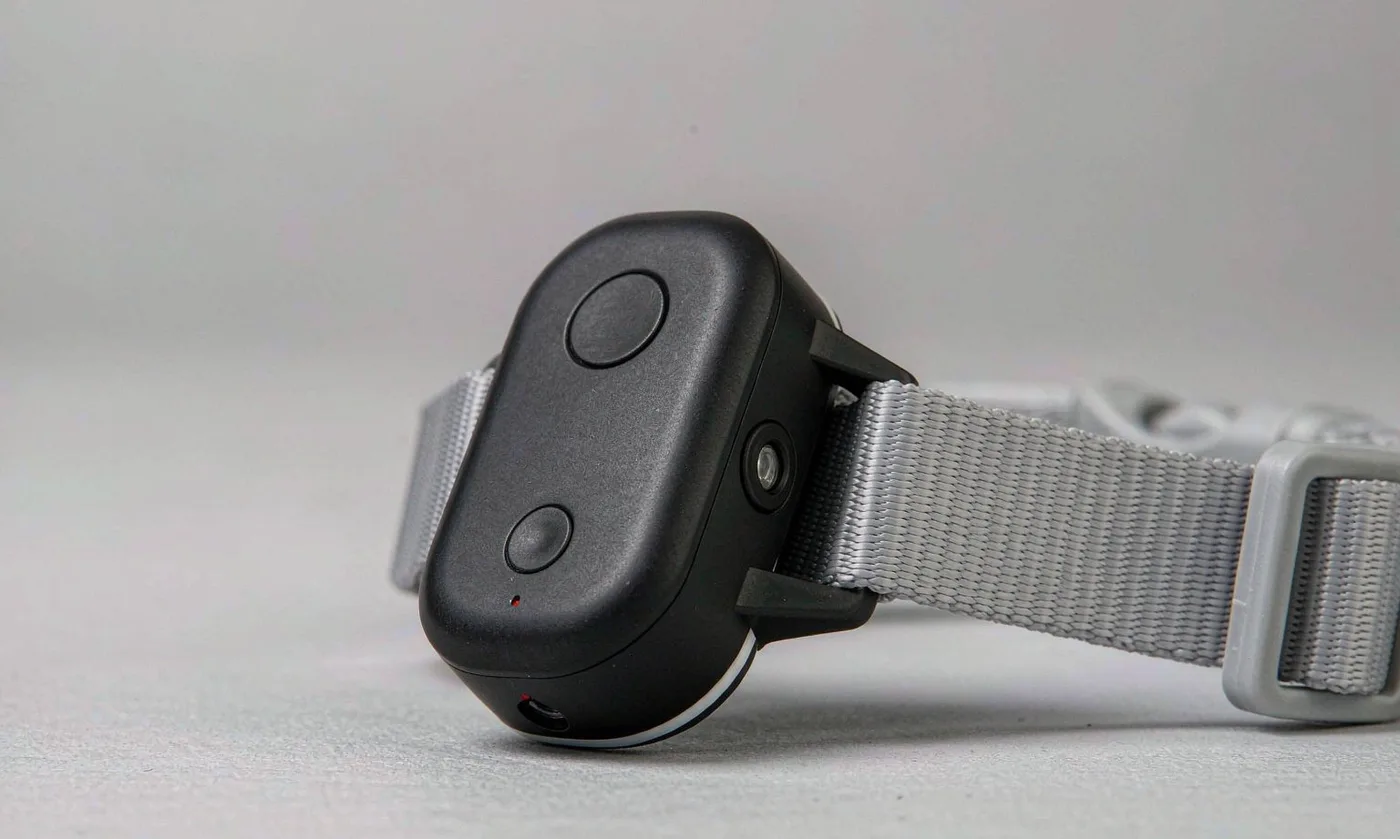
Current consumer trackers cluster into two formats. The disc or puck format sits around 32-40 mm across and 8-10 mm thick. The tag or card format is broadly rectangular, typically 55-85 mm on the long side, 30-55 mm on the short side and 5-8 mm thick. A pocket sized for the larger of the two will accept the smaller one with room to spare, and a pocket sized for the disc alone will not accept a card at all.
Practical guidance: specify internal clearance of at least 40 by 40 mm with 10 mm depth for a disc-only product, and 90 by 60 mm with 8 mm depth if card-format trackers are in scope. Depth is the specification people forget, because a tracker that fits in plan view but bulges against the cover fabric looks wrong and presses against whatever is behind it.
Tolerance direction matters. Build the pocket on the generous side rather than the tight side, because a snug pocket is extremely satisfying on the device it was designed for and unusable on everything else. Two millimetres of additional clearance is invisible in use and doubles the range of devices the product will support over its life.
Consider a second, smaller sleeve as well. Many owners run two devices — a Bluetooth tag for close-range finding and a cellular GPS unit for real tracking. Giving the product a primary pocket sized for the larger device and a secondary slip pocket for a disc costs a few cents in fabric and turns a single-feature product into a genuine tech platform. It also creates a reason to buy the premium tier, which is usually the commercial objective behind adding the feature in the first place.
Dimension the opening separately from the pocket. The internal clearance can be generous while the mouth of the pocket stays narrower, which stops a device working its way out while still allowing it to be inserted easily. A mouth about 80% of the pocket width, with a slight curve rather than a straight edge, is the detail that makes a slip pocket feel considered rather than cut.
Measuring against real hardware
Sample with the actual devices, bought at retail, not with a printed template. Tolerance stacks across the fabric, the seam allowance and the liner, and a pocket that measures correctly on paper can be 3 mm tight in construction. Fit-test at least two devices per format and record which ones pass, because that list becomes the compatibility statement on the packaging.
Signal Path: What Blocks a Tracker and What Does Not
Every consumer tracker communicates by radio, and radio does not pass through metal. This is the single most common technical failure in tracker pocket design and it is entirely avoidable, because the materials that cause it are the same ones brands choose for other reasons.
The blockers are metal mesh, metallic or aluminised coatings, metal hardware directly behind the pocket, carbon fibre panels, and conductive or anti-static finishes. A tracker sitting behind a metal mesh ventilation panel will lose a meaningful share of its range, and one sitting directly over a steel frame stay may lose most of it. Fabric, foam, plastic hardware and leather are all transparent to these frequencies and cause no problem.
The practical rule is to keep a clear zone of at least 50 mm around the pocket free of metal in any direction, and to check what is behind it. On a structured carrier that often means relocating a frame stay, replacing a metal mesh panel with a coated polyester mesh, or moving the pocket to a softer area of the shell. None of those are difficult if they are decided at the pattern stage; all of them are expensive if discovered after tooling.
Orientation matters less than people assume, but it is not nothing. Most trackers are omnidirectional enough that orientation does not affect function, though a device lying flat against a panel will radiate slightly differently from one standing proud of it. If the product carries a cellular GPS unit, which transmits at higher power and is more directional, give it a pocket on an outer face rather than one buried against the wearer's body.
Verify rather than assume. A simple range check — place the device in the pocket, walk away with the paired phone, and record the distance at which the connection drops, then repeat with the device held in open air — takes ten minutes and tells you everything. Do it on the pre-production sample, not on the finished bulk.
Placement: Reachable by You, Not by the Pet
Placement is where the design stops being a technical exercise and becomes a welfare question. A tracker contains a battery, usually a coin cell, and a swallowed coin cell is a genuine medical emergency. The pocket therefore has to satisfy two conditions that pull in opposite directions: the owner must be able to reach it in seconds, and the animal must not be able to reach it at all.
The resolution is to place the pocket on an outer panel, outside the interior volume entirely, with the animal separated from it by at least one structural layer that has no opening. An exterior slip pocket on the front or side of the carrier satisfies this. A pocket inside the carrier, even one with a flap, does not, because a determined cat will work at a flap for as long as it takes.
Reachability for the owner means one-handed access without putting the bag down. The pocket should be on the side or front, at a height that is comfortable when the bag is being worn, and the closure should open with a single motion once the hand is on it. A tracker that requires the wearer to remove the bag, unzip a lining and fish around is a tracker that stops being used after the first week.
Consider what else shares that area. A pocket placed next to a water bottle pocket will be squeezed by the bottle, and one placed under a strap will be inaccessible when the bag is worn. Map the pocket against every other feature that competes for the same panel, because the front of a carrier is the most contested real estate on the whole product.
Finally, think about the pocket in the context of the whole range. The same pocket, in the same position, on every product, means one instruction card, one compatibility statement and one recognisable design detail. Customers who upgrade within the brand already know where the tracker goes.
Closure, Retention and Anti-Chew Construction
A tracker that falls out is a product failure that will be remembered. Retention has to be designed rather than assumed, and the failure mode is predictable: the pocket is on the outside of a bag, the bag is set down and dragged, and the device works its way out of a slip pocket that has no closure at all.
Three closure levels are available. A simple elasticated lip is cheapest and adequate for a disc in a snug pocket, but it is not secure enough for a device the customer will be upset to lose. A turned flap with a snap or a short hook-and-loop tab is the right default: two motions to open, silent, and impossible to open by accident. A zip is the most secure and the most expensive, and it is worth it when the pocket also holds something valuable.
Hook-and-loop deserves a caution. It is cheap, quiet enough and easy to use, but the hook side abrades clothing and collects lint, and its holding force drops measurably over a few hundred cycles. If you use it, specify a high-cycle grade and consider putting the loop side on the exposed face so the hook side is hidden.
Anti-chew construction is about layers rather than materials. No soft product is genuinely chew-proof, so the objective is to make the tracker unreachable rather than to make the pocket indestructible. Achieve that by placing the pocket outside the interior as already described, by using a double layer of fabric over the device, and by ensuring there is no seam or gap leading from the interior toward the pocket. A lining seam that terminates near the pocket is the detail that turns a safe design into an unsafe one.
Add a small retention detail worth its cost: an internal tether point. A short elastic loop inside the pocket lets the owner clip a tracker that has its own lanyard hole, which covers the case where the pocket is sized generously and the device is small.
Safety: Coin Cells, Chewing and Containment
The safety case for a tracker pocket rests on one fact: the coin cell inside a typical tracker is dangerous if swallowed. This is not a theoretical concern and it is not specific to pet products, but a pet product puts a battery-bearing object in the same enclosed space as an animal that explores with its mouth. The design response is containment plus separation, and both should be documented.
Containment means the pocket enclosure itself. If the animal cannot reach the device, the risk is addressed at source. Where a design places any device inside the interior volume — for example a tracker clipped to an interior D-ring — that is a design we would not build, and it is worth saying so plainly in the brief.
Separation means the structural layer between the pocket and the interior. One layer of shell fabric is not enough if a claw can catch it. Two layers, or one layer plus a stiffener, is the sensible target, and the seam path should be drawn so that no seam leads from an interior edge toward the pocket opening.
Public guidance on button and coin cell battery safety published by the U.S. Consumer Product Safety Commission is the reference point for why this matters, and it is worth including a line on the instruction card directing owners to keep tracking devices away from animals. That single line protects the animal, and it protects the brand from the argument that it should have known.
Independent verification is available and cheap. A construction review and a containment assessment through SGS, documented under a quality system aligned to ISO 9001, gives a brand owner a defensible position on a feature where the downside is severe even though the probability is low.
Cost, MOQ and Programme Planning
A tech pocket is one of the cheapest features in this whole category and one of the highest in perceived value. The cost is fabric, a closure and a little extra assembly time. There is no electronics, no certification of the product itself, and no battery in the bag. That ratio is why we recommend it as the first tech feature a brand adds, ahead of anything powered.
The table below compares the four pocket levels we build most often, with indicative cost per carrier at a 500-piece programme and the lead-time impact of each.
| Pocket level | Construction | Indicative cost per unit | Device support | Added lead time |
|---|---|---|---|---|
| Slip | Elasticated lip, single layer | $0.45-$0.80 | Disc only | None |
| Flap | Turned flap, snap closure | $0.85-$1.50 | Disc and card | 1 week |
| Lined | Spacer liner, tether, snap | $1.40-$2.30 | Disc, card, cellular unit | 1-2 weeks |
| Dual | Two sleeves, moulded retainer | $2.60-$4.10 | Two devices at once | 3-4 weeks |
Custom moulded retainers are the only item here with a tooling cost, and they are optional. A moulded frame that holds a specific device precisely is a premium touch and it makes the product feel engineered, but it ties the pocket to one device generation, which is exactly the risk the clearance-envelope approach exists to avoid. Use a moulded retainer only where the brand is deliberately partnering with one tracker maker.
Timing is short by the standards of this category. Sampling is 6-10 working days including a fit test with real devices. Bulk is 35-50 days after sign-off, with printed instruction cards and custom retainers at the longer end. Inspection to AQL 2.5 covers pocket dimensions and closure function, and shipments move FOB Xiamen on T/T 30/70 terms. Because there is no electronics qualification in the chain, a track-ready programme is materially faster to market than any powered feature.
Instruction card and packaging
Include a card in the box that lists the devices tested, the maximum device dimensions, and the one-line safety note about keeping devices away from the animal. That card is the compatibility statement, the safety instruction and the reassurance all at once, and it costs a few cents.
Do not print a device brand logo on the product without permission. Naming a compatible device in text on the packaging is normal; using its trademark on the bag is not, and it is a conversation with a legal team that most brands do not want to have.
Selling Track-Ready as a Platform Claim
Track-ready works best as a platform promise rather than a product feature. When every carrier in a range has the same pocket in the same place, the brand can say it, the customer can rely on it, and the design detail becomes part of the brand's visual identity. When one product has a pocket and its siblings do not, the claim is a spec line and the range looks unplanned.
Name the platform. A named pocket reads as engineering; an unnamed one reads as an afterthought someone added to a cost-down. Put the name on the hangtag, on the product page and in the compatibility card, and carry it forward into year two unchanged.
Price it as a reassurance feature rather than as a tech feature. The customer is not paying for a pocket; they are paying for the feeling that if the worst happens, the bag was designed with that in mind. That is a much stronger positioning than a specification, and it supports a premium far better than the bill of materials suggests.
Be scrupulous in the language. Track-ready, tracker-compatible, fits devices up to a stated size — all accurate and all defensible. Language that implies the bag itself tracks a pet is not, and in a category where the emotion runs this high, an overclaim that fails is worse than no claim at all.
Extend the platform once it is established. A track-ready pocket pairs naturally with a power pocket for a cellular tracker, and a range that offers both can support the full spectrum of devices from a passive tag upward. Add a dedicated quick-access phone pocket so the paired handset has a home too, and the tech story becomes complete without the brand ever having to build an electronic product.
Review the platform once a year, not once a season. Tracker dimensions drift slowly and a pocket that was generous in year one can be marginal in year three. Keep the compatibility card under version control, re-test one device from each format annually, and update the stated maximum dimensions rather than letting the pocket quietly stop fitting the devices customers actually buy.
Why brands source here
- Pet carrier programs run since 2014; founding team in sewn goods since 2004
- SGS-verified production floor of 4,950 m² with 137 workers across 7 lines
- Monthly capacity of 200,000 units, audited to BSCI and ISO 9001
People Also Ask
What does track-ready mean on a pet carrier?
It means the bag has a pocket engineered to hold a tracking device, sized to stated dimensions and positioned so the signal is not blocked. The bag does not track anything; it provides a properly designed home for a device the owner supplies.
Do AirTag holders work in pet carriers?
They work if the pocket is sized for the device and free of metal nearby. A generic holder stuck inside a lining usually fails on both counts: it is reachable by the animal and it sits behind other layers.
Can a pet chew through a tracker pocket?
No soft product is chew-proof, so the design goal is to make the device unreachable rather than the pocket indestructible. Place the pocket outside the interior volume behind at least one structural layer with no seam leading toward it.
Does a tracker pocket need a zip?
Not usually. A turned flap with a snap is secure enough for most programmes and easier to open one-handed. A zip is worth it only when the pocket also holds something valuable besides the tracker.
Will the tracker still work when the bag is being worn?
Yes, provided there is no metal behind the pocket and the device is not buried against the wearer's body in a way that puts several layers in the signal path. A range check on a pre-production sample confirms it in ten minutes.
Why not just clip a tracker to a D-ring?
Because a device clipped inside the carrier is within reach of the animal and contains a coin cell. An engineered pocket on an outer panel solves the same problem without putting a battery-bearing object in the animal's space.
Frequently Asked Questions
What size should a GPS tracker pocket be?
Specify internal clearance of at least 40 by 40 mm with 10 mm depth for disc-format trackers, and 90 by 60 mm with 8 mm depth if card-format devices are in scope. Build on the generous side, because a snug pocket works for one device only and a slightly loose one works for years.
Should we design the pocket for one specific tracker?
No. Design for a clearance envelope that fits the largest device you expect to support. Tracker models are replaced during a bag's life, and a pocket tailored to one product becomes a complaint rather than a feature.
Will metal in the bag block the tracker signal?
Yes. Metal mesh, aluminised coatings, carbon panels and hardware directly behind the pocket all degrade range. Keep a clear zone of at least 50 mm around the pocket free of metal and check what sits behind it at the pattern stage.
Where should the tracker pocket go?
On an outer panel, outside the interior volume entirely, reachable one-handed while the bag is worn. The owner must get to it in seconds and the animal must not be able to reach it at all.
Is it safe to put a tracker inside the carrier?
No. A tracker contains a coin cell, and a swallowed coin cell is a medical emergency. Keep the device outside the interior volume, separated by at least one structural layer with no opening and no seam leading toward the pocket.
How should the pocket close?
A turned flap with a snap or a short hook-and-loop tab is the right default: two motions to open, silent and secure. An elasticated lip is cheaper but not secure enough for something the customer will be upset to lose.
Can the pocket hold two devices?
Yes, and it is worth offering. Many owners run a Bluetooth tag for close-range finding and a cellular GPS unit for real tracking. A primary pocket plus a secondary slip sleeve costs a little fabric and makes the product a genuine tech platform.
How do we stop the tracker from rattling?
Use a soft liner or a light elastic panel to take up the slack rather than shrinking the pocket. A thin spacer-knit liner adds almost nothing in cost and solves it without limiting which devices will fit later.
Do we need to test with real devices?
Yes. Tolerance stacks across fabric, seam allowance and liner, and a pocket that measures correctly on paper can be several millimetres tight in construction. Fit-test at least two devices per format and record which ones pass.
Can we print a tracker brand logo on the bag?
Not without permission. Naming a compatible device in text on packaging or an instruction card is normal; using its trademark on the product is not, and it is a legal conversation most brands should avoid.
What is the MOQ and lead time for a tech pocket?
MOQ 500 pieces per colourway, driven by the fabric minimum and any custom moulded retainer tooling. Sampling is 6-10 working days including a fit test; bulk runs 35-50 days, and there is no electronics qualification in the chain.
Is a tracker pocket expensive to add?
No. Fabric, a closure and a little assembly time, with no electronics and no battery in the bag. It is the highest ratio of perceived value to engineering risk of any tech feature in the category.
Talk to QUANZHOU JUNYUAN BAGS about a pet carrier program: MOQ 500 pieces per colourway, samples in 6-10 working days, bulk production in 35-50 days under AQL 2.5 inspection.
Get a free quote Request a sample