Foam Padding Density: Comfort Guide
Specify 25-30 kg/m3 high-resilience polyurethane foam for premium base pads, 20-25 kg/m3 for entry tiers, and EVA sheet where rigid support or a moulded shell is needed. Anything below roughly 20 kg/m3 compresses permanently within months and is the most common cause of products that look flat and tired early. Every option runs at MOQ 500 per colourway and ships against AQL 2.5 inspection.
Executive Summary
Padding is the least visible and most consequential material in a soft carrier. Customers never ask about it, rarely see it, and yet it determines whether the product holds its shape, whether the animal settles, whether the silhouette survives shipping, and whether reviews six months later describe something that still looks new.
This guide translates foam specification into decisions a designer can make. We explain density and what it actually predicts, compare the three families that matter, examine compression set and why pads go flat, address indentation load deflection as the practical feel measure, and resolve the recurring thickness-versus-density mistake. We finish with construction methods, shipping consequences and a tiered specification table. Terms throughout: MOQ 500 units per colourway, pre-production samples in 6-10 working days, bulk production in 35-50 days, final random inspection to AQL 2.5. Development runs with our production team at SGS-verified partner facilities under ISO 9001 process frameworks. What follows applies whether you are launching one hero product or building a three-tier collection, and it assumes padding decisions are made before the pattern rather than after it.
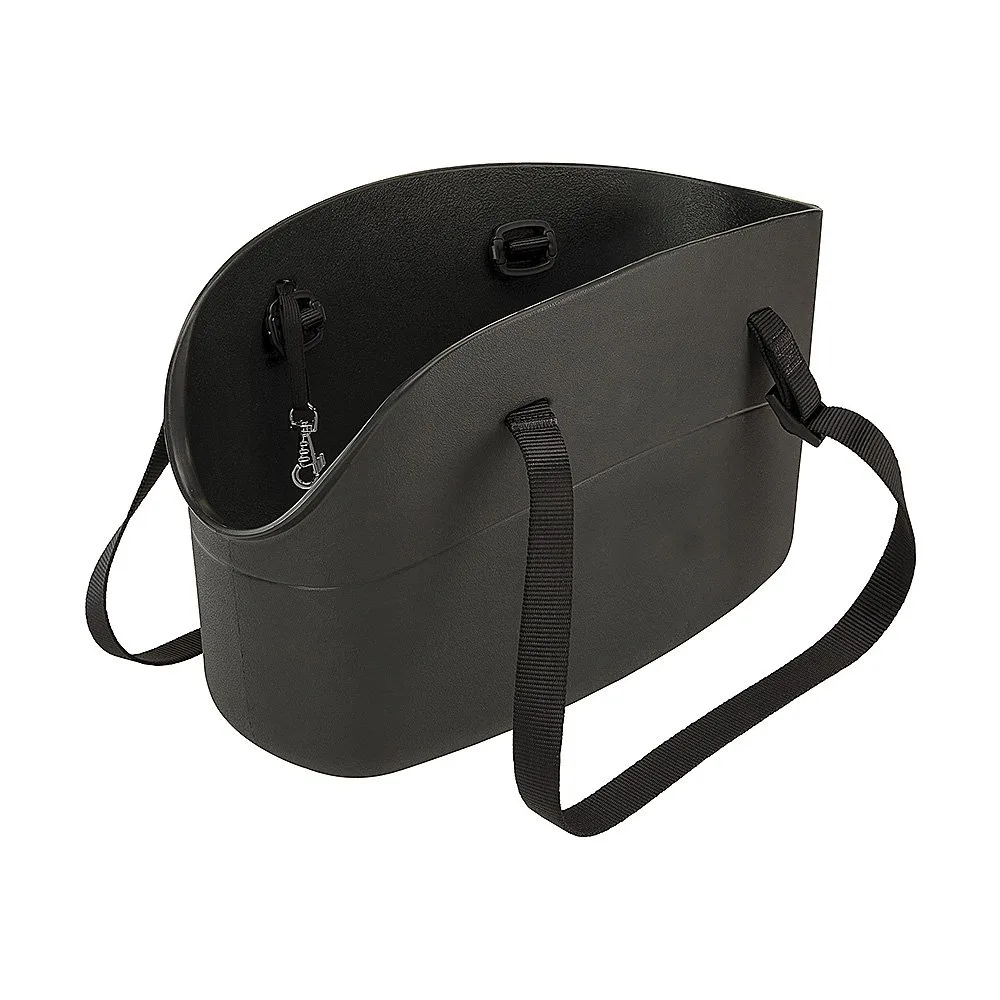
A private label pet carrier keeps the buyer artwork on the panel while the compliance text and country-of-origin marking follow the destination market.
Padding Is Structure, Not Softness
The most productive reframe available in this topic is to stop thinking of padding as comfort and start thinking of it as structure. Foam gives a soft product its shape, distributes load across seams, protects contents, and determines how the whole thing looks both empty on a shelf and loaded in use.
Every one of those roles is structural. A carrier that slumps empty is not uncomfortable — nothing is in it — but it photographs badly, looks old before its time, and reads as poor quality to anyone walking past a shelf. Adequate padding fixes this without changing anything visible.
Load distribution is the second structural job. Straps meet the body at specific points; foam spreads those forces so that neither the animal nor the owner experiences pressure concentrations. Get this wrong and the product becomes uncomfortable to carry regardless of how soft the pad itself feels.
- Shape retention: the empty product standing square is entirely a padding decision
- Load spreading: strap forces concentrate at predictable points that padding must distribute
- Impact protection: accidents, drops and curbs all transmit through the base
- Perceived depth: subtle fullness reads as generosity; thin panels read as economy
The consequence for designers is that padding cannot be specified last. It determines panel geometry, it dictates whether an external frame is needed, and it changes how every seam behaves under load. Deciding late means discovering during sampling that the silhouette you drew is not the silhouette the materials produce.
Finally, note that comfort for the animal and comfort for the owner often conflict. Animals generally prefer a firm, stable base that does not shift under them; owners associate softness with quality. Resolving that tension deliberately, rather than accidentally, is what makes a product feel resolved.
Treat the base pad as the primary load-bearing element and every other panel as secondary. Most programmes overspend on decorative quilting and underspend on the one surface that carries all the weight.
It follows that padding should be costed as structure rather than trim. Comparisons that penalise padding for being invisible routinely produce products that look acceptable in a catalogue and disappointing within a season, which is an expensive way to save a small amount per unit.
Reading Density: What Kilograms Per Cubic Metre Predicts
Density measures mass per unit volume, typically reported in kilograms per cubic metre. It is the most useful single figure in foam specification because it correlates with almost everything that matters: durability, resilience, load support and cost.
The relationship is intuitive once stated. Higher density means more polymer per unit volume, which means thicker cell walls and more material resisting deformation. Those stronger cells survive repeated compression cycles far better, which is why density predicts service life better than any other published property.
What density does not predict is firmness. Two foams at identical density can feel completely different because firmness depends on cell structure and polymer chemistry rather than on how much material is present. This is the single most common confusion in foam specification, and it causes brands to order the wrong thing repeatedly.
- 15-20 kg/m3: economy; acceptable for decorative quilting, not for load-bearing pads
- 20-25 kg/m3: standard; appropriate to entry and mid-tier base pads
- 25-35 kg/m3: premium; appropriate to signature tiers and long-life products
- Above 35 kg/m3: speciality; used where maximum durability justifies the cost and weight
Cost scales roughly linearly with density, which makes the upgrade unusually good value. Moving from twenty-two to twenty-eight kilograms per cubic metre adds a modest amount per unit while noticeably extending the period during which the product looks new.
Always specify density together with firmness. Either alone is insufficient, and a quotation stating only one of them is not a specification you can verify against.
Humidity and temperature change readings mildly, so agree the testing conditions alongside the target. Two laboratories measuring the same sample under different conditions will disagree, and agreeing practical testing conditions early prevents disagreements that cannot be resolved after production.
The Three Families That Matter and Where Each Belongs
Flexible polyurethane foam is the default. Open-celled, resilient, inexpensive and available in an enormous range of densities and firmnesses, it is what most base pads and quilted panels use. Cutting and fabrication are straightforward, which keeps labour predictable.
High-resilience variants within that family use modified chemistry to produce faster recovery and better support characteristics. They cost more, feel distinctly better under sustained load, and recover from compression noticeably faster after unpacking — which matters enormously for flat-packed e-commerce shipments.
Ethylene-vinyl acetate, known as EVA, is a closed-cell material supplied in sheet form. It is denser, firmer and substantially more durable, making it the right choice for rigid support, moulded shells and base inserts where structural rather than cushioned performance is wanted. Many premium programmes use EVA at the base and PU above it.
Expanded polyethylene, or EPE, appears occasionally as lightweight filler. It is cheap and light, works acceptably as packaging protection, and performs poorly as a long-term cushion. Where proposals specify it for load-bearing areas, treat that as a cost decision worth questioning.
| Material | Typical density | Recovery | Best role in a carrier programme |
|---|---|---|---|
| Flexible PU foam | 18-30 kg/m3 | Good | Base pads, quilted side panels, entry and mid tiers |
| High-resilience PU | 28-45 kg/m3 | Excellent | Signature tiers, flat-packed e-commerce, long-life products |
| EVA sheet | 60-250 kg/m3 | Excellent | Rigid base support, moulded shells, structural inserts |
| EPE foam | 20-40 kg/m3 | Fair | Lightweight filler; avoid in load-bearing applications |
| Memory foam | 40-80 kg/m3 | Deliberately slow | Premium base pads where a conforming feel is the proposition |
Material selection follows role rather than fashion. Decide what each panel has to do, then select the least expensive family that does it properly, and spend the saving somewhere customers actually perceive.
Compression Set: Why Pads Go Flat and Products Look Old
Compression set is the property that explains most disappointed customers. It measures permanent deformation remaining after a material has been held under compression for a defined period at a defined temperature. Express it as a percentage and lower is better.
In practice, it is the reason a carrier that felt generously padded in March looks thin and saggy by October. Nothing broke; the cells simply took a permanent set and stopped springing back. This is invisible week to week and obvious season to season.
Testing is straightforward and cheap: compress a sample to a defined proportion of its thickness, hold it under controlled conditions for a set duration, release it, and measure residual deformation after recovery. Results are comparable across materials and are among the most informative numbers available for predicting appearance over time.
Preventing it has three levers. Specify adequate density. Specify better grades within a family, since premium formulations resist set substantially better at equal density. And design so that sustained compression is reduced — larger load-bearing areas mean lower stress for the same weight.
- Adequate density is the primary defence and pays for itself in perceived longevity
- Premium grades within a family outperform economy grades at identical density
- Increasing contact area reduces stress more cheaply than increasing material quality
- Foam should be allowed to recover fully before being compressed again in storage or shipping
Recovery time deserves special mention for flat-packed programmes. A pad compressed for eight weeks in a shipping container needs real time to recover, so how long recovery should take belongs in the specification rather than being discovered later. Test it: pack a sample, leave it the intended duration, then unpack and measure.
Note that recovery is partly recoverable and partly not. The distinction is exactly what separates a pad that looks restored after an hour from one that never does, so measuring after a defined recovery period rather than immediately is what makes the test meaningful.
Indentation Load Deflection: Specifying Feel, Not Just Mass
If density predicts durability, indentation load deflection predicts feel. It measures the force required to compress a foam sample by a stated percentage of its thickness — usually twenty-five or forty percent — with the result reported in newtons.
Higher values mean firmer foam. For a pet carrier base, values should be high enough that the animal does not bottom out onto the shell but not so high that the surface feels board-like. The correct target depends on the animal size the product serves, which is precisely why one specification cannot serve a whole range.
Matching support to occupant is the practical skill. Small-breed carriers need less absolute support but benefit from a stable, non-deflecting surface, since tiny animals dislike sinking into anything. Larger occupants need substantially firmer support to avoid bottoming out under real weight.
- Light padding around the perimeter for shape and perceived generosity
- Firmer, higher-density support across the central load-bearing footprint
- Softer material only where the animal rests gently, never where concentrated load occurs
This zoned approach costs slightly more in cutting and assembly and performs considerably better than any uniform specification, because it puts material properties where actual forces occur.
Physical testing always beats datasheet comparison here. Press a loaded sample firmly with your palm and feel whether you contact something hard beneath. Reaching the shell means the specification is too soft for the intended occupant, and no amount of additional thickness will fix that particular problem.
Finally, specify both density and indentation load deflection together, and treat any quotation providing only one as incomplete. Together they describe exactly what you are buying; separately they describe almost nothing.
Thickness Versus Density: The Trade Most Brands Get Wrong
When a product feels insufficiently padded, the instinct is to add thickness. That instinct is usually expensive and often wrong, because thickness and density solve different problems and thickness degrades in ways density does not.
Thickness increases initial comfort and perceived generosity, both real benefits. But it also adds bulk, raises shipping volume, changes how a product folds, and — critically — does nothing whatsoever to prevent long-term flattening. A thick low-density pad simply has further to fall.
Density, by contrast, addresses durability directly and adds almost no volume. For the same weight of polymer you can either have a thick slab that will flatten or a thinner one that will not, and the thinner durable pad generally produces a better-looking product after twelve months.
The correct sequence is to select density for durability first, then thickness for the initial feel you want, then reduce thickness if cost or bulk requires it. Reversing those steps is how products arrive simultaneously bulky and disappointing.
There is an important exception. Very high density combined with low thickness can feel harsh, because there is insufficient material depth to distribute point loads. Where this occurs, adding three or four millimetres of softer material above the firm layer resolves it better than changing either material.
Layering therefore usually beats thickening. A firm high-density core with a softer comfort layer above delivers support, comfort and longevity simultaneously, and it is how most premium programmes are actually built.
Construction: How the Pad Is Built and Covered
Material specification is only half the question; how the pad is assembled determines whether that material performs as intended. Three decisions dominate.
Coverage comes first. A loose pad inside a sleeve allows independent movement and easier replacement, while laminating or quilting the foam to the shell locks everything together and prevents shifting. Laminated panels hold shape better; loose pads wash better and are cheaper to replace.
Quilting through both fabric and foam — used decoratively on countless bags — compresses the foam permanently along every stitch line, reducing effective thickness and creating visible channels. Where appearance matters more than cushioning this is acceptable; anywhere load-bearing, it should be avoided.
Edge treatment comes next. An unsupported pad edge collapses and telegraphs through the outer fabric, producing the wavy seam lines that make a product look poorly finished. Binding the edge, tapering it, or extending the shell fabric to wrap it all resolve this.
- Loose pad: best for washability and replacement; risks shifting in transit
- Laminated panel: best shape retention; harder to clean thoroughly
- Quilted construction: attractive; compresses material along stitch lines
- Bound edge: prevents edge collapse and improves visible finish considerably
Moisture management deserves mention too. Foam inside a non-breathable cover can hold water after cleaning and develop odour. Specifying a removable cover, drainage provision, or low-water-absorption material prevents a problem that only appears after cleaning.
Weight, Packability and Shipping Consequences
Foam is bulky relative to its mass, which makes it the primary driver of carton dimensions and therefore of parcel shipping cost. In direct-to-consumer programmes this often matters more than material cost, and it is rarely evaluated at specification stage.
Compression packing — vacuum or rolling — genuinely helps for some constructions and disappoints for others. Open-cell high-resilience foam recovers well from compression; economy foam frequently does not, which is another hidden argument for specifying better material.
Arrival condition is the visible consequence. A product unpacked from a tight carton needs time and sometimes warmth to recover fully. If your customer's first experience involves something creased and flat, no subsequent recovery undoes that impression, and this is one of the most common causes of returns in flat-packed soft goods.
Test it properly. Ship cartons to yourself through the actual channel, leave them the actual transit time, then unpack and evaluate. A specification that survives this test will survive retail; one that does not will generate complaints nobody can explain away later.
There is a second shipping effect that compounds quietly: compression also presses creases into shell fabric, so inadequate packing harms appearance well beyond the pad itself. Slightly looser cartons with a little internal support frequently outperform tightly compressed ones once both arrive.
Plan the unboxing too. A short instruction asking customers to allow a few hours for the product to regain full shape costs nothing, sets expectations accurately, and measurably reduces first-impression returns across every flat-packed category we work in.
A Tiered Specification and the Checklist to Lock It Down
Most programmes benefit from three padding specifications rather than one, matched to tier in the same way fabric and hardware are tiered elsewhere. Cost then follows perceived value rather than uniform compromise.
- Entry tier: 20-24 kg/m3 flexible PU, single layer, approximately 8-12 mm, bound edge
- Core tier: 25-30 kg/m3 PU with a firmer central zone, 12-18 mm, laminated or basted
- Signature tier: EVA structural base with 30-40 kg/m3 high-resilience comfort layer, zoned support, removable cover
Lock the specification in writing: material family, density with tolerance, indentation load deflection range, thickness with tolerance, layer sequence, edge treatment, cover fabric and construction method. Each line corresponds to a failure we see regularly when it is omitted.
Verification then follows the usual calendar. Samples arrive in 6-10 working days, bulk follows approval in 35-50 days, and finished goods clear AQL 2.5 inspection before release, with padding-specific checks for thickness consistency, edge definition, coverage freedom from wrinkles and recovery after unpacking.
Standard test procedures covering these measurements are published by bodies such as ASTM International, and referencing a method rather than an outcome makes the specification enforceable. Independent confirmation through SGS is available where a programme requires it.
Finally, review padding once a year alongside everything else in the product. It is the component most quietly substituted because it is the one nobody sees, and the substitution always shows up eventually in how the product looks.
Writing the pad specification so it survives a reorder
A padding specification that depends on one person's interpretation will drift, and padding drifts more quietly than any other component because nobody can see it. Each pad in the range should be documented as a short block: material family, density with a tolerance, thickness with a tolerance, indentation load deflection target, cover fabric and quilting rule.
Those six lines fit on half a page and they answer almost every question a reorder raises. Adding a retained sample per pad completes the record, because density and thickness are measured properties while hand feel is not, and a physical reference settles the difference instantly.
| Pad position | Density band | Thickness | ILD target | Cover direction |
|---|---|---|---|---|
| Base pad, premium | 28-32 kg/m3 HR | 25-30 mm | Medium firm | Brushed knit, minimal quilting |
| Base pad, mid tier | 24-28 kg/m3 | 20-25 mm | Medium | Plain knit, no load-bearing quilting |
| Shoulder strap | 20-24 kg/m3 | 8-12 mm | Soft | Air mesh for breathability |
| Side wall support | EVA sheet | 3-5 mm | Rigid | Bonded to shell, hidden |
| Entry tier pad | 20-24 kg/m3 | 15-20 mm | Medium | Plain knit, bonded rather than quilted |
Writing the position alongside the number matters, because the same density serves different purposes in different places. A base pad needs durability and support; a shoulder pad needs softness and low bulk; a side wall needs shape rather than cushioning.
Reviewing padding performance after launch
Padding problems arrive late, usually between three and nine months after purchase, which is why a scheduled review is more useful than a reactive one. Returns data, review language and customer service notes together show whether the specified density matched the load the product actually carries.
Three signals are worth tracking specifically. Products described as flat or sagging indicate a density or compression set issue. Complaints about a pad feeling hard indicate an indentation load deflection mismatch rather than a density problem. And reports of lumpy padding usually trace back to a cover or quilting decision rather than to the foam itself.
Each has a distinct fix, and all three are far cheaper to correct in the next production run than through a product redesign. Building that review into the annual calendar is what keeps a padding specification improving rather than merely repeating.
One further discipline helps. Keep the review tied to the specification version that produced the batch, because padding is the component most quietly substituted and a version record is what turns a change in field performance into a traceable cause rather than a suspicion.
Why brands source here
- Pet carrier programs run since 2014; founding team in sewn goods since 2004
- SGS-verified production floor of 4,950 m² with 137 workers across 7 lines
- Monthly capacity of 200,000 units, audited to BSCI and ISO 9001
People Also Ask
What foam density should I use for a pet carrier?
Specify 25-30 kg/m3 high-resilience polyurethane for premium base pads and 20-25 kg/m3 for entry tiers. Anything below roughly 20 kg/m3 compresses permanently within months, which is the most common cause of products looking flat prematurely.
Is thicker padding always better?
No. Thickness improves initial feel but does nothing to prevent long-term flattening, while density addresses durability directly with almost no added bulk. Select density for longevity first, then thickness for initial comfort, and reduce thickness if bulk requires it.
Does higher density mean firmer foam?
Not necessarily. Density predicts durability; firmness comes from cell structure and chemistry. Always specify density together with indentation load deflection, since either alone describes almost nothing about what you are buying.
Why does my carrier base go flat after a few months?
Compression set — permanent deformation remaining after sustained load. Prevent it with adequate density, better grades within a material family, and larger load-bearing contact area to reduce stress for the same weight.
Should I use EVA or PU foam?
Use EVA where you need rigid support or a moulded shell, such as structural base inserts, and PU where cushioning is the requirement. Many premium programmes combine them: EVA below for structure, PU above for comfort.
Does quilting reduce padding performance?
Yes when it passes through the foam, since stitching compresses material permanently along every line. Acceptable for decorative panels, but avoid it anywhere load-bearing, where structure matters more than appearance.
Frequently Asked Questions
What is the minimum order quantity for foam pads?
MOQ is 500 units per colourway for standard constructions. Custom die-cut profiles or unusual thicknesses may carry a cutting or tooling minimum, which we confirm at quotation rather than after scheduling begins.
How long does padding sampling take?
Pre-production samples take 6-10 working days once specification and cover fabric are agreed. Because padding affects silhouette significantly, we recommend evaluating at least two densities before committing to bulk.
What are bulk production terms?
Bulk production runs 35-50 days following sample approval and deposit. Custom die-cut profiles occasionally add a few days for tooling, which we build into the schedule rather than discovering mid-programme.
How are pads inspected before shipment?
Final random inspection follows AQL 2.5 for major defects. Padding-specific checks cover thickness consistency against tolerance, edge definition, absence of wrinkles or voids under cover fabric, and recovery after unpacking.
Can you help us choose between two densities?
Yes. Building the same product in two densities is straightforward and costs no additional calendar time, which is considerably faster than trying to decide from datasheets and then reversing the decision later.
Is memory foam appropriate for pet products?
It suits premium base pads where a conforming feel is the proposition, though it recovers slowly and retains warmth, which not all animals enjoy. Test it before committing, particularly for larger breeds.
How thick should the base pad be?
Typically twelve to twenty millimetres for soft carriers, varying with density and intended occupant weight. Rather than fixing thickness, specify the performance target and let density and thickness together achieve it.
Will the foam survive washing?
Open-cell foam holds water and dries slowly, so a removable cover is strongly preferable. Where the pad must be washable, low-water-absorption constructions with drainage provision perform considerably better.
Can padding be recycled or responsibly sourced?
Recycled content options exist and remain modest in this category. We will present whatever is genuinely available rather than implying standards we cannot document.
How does padding affect parcel shipping cost?
Substantially, because foam drives carton volume. For direct-to-consumer programmes this frequently outweighs material cost, so it belongs in the specification conversation rather than solely in costing.
What if the pad looks wrinkled under the cover?
Usually a construction rather than material problem: loose coverage, insufficient lamination or poor edge treatment. Bound edges and appropriate lamination resolve it, alongside specifying cover fabric with adequate body.
Should pads be removable?
Removable pads wash better, dry properly and can be replaced rather than discarding the product. They can shift during use, so specify attachment points where shifting would be noticed.
Do you test compression performance?
Yes. We can arrange testing using published standard methods and provide results with the method stated, so the figure is verifiable rather than promotional, and we retain it as the reference for future lots.
How often should I review padding specification?
Annually, even when nothing appears to have changed. Padding is the most quietly substituted component because it is the least visible, and that substitution eventually becomes visible in how the product looks.
Talk to QUANZHOU JUNYUAN BAGS about a pet carrier program: MOQ 500 pieces per colourway, samples in 6-10 working days, bulk production in 35-50 days under AQL 2.5 inspection.
Get a free quote Request a sample